Category: Ratings

  • Results WBIF Online Championship

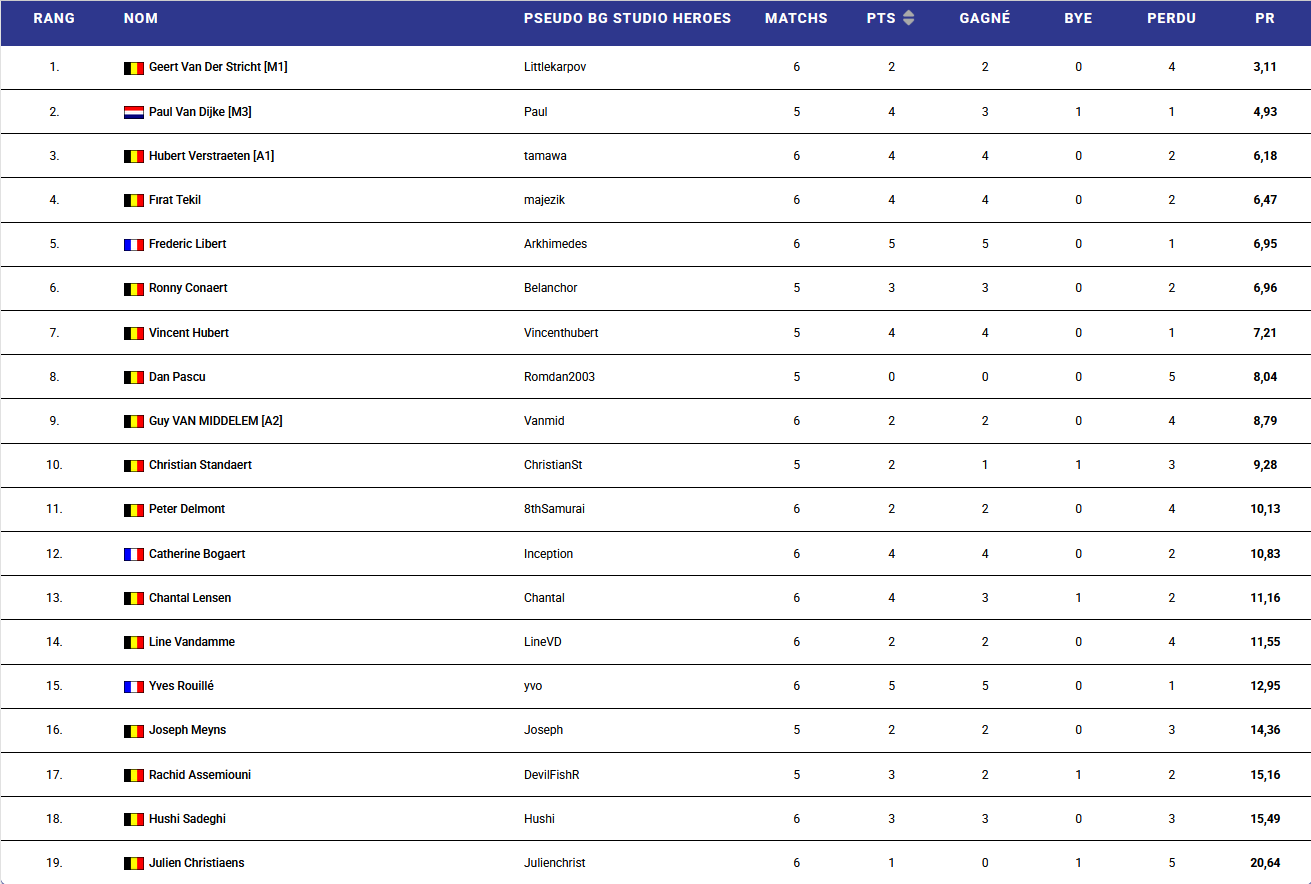
    View here the results after first round Based on PR :

    (click to view full size)
  • Magical 1800 Rating Point Ceiling broken !!

    For the first time in BGFed.be history the Magical 1800 Rating Point Ceiling has been broken By Kristoffer De Weert!!!

    Read all details here.

  • Tournaments etc. postponed/cancelled (2)

    Due to the measures to limit the propagation of the COVID-19 virus, the following live backgammon activities are postponed or cancelled:

    • Leuven Monthly (Friday, April 24)
    • 4 Cubes rounds 2 & 3 (Sunday, April 26)
    • Brussels Friendly 100 (Friday, May 1)

    As soon as we have more information about the meeting possibilities, the BIC competition will be rescheduled. By now, our expectation is to postpone all matches by +/- 3 months (for ex. the D2 qualifying round-robin to be finished in June will be rescheduled till September).

    Online matches still valid for the rating list (see earlier post).

    Take care of yourself and those around you.

  • Online matches temporarily valid for rating list

    Because of the current restrictions to limit the propogation of the corona virus, live backgammon events are currently impossible.

    For as long as the restrictions are in force, it is therefore allowed and even encouraged to register the results of online matches for the BGFed.be rating list. Currently, this possibility is granted for matches played up to and including April 19.

    Conditions

    • Both players need to agree beforehand that the match will count for the rating.
    • A maximum of 50 match points per player per week can be registered. Weeks start on Mondays.
    • As before, only results of matches between BGFed.be members can be registered. See the rating list for current members.

    As far as the online environment permits, players are encouraged to simulate the circumstances of live play:

    • Hide the pipcount.
    • No computer analysis (PR) visible during the match.
    • Use of clock, for instance 2 minutes per match plus 12 seconds per move.

    How to communicate your results

    The match winner communicates the result to the rating responsible of his or her club:

    • Brugge: Pascal Vanneste
    • Brussels: Guy Van Middelem
    • Gent: Bert Van Kerckhove
    • Leuven: Johan Segers

    Results need to be communicated within a week. Please indicate clearly:

    date, match length, winner, loser, website/app/platform…

    Have fun, and keep on rolling clicking.

  • Rating list: update delayed due to technical problem

    As you may have noticed, the rating list is showing the situation of a few weeks ago. The website has moved recently to a new server, but there’s been a technical issue. We’re working on the problem. In the meantime, sorry for the inconvenience. Thank you for your patience.

    (Update March 2.) We’ve found and solved the problem now. The rating list is up-to-date again, with match results included up to February 26. Feel free to check. Should anything be missing, please let me know. Thanks once more for you understanding, — Johan S.

  • Correction rating formula

    A few days ago, it was pointed out to me that the Elo-based formula used to calculate the rating list was implemented incorrectly. This mistake has now been corrected. The result is major shift in the ratings.

    I sincere apologize for the error, for which I take full responsibility. I also thank the person who has kindly pointed out the error to me.

    The error and its consequences

    My programming error was that the match length was not taken into account when calculating the winning chances of the two players. In other words, the winning chances were calculated as if each match were a 1-point match. This error gave an unfair advantage to the players with a high rating and a disadvantage to the players with a low rating. The ratings on top of the list were thus too high, and the ratings on the bottom of the list too low.

    To understand why, remember that the longer match, the higher the winning chances of the rating favourite. The greater your winning chances, the fewer rating points you gain when you win and the more points you lose when you lose.

    However, by treating each match incorrectly as a 1-pointer, the winning chances of the rating favourite were underestimated. If the rating favourite then actually won the match, her rating went up by too much. But if she lost the match, her rating went down by too little. Similarly, if the rating underdog won the match, she did not receive the rating increment she actually deserved, while she was punished too much in case of a defeat.

    Technical explanation

    The correct formula for a player’s winning chances P is to be found on http://www.bkgm.com/faq/Ratings.html#what_are_my_chances_of_winning_:

    P = 1 / (1 + 10^(- D * sqrt(N) / 2000))

    D is the difference between the player’s rating and her opponent’s rating, while N is the match length.

    In the software I wrote, I had forgotten the sqrt(N) on the right-hand side in the definition of P.

    Correction

    To rectify things, a choice had to be made between two options:

    1. The ratings are recalculated using the correct formula for all matches in the database.
    2. The correct formula only takes effect for matches played on or after a specific date, while for matches before that date, the incorrect formula is maintained.

    After discussion with BGFed.be president Guy Van Middelem and with former rating committee member Luc Palmans, it was decided unanimously to opt for the first possibility. I would like to thank Guy and Luc for their kind advice and their understanding.

    The result of the correction is major change in the rating list. A large bonus for some, an equally large discount for some other.

    Once more, I am extremely sorry for the mistake, which is mine and mine alone. To the best of my knowledge, the ratings are now correct.

    Should you wish to have more explanations, please do not hesitate to contact me by phone or by email. If there is anything else I can do, just let me know.

    — Johan Segers

  • Update rating list: two-week period

    It seems that last weekend, I’ve forgotten to update the rating list. My apologies. This weekend’s update therefore concerns a two-week period, taking into account matches played between Monday, November 26 and Sunday, December 9, 2018. — JS.

  • Technical issue rating list resolved

    The technical problem that prevented last weekend’s update of the rating list has been resolved. Tomorrow’s update will span a two-week period, from March 12 to March 26.

    — Johan

    PS (In case you’re interested): The match results have been split into several files to reduce the file size, one per year, and the php script had to be adapted accordingly.

  • Rating update temporarily unavailable

    Due to a technical issue, the rating update cannot be done for the moment. Your match results are still being recorded as usual, and the rating list with results up to March 12 is still available.

    I believe I know what the problem is, but finding a workaround may take some time. I’ll get into it during the Easter break, two weeks from now. I apologize for the inconvenience and thank you for your patience.

    — J.

    PS: The problem is that the csv file containing the match results has become too large, and its contents can no longer be processed in php in one chunck. So I need to either reimplement everything using MySQL databases, which I would have to learn first, or to find a way to make the match result file smaller, for instance by cutting it into pieces, one for each year. I am confident that I’ll find a solution, but again, it will take some time. Any help would be welcome of course!

  • Rating update finally done

    It seems I’ve forgotten to update the rating list in the weekend of April 23-24. Moreover, I’ve only done the update scheduled for this weekend this morning (Tuesday). I’m sorry for the delay and thank you for your patience.

    — JS

  • Rating list : new feature

    A new feature has been added to the rating list. For each player, summary statistics can now be shown in two different ways: either grouped per match length or grouped per opponent.

    These statistics put the ratings in some perspective. They show, for instance, how Michel Lamote arrived at his impressive lead and who were his victims.

    On behalf of the BGFed.be rating commission,
    — JS

  • Ratings: Update member list 2016

    The rating list has been updated in accordance to the current member list 2016. Specifically, this means that the names of the players who are no longer registered as a BGFed.be player have been made invisible. This concerns in particular the players who have not yet paid the membership fee, which is 10 euro for 2016, to be paid via one of the member clubs.

    The match results of the players whose names have been made invisible remain in the database, however. You can confirm this by checking the match lists via the drop-down menus on the right-hand side of the rating list. Moreover, the ratings of the other players remain unaffected. Finally, to make your name visible again, while keeping your old rating, it suffices to renew your BGFed.be affiliation.

    If you spot any mistakes, please let me know.

    Best wishes, – Johan Segers (jjjsegers@gmail.com)

  • The Rating Formula (Rating Update January 24, 2016)

    In the most recent update of the rating list, Michel Lamote is the first player to have a rating higher than 1900. This is mostly symbolic of course, for the difference between 1895 and 1905 is the same as the difference between 1450 and 1460. Still, what does it mean to say that Michel’s rating is more than 400 points higher than average? The answer is given by the rating formula.

    Rating Principle

    The rating formula converts rating differences into match winning percentages. It underlies the computations needed to apply the rating principle. According to that principle, the number of rating points that Guy wins if he defeats Michel is proportional to his chances of losing the match. And if Guy would lose, his loss would be proportional to his chances of winning.

    Sounds weird? Not at all. The more Guy is the underdog, the less he can lose and the more he can win. And the more Michel is the favourite, the less he can win and the more he can lose. Just fair, isn’t it?

    Rating Formula

    So how to know Guy’s chances to defeat his friend Michel? According to the rating formula, the odds depend on two things:

    1. the difference between both Guy’s and Michel’s ratings;
    2. the match length.

    The exact formula is a mathematical curiosity founded in statistics and originating from chess. If you want to know more, check out the article Ratings on Backgammon Galore!.
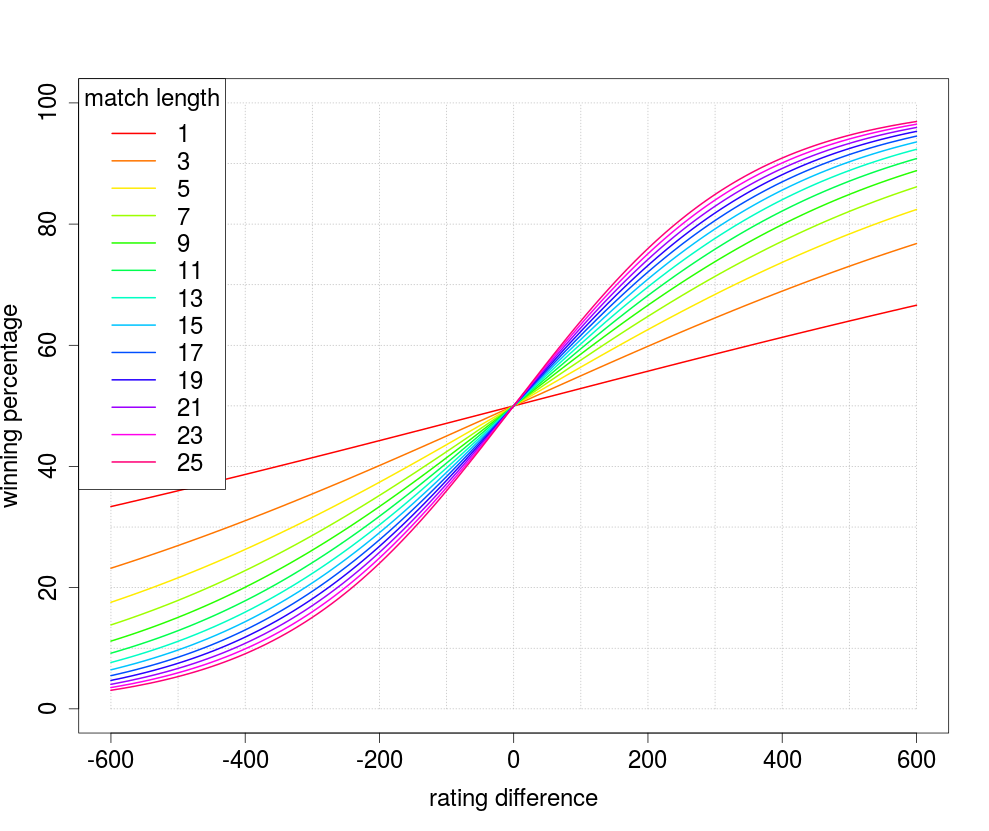
    The rating formula produces winning percentages as a function of the rating difference and the match length
    What’s your probability of beating Michel? Calculate the difference between your rating and his (it’s probably negative), choose a match length, and read off the answer on the vertical axis. Click on the image to enlarge.

    What it boils down to: a bigger rating difference means better chances for the favourite. The longer the match, the better for the favourite too.

    See the picture on the left. (Click on it to enlarge.) Each line represents a match length. Calculate the difference between your own rating and your opponent’s. Find this value on the horizontal axis. On the curve representing your match length, find the point corresponding to that rating difference. Then read off the percentage on the vertical axis. That’s your match winning percentage.

    Suppose for instance that Annie’s rating is 200 points higher than Bob’s. They play a 3-point match. Following the orange line, we find that Annie has about 60% chances of winning the match.

    Long Run

    Of course, all this is but a mathematical idealization. Ratings are volatile. If you have a lucky streak, your rating goes up. That doesn’t mean that your chances of winning future matches have suddenly gone up accordingly. Likewise if you’re having a bad week.

    As a measure of your playing strength, your average rating over a period of time is probably a more accurate measure. (Even better is to analyze your matches by the merciless scalpel of the machine.)

    So by all means, don’t take ratings too seriously. Don’t let them spoil the fun! If your rating goes up, great. If it goes down, just blame it on the dice and wait until the sun comes out again.

    And now: go and check out your latest rating.

    — JS

  • The Rating Principle (Rating Update January 3, 2016)

    Suppose Michel Lamote, BIC 2015 champion, and Guy Van Middelem, play a 13-point match. What effect will the outcome of that match have on both players’ ratings? The winner’s rating should go up, of course, and the loser’s rating should go down. But by how much? What is the rating principle?

    Let us admit that Michel is the better player. Then Michel is more likely to win the match than Guy. (In the recent rating update, Michel broke his own rating record again: 1875.48, taking into account matches played up to January 3, 2016. Michel is currently more than 200 rating points up to Guy, the second ranked player on the list.)

    Fair or not?

    Suppose Michel and Guy would agree to the following: no matter who wins, the winner’s rating goes up by 1 point, and the loser’s rating goes down by 1 point. Sounds fair, right? Well, actually, it isn’t.

    Enjoying life and quite a couple of beers, Michel and Guy play 100 matches. Michel is likely to win about 60 matches, say, and Guy about 40. Michel’s rating will thus go up by 20 points, and Guy’s will go down by 20 points.

    The more they play, the more Michel’s rating will go up and Guy’s will go down. This isn’t fun for Guy. Guy will not want to play with Michel for the rating anymore. Too bad, really, for the two Brugge comrades.

    Handicap

    Then Guy, a passionate golf player, gets an idea.

    “Perhaps I should get a handicap,” proposes Guy to Michel.

    “All right, if that can convince you to play me again, why not,” replies Michel reluctantly. He has been enjoying himself quite a lot, cashing in rating points while nipping his Brugse Zot. But something needs to change, he admits. “What do you propose?”

    Guy searches in his wallet, takes out a small piece of paper (it’s the receipt of last night’s dinner at the Brasseries George — hmm, that salmon was really delicious). He finds a pen and starts to scribble a few numbers. After a few minutes,  he looks up and smiles.

    “Look here,” says Guy. “Of the 100 recent matches, you won 60 and I only 40. Suppose that for each match you win, you get 2 points and I lose 2 points. But for each of my victories, I win 3 points and you lose 3 points. Then after 100 matches, our ratings wouldn’t have changed.”

    Michel can see the logic of that. He feels like saying okay, but then an objection crosses his mind.

    The odds are changing

    “Why not,” says Michel. “But what if you start to play better? I mean, you’re filming your matches, learning from your errors, reading books…. I’m even teaching you things once in a while. That cube you just took, for instance. How many times didn’t I tell you already that when you’re leading 3-away 4-away, you should be very careful with gammonish cubes? Anyway, perhaps that in six months from now, you’ll play better than you do now. You may then win 45 matches out of 100, rather than 40. Then you would get rewarded too much for your victories, wouldn’t you?”

    “I see,” says Guy. Two middle-aged white-skirted lady tennis players just enter the Brasseries du Longchamp, and for a moment, Guy’s focus is elsewhere.

    “A-hum.” Michel clears his throat discreetly, and Guy wakes up from his reverie.

    “I’m sorry? — Right, what if I start to play better.” Guy looks at his envelope again.

    “Well, then the odds should change too.” Guy explains: “As soon as I start to win more matches, my handicap should get smaller. And if you, Michel, would be winning even more matches than you do now, my handicap should become even bigger.”

    Guy continues: “In fact, the rating points I can win or lose should be according to my odds of winning the match. Same thing for you. On average, once our rating difference is a good indicator of our relative playing strengths, neither you or I should win or lose rating points.”

    The Rating Principle

    What Guy has just discovered can be called the rating principle. Let us say that Guy’s chance of winning a match to Michel is p. Michel’s chance of winning is then q = 1-p. Let us further assume that when underdog Guy wins the match, he should get G points, and Michel would lose G points. If Michel, the favourite, would win, then Michel’s rating should go up by M points, and Guy’s should go down by the same amount. What can we say about G and M?

    Guy’s explanation amounts to saying that G and M should be chosen such that the average rating update should be equal to zero. From Guy’s perspective, this update will be p*G – q*M on average: a proportion p of the matches, he wins G, and a proportion q of the matches, he loses M. We should thus have that p*G – q*M = 0. This is true provided G/M = q/p.

    “Algebra was never my cup of tea, and my college days are longer ago than I’d like to admit,” says Michel. “But if you understand you correctly, you’re saying the following. The amount of points that you can win relative to those you can lose are proportional to your odds of losing the match. The more you are the underdog, the less a defeat will cost you and the more a victory will profit you.”

    “That’s it, my friend,” answers Guy. “Another beer, perhaps?”

    “Thank you, no, I’m driving,” says Michel. “By the way, you seem to know the lady on the left. Could you perhaps introduce me to her?”

  • Rating update December 20

    Welcome to new BGFed.be members Dan Pascu (Hasselt), Nader K. Rad (Leuven), and Gery Vermaut (Leuven). May the odds be ever in your favour.

  • Rating update December 13

    Biggest jump up by Bert Van Kerckhove (Ghent, from 1568 to 1589), knocking on the door of the top-3. Johan Huyck, another Ghent player, had a successful backgammon week too: +20. But the rating list is a zero-sum game, and this time, it was up to Michel Lamote (Brugge) to preserve the balance: -26. I’m sure he doesn’t mind, given his fresh BIC 2015 title, which he acquired Friday December 18 at Longchamp’s after two consecutive 13-point victories to runner-up Luc Palmans (Hasselt). Congratulations! The second match has been recorded and analyzed and will be made available in due time.

    – JS

  • Rating update December 6

    After playing Brussels Friendly 56 on December 4, Sabrina Vastapana has collected 105 experience points and she enters the main list as the highest-ranked woman – congratulations!

  • Rating update November 29

    The 7th Leuven Open was responsible for an unusually large activity in the period Nov 22-29. Marc Steyvers, having good runs both at the Thursday Brugge club evening and the Sunday Leuven Open, achieved the week’s biggest rating increase.

  • Rating update November 22

    The Autumn Series matches have been grouped under the label ‘BMS’. (By the way, the first Winter series has already started: it isn’t that cold yet, is it?)

    PS: Almost forgotten to mention that someone has broken the rating record again: 1856.56.

  • Rating update November 8: one record and two ladies

    Winning four 5-point matches in a row at the Brussels Friendly 55 tournament on November 6 was sufficient for Michel Lamote to push the national rating record up to 1834.15. (If you want to watch Michel playing live: just mark Friday evening December 18 at Longchamp’s in your calendar for the BIC 2015 final, with live commentary by Walter Meuwis.)

    Sabrina Vastapane (Brussels) is just a 5-point match shy of acquiring 100 experience points and entering the main part of the rating list. If she would win that match, she would have a good chance of overtaking Pascal Vanneste (Brugge) as the highest ranked lady on the rating list.

    — JS.

  • Rating Update, Nov 1: New rating record and improved event view

    In the course of the 3rd Brussels Backgammon Day, Michel Lamote improved his own rating record to 1829.08 points.

    The way in which the match list per event is shown has been improved in the sense that, for instance, for the Brussels Friendly tournaments, you can now also see the tournament number.

  • Rating Update Oct 25

    A good performance at the Rotterdam Superzondag (the last Sunday of each month, organizer Ed Baars) gives Bert Van Kerckhove’s rating a 25+ boost.

  • Rating update Oct 18

    Michel crosses the 1800 again, but he’s still more than 8 points away from his August 22 record: rating list.

  • Rating update, Oct 11

    Michel Lamote has been particulary active and successful in the week of 5 to 11 October, shooting up more than 31 rating points.

  • Rating update Oct 4

    Geert Van der Stricht crosses the 1600 barrier again, after having already done so in May. Biggest leap forward this week is by Alain Chif, thanks to good performances in BIC 2015 and the Brussels Friendly. Welcome finally to new Brussels player Thierry de Limburg Stirum.

    — JS

  • Update rating list up to September 27

    New data to analyze and discuss: rating list. Have added Rotterdam Superzondag as an event. Please let me know if there are earlier matches that should be registered under this event name too.

    — JS

  • Update rating list up to September 20

    The biggest move up in the rating list is by Geert Dooms, who won his two BIC matches against Johan Segers, thereby securing the first place in Group A of the 2nd Division and ensuring promotion to 1st Division next year. Well done!

  • Rating update, matches up to September 13

    While our gladiators fight in the Budapest arena, here is some local news: http://bgfed.be/bgrating/

  • Rating Update Sep 6

    Congrats to Guy, the second player to overcome the 1600 hurdle! http://bgfed.be/bgrating