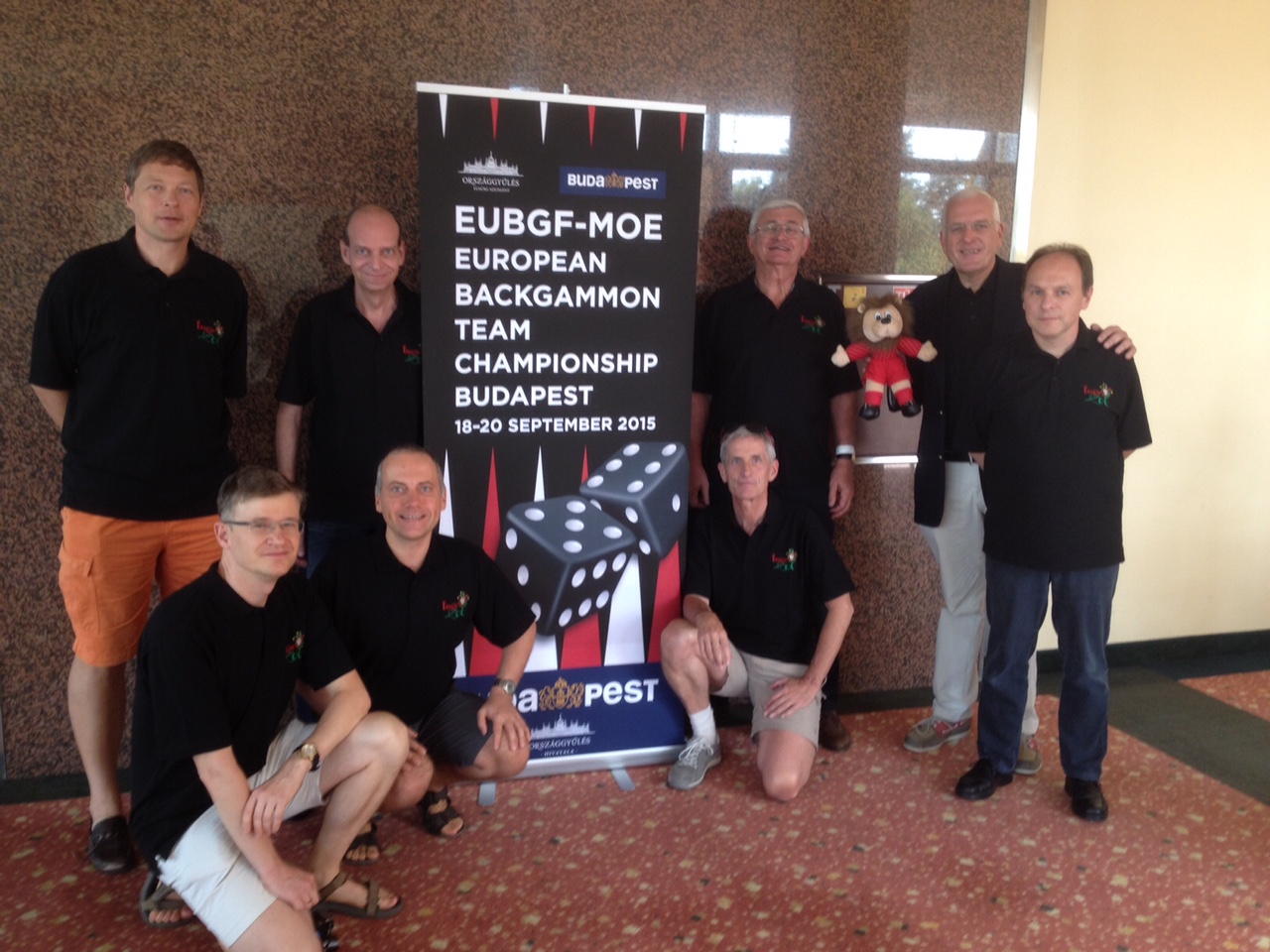
From top left : Maurits Pino, Walter Meuwis, Alain Chif, Guy Van Middelem (captain) and Luc Palmans.
From bottom left : Zsolt Tasnadi, Geert Van der Stricht and Michel Lamote.
From top left : Maurits Pino, Walter Meuwis, Alain Chif, Guy Van Middelem (captain) and Luc Palmans.
From bottom left : Zsolt Tasnadi, Geert Van der Stricht and Michel Lamote.
Belgium participates at the 2nd European Backgammon Team Championship in Budapest, Hungary. The team consists of : Guy Van Middelem (captain), Alain Chif, Michel Lamote, Walter Meuwis, Luc Palmans, Maurits Pino, Zsolt Tasnadi and Geert Van der Stricht. Luc Palmans will provide daily updates.
It’s after midnight. The first day of the Budapest tournament has finished, and contemplating in my hotel room, enjoying a glorious panorama of the Danube and the Margaritha Island by night, I let my Waterman fountain pen go its own way and inform you about the events so far.
Every second hotel in Budapest has “Danube” in its name, and after a lot of confusion, we managed ultimately to detect the correct one. It is a modern hotel with all facilities situated at the border of the Danube in Pest. Sadly, it takes a half hour stroll to reach the centre. Which is of course a pleasure with temperatures of 30°, a lovely sun and refreshing wind.
Nothing is perfect, and therefore I complained to the cleaning lady that the flush from my toilet didn’t work. H
No matter how hard I tried, pushing and turning and pulling and swearing, it just didn’t work. “No problem,” the cleaning lady informed me and after a forceful hit, which you only see in the decisive fight in a kung fu-film, the system suddenly worked. I learned my first lesson in Hungary: never mess with Hungarian women.
The main event is of course the team tournament, which starts Friday, and we will discuss it in the next report. Thursday there was the “Budapest Open” – more or less a regular individual tournament. There is a Masters division (330 euro registration –rather cheap for a tournament of that level) and an Intermediate division (50 euro). The Masters with 48 players was well attended with a lot of world top class players. The Intermediate had 32 players. But that’s only the beginning of the story.
Here are the facts: Masters was the traditional system with a main and a fighters bracket. When you lose twice, you are out. When you lose once, you still have a chance for the tournament win. First round 13 points.
Here is the reality: first round 11 points…
Here are the facts: Intermediate: Swiss system, 7 rounds, 9 points.
Here is the reality: “9 rounds, 7 points”, but later it became the dreadful system with “3 losses and you are out”, and even later I was informed that it would only take 7 rounds (such a tournament normally needs 11 to 14 rounds to finish).
Registration, announcement of the draw and the rules, players in search for boards and clocks: it was quite a mess.
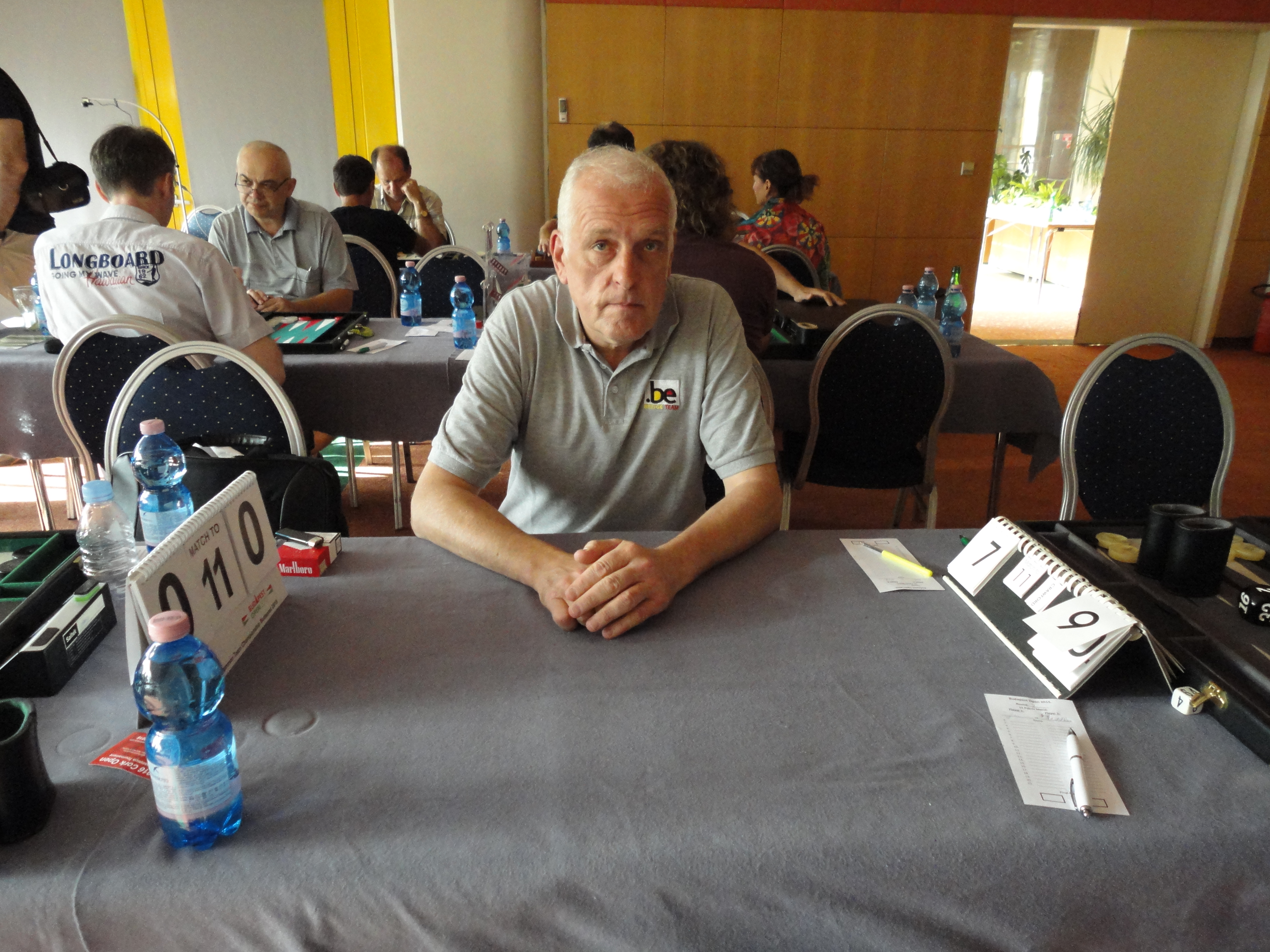
And it could have been so easy: table numbers, correct pronunciation of the names of the players, etc. I will spare you all the details. After a delay of one hour we could start. In the corridor there was a lot of discussion about the organisation and the European Federation. I will discuss this matter in detail in a subsequent article. But I also have to admit that after the initial problems, the tournaments quickly found their natural flow.
Michel and Geert didn’t participate, because they focus all their attention on the team tournament. Walter decided to play the Masters, because he lacked practice. Guy and your humble narrator followed him. Alain, Zsolt and Maurits preferred the intermediate, because they were guaranteed seven 9-point matches – at least they thought. But, as mentioned earlier, that would not be the case.
In the intermediate division things went quite well for our members. Maurits finished the day with 4 wins and 1 loss; Zsolt with 3 wins and 2 losses. Alain was eliminated after some fierce battles with half of the Iceland population. Maurits received a free point after one of his opponents didn’t show up. At least one good decision by the tournament director.
In the Masters Walter started with a good win against a Danish player, but lost to (also Danish) top player Thomas Kristensen.
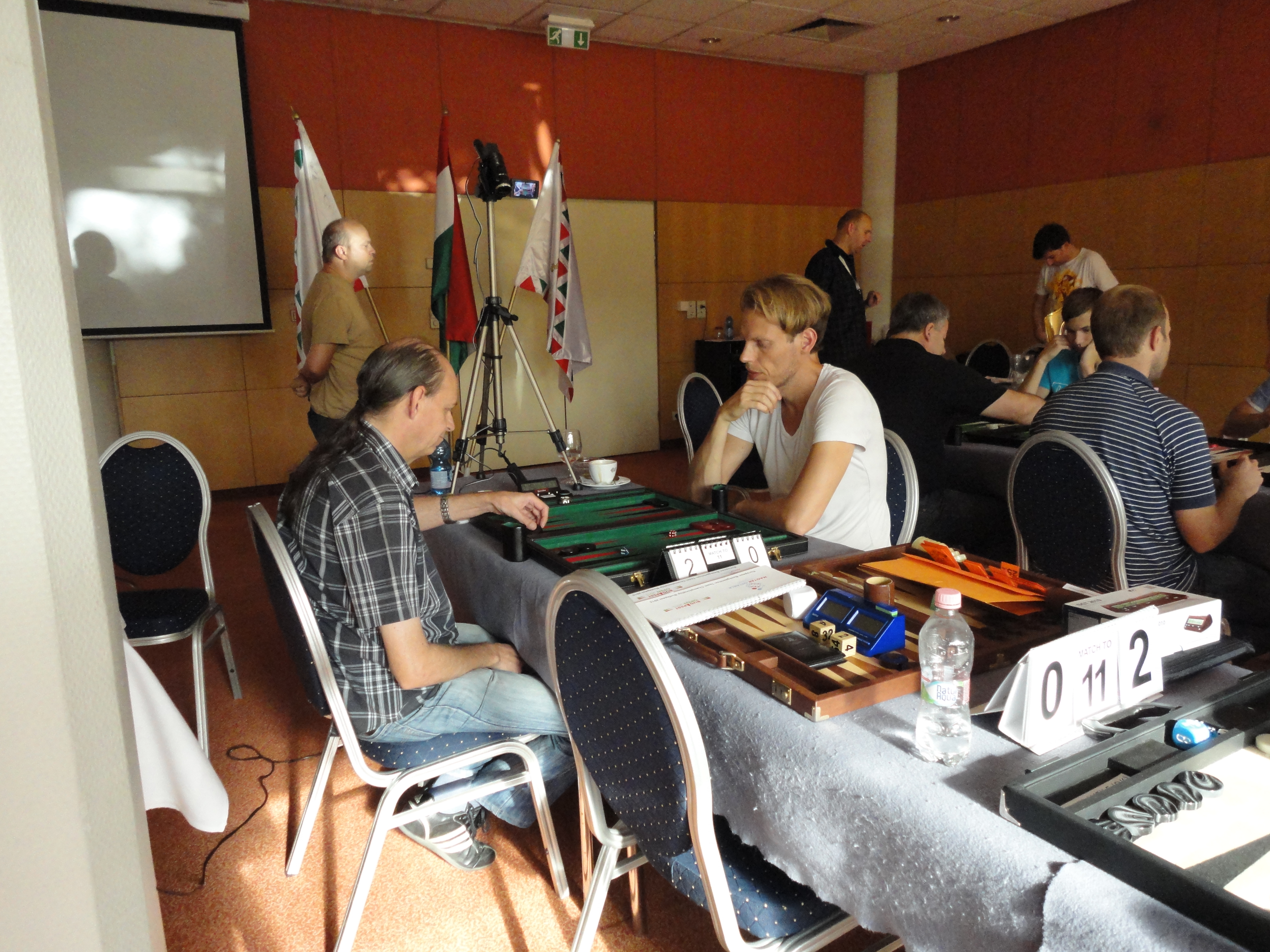
In the fighters bracket he could only win one game, and was then finally eliminated. Your humble narrator experienced his yearly loss against Norwegian Tore Frederiksen, and in the fighters bracket had to face two Romanian players. I could manage one, but the second was too much for me.
Guy had a good run, and after winning his first match, he beat German top player Jan Jakobowitz. But leading 9-1 against Norwegian Hans Liby, suddenly everything went completely wrong, and he lost the match. He will continue his struggle Friday morning in the fighters bracket.
After working hours in the bar, we discussed the favourites for the nations tournament.Walter prefers the Germans. And while Orlowski, Hellwag and Jakobowitz are certainly good players, I consider the Danes Kristensen, Bredahl and Gronbech the better players. The future will tell.
Latest news: this morning at 10 o’clock I had a short visit to the tournament hall. Yesterday we played in two rather small rooms – but still sufficient for the number of players.
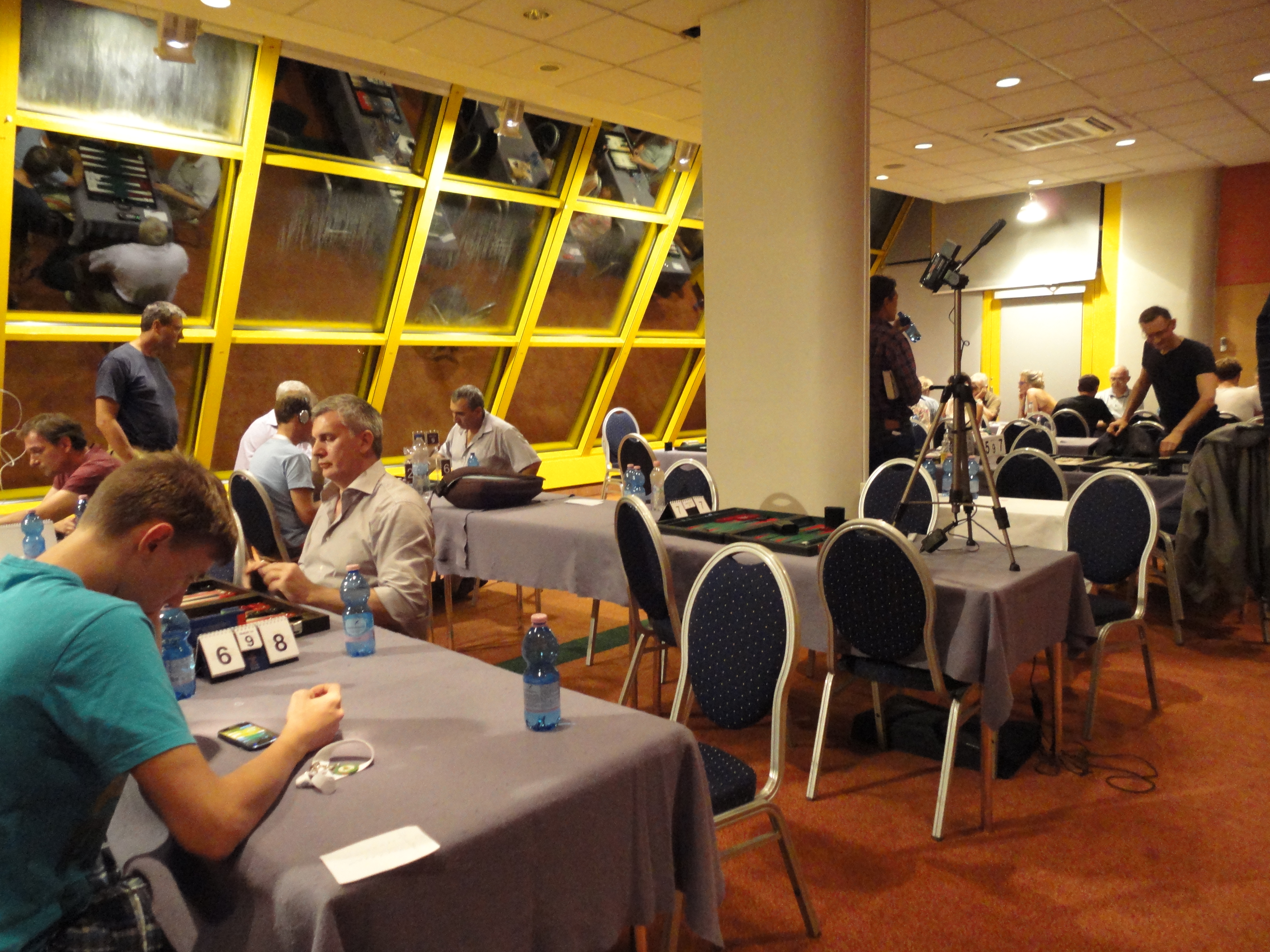
The nations cup, however, will take place in a nice and spacious room, with a big screen for the results. It seems the critics have lost some of their ammunition…
Luc
On our way to Budapest for the European Backgammon Team Championship, Walter (Meuwis) and I spent a weekend in Prague to compete in our first Backgammon Master Series event.
In tournaments of this kind, all matches are recorded and afterwards transcribed in XG. That way, players can earn Master or even Grandmaster status if they perform consistently well. This initiative was taken by Rick Janowski and more information can be found on the website of the BMAB (www.bgmastersab.com)
The organizer of the Prague event is Honza Cerny. He is the motivating force behind backgammon in the Czech Republic. He made sure 8 players showed up, armed with recording equipment. As we all know, recording your matches, feeding them into XG and then analyzing them is one of the best ways to seriously study the game. In Belgium, only Walter, Luc Palmans and myself seem to have picked up this idea. Let us hope that more players will pick up this habit in the future.
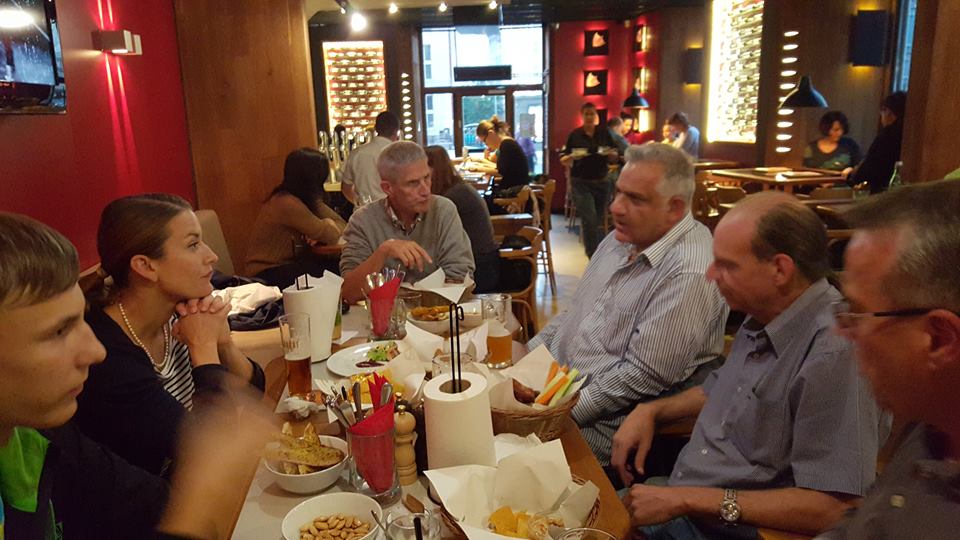
On Friday night, Honza treated all players to a fine dinner in a local restaurant (see picture below) :
Then, on Saturday and Sunday, 7 rounds of 11-point matches were played. After losing my first match, I was able to win 3 in a row, so on Sunday I was very much in contention for the first prize. Walter on the other hand was not blessed with good dice and was soon out of the running.
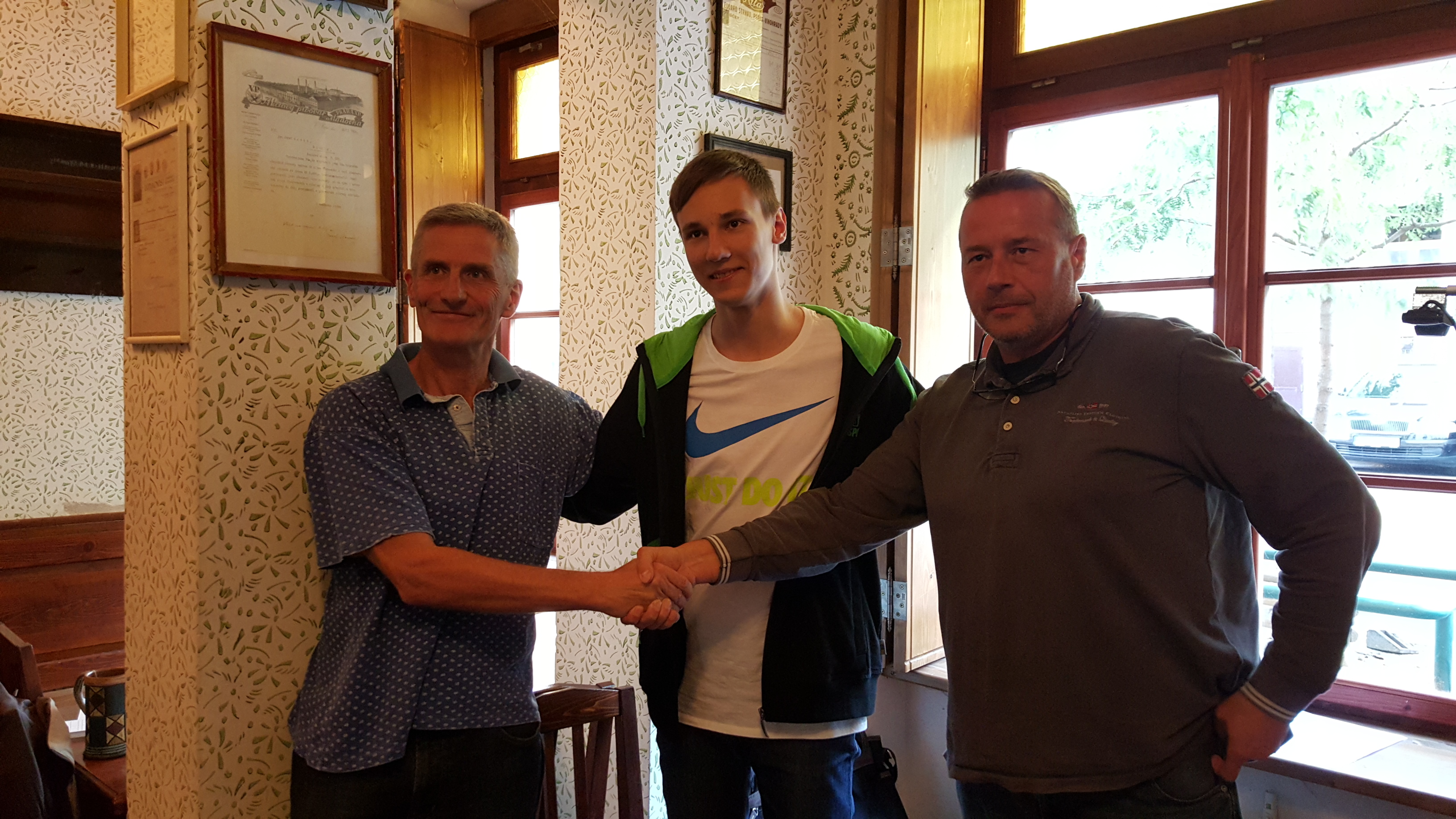
On Sunday I had to play a 17-year-old Czech talent, Zdenek Zizka. I won the match and we both played at Grandmaster level (Michel : 2,93, Zdenek 2,61). Later I lost to his mother (Eva Zizkova) so I had to beat Honza to win the tournament. It was a tense fight, which I managed to win under extreme time pressure (7 seconds left at 3-away 3-away). PR’s in that match were : Michel : 3,29, Honza : 4,79.
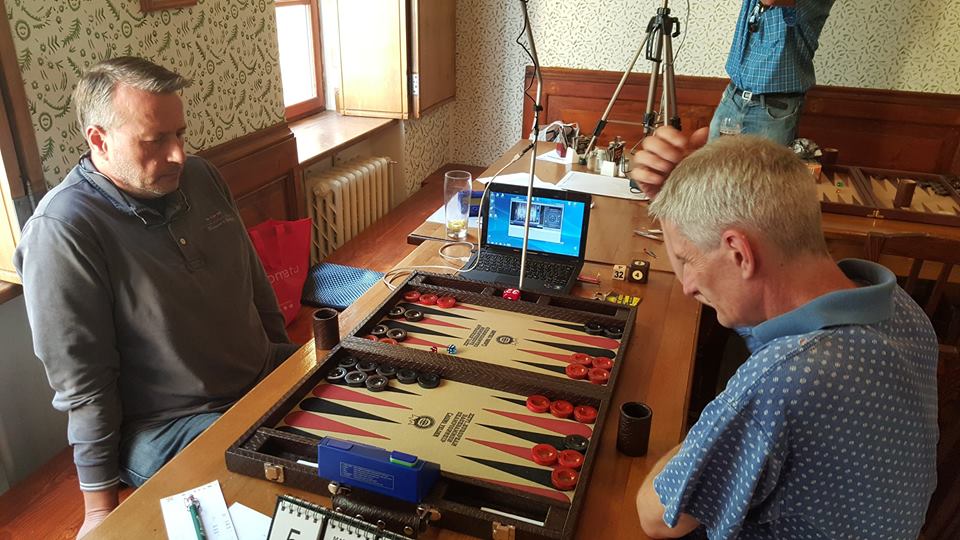
So Zdenek and I both had 5 wins out of 7, but I was declared the winner based on our mutual result.
On Tuesday morning, all matches had been transcribed (these Czech players know their business) and my average PR over the 7 matches was 4,28… If it had not been for one “bad match” (PR of 7,22 …) I would have scored a Grandmaster result. It was not to be. My next attempt will be the BMS event in Nottingham in October.
M
Michel, Guy and Paul scored 3 out of 3 against Leonidas, Zsolt and Maurits. Surprisingly, Brussels player Alain Chif decided to watch proceedings from the sidelines.
Brugge is now top contender for the 2015 BIC trophy.
M
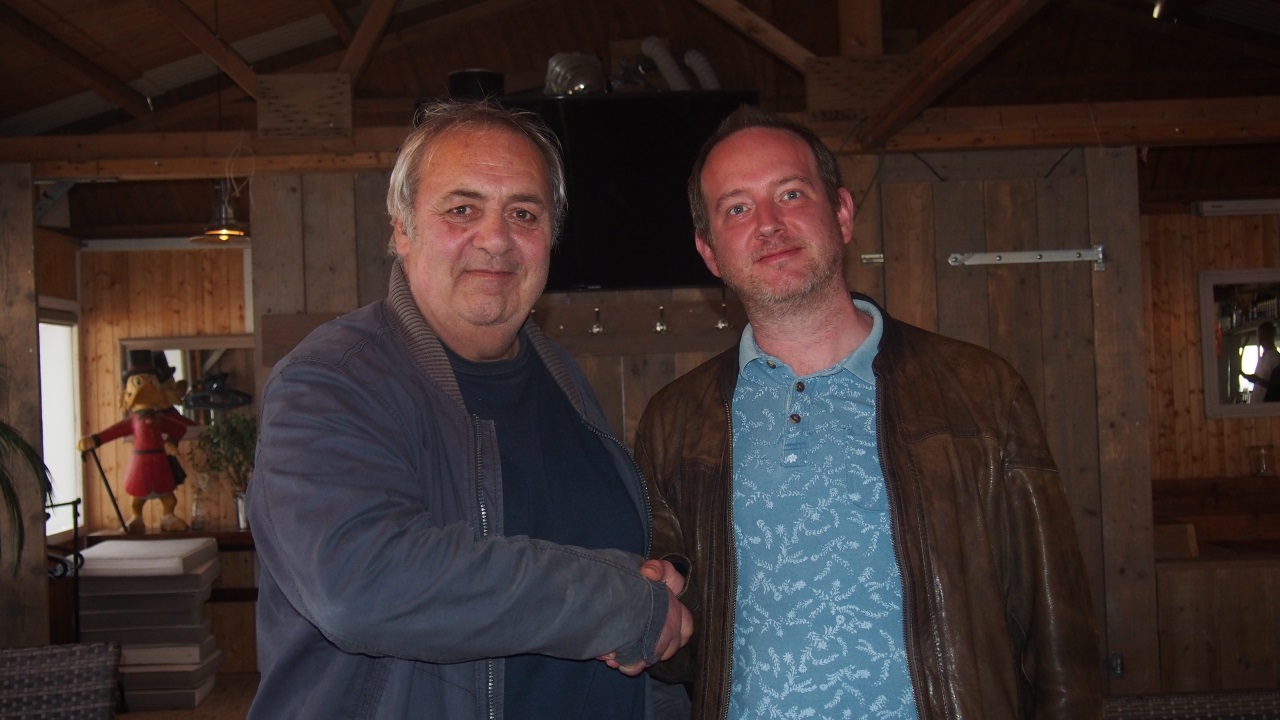
The yearly tournament at Zandvoort-aan-zee is held in a spacious pavilion situated on a broad beach. On beautiful days the sea breeze can waft through the pavilion and on chillier days, the pavilion can be closed off with canvas. In short, a great location. Moreover, a super buffet is set up for dinner and the staff is exceptionally friendly. In short, I regret not having competed there this year, but will certainly do so at the 5th edition in 2016.
Only Bert Van Kerckhove (Ghent BC) made the 3-hour trip (I hopped in later in the day) and found himself in a worthy field of Dutch and German players. Bert succeeded in winning three 13-pointers in a row, which brought him to the final. There he was beaten by Paul Van Koningshoven, who sent some speculative cubes Bert’s way, but was rewarded with good dice.
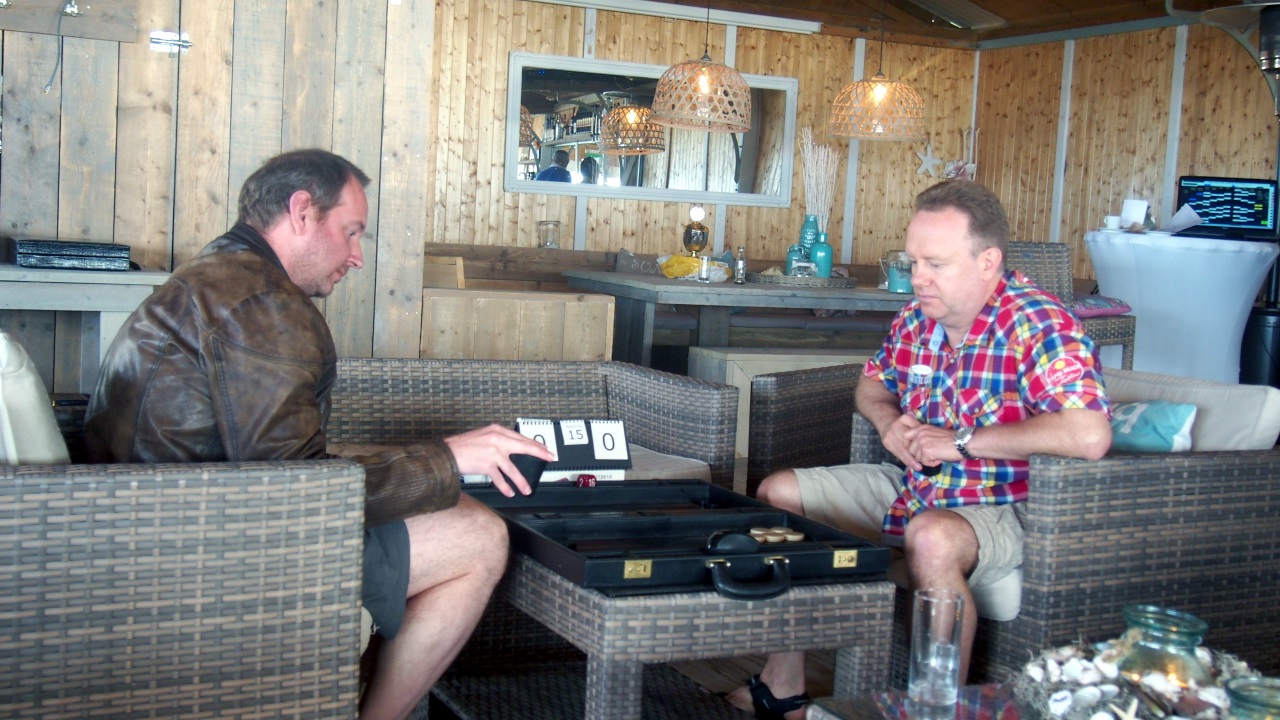
An encourageing result for Bert, who is also steadily climbing up the BGFed-ranking. It looks like Bert has his eyes on the number 3 spot…
M
The word blunder is conventionally used in backgammon to indicate a checker play or cube action mistake which costs 0,100 or more in equity. What does this mean?
Those of us who use eXtremeGammon as a learning tool are familiar with the numbers used in computer analysis. People not familiar with computer analysis, however, probably have no idea what these numbers are about. Still, it may be useful to have at least an idea of what the numbers reflect.
At the beginning of a game, the equity of both players is zero, which means that none of the players has even the slightest advantage over the other. If you win the game your equity has become +1. The loser of the game then has an equity of – 1. During the game the player who is favourite to win the game will have a positive equity of something between 0 and 1, whereas the underdog will have the same equity, but negative.
Let us have a look at an example. Mind you : we are playing a 1-point match here, so gammons do not count and are not taken into the mix.
Once again, it should be clear to every reader that at the beginning of this 1-point match, the probability of winning the match for either player is 50% or fifty-fifty (if both players are of equal playing strength). The equity of both players is 0 ( = zero).
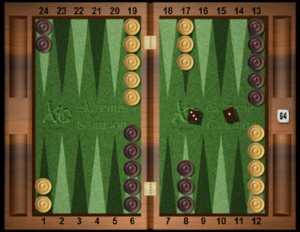
1. 8/5 6/5 eq:+0,100
Player: 55,00%
We see that by winning the opening roll and finding the strongest possible opening roll, 31, Black is suddenly favourite to win the game. He has 55% winning chances (it is actually slightly more, but I have rounded down a bit). His equity has gone up from zero to +0,100.
Where does that + 0,100 come from? Well, it reflects the difference between the winning percentage of the favourite (55%) and the winning percentage of the underdog (45%), which is 10%. 10% of 1 = 0,100.
If, however, you misplay your 31 and play the second best move, 13/10 6/5, you have gained no advantage. Your winning chances are still 50% (actually it is a bit lower) and your equity is still zero (because your opponent is now on roll).
2. 13/10 6/5 eq: 0
Player: 50%
The bot tells us that playing 13/10 6/5 costs 0,100 in equity (the difference between 55% and 50%) :
2. 13/10 6/5 eq: 0 (-0,100)
Player: 50%
We have made a blunder.
Since not all blunders cost exactly 0,100 in equity, they are quantified in millipoints (one millipoint of course being one thousandth of a point). Here we would say that the player made a 100 millipoint blunder.
To help get a feel for the magnitude of this blunder, let us visualize a bag with 500 black and 500 red casino chips. The black ones are yours and they have a value of + 1€. The red ones have a value of -1€.
It is clear that with 500 black and 500 red chips in the bag, the value of the bag (i.e. your equity) is zero. If you replace all the red chips by black chips, there will be 1,000 black chips in the bag and no red chips, so the value of the bag becomes 1,000€ (i.e. your equity is + 1,000).
If you replace 50 red chips by 50 black chips, there will be 550 black chips in the bag and 450 red chips. The value of the bag has become : + 550 – 450 = 100€. Your equity is no longer zero, but + 100.
Look at it this way : if your life depended on drawing a black chip from the bag, would you grab a chip from the bag with 500 black chips and 500 red chips, or would you feel slightly more comfortable drawing one from the bag with 550 black chips and 450 red chips?
If you think this difference is negligible, then I suggest you quit playing backgammon and start gardening.
The difference is substantial. It is the difference between 55% chance of survival and 50% chance of survival. This is huge. So, in backgammon terms, picking a chip from the bag with only 500 black chips would be a blunder, namely the difference in equity between 0 and 100.
1) After 10 moves in your backgammon game, your winning chances have gone up to 65%. What is your equity?
O + 0,150
O + 0,300
0 + 0, 650
2) You have a choice between two moves. One move gives you 80% winning chances and the other gives you only 70% winning chances. How big is the blunder if you make the wrong move?
O 200 millipoints or -0,200
O 100 millipoints or – 0,100
0 400 millipoints or – 0,400
3) The game is not going your way. The probability of you winning the game has gone down to 30%. What is your equity?
O – 0,200
O – 0,400
O – 0,300
4) What is Black’s equity here if he is on roll?
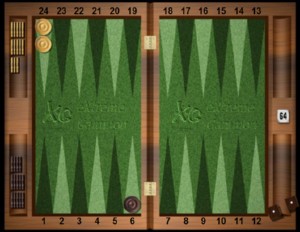
O +0,250
O +0,750
O +0,500
5) Your equity in a DMP-game is +0,340. How much wc do you have? Or, in other words, what is your winning%?
O 66%
O 34%
O 67%
1) With 650 black chips in the bag and 350 red chips, the value of the bag would be +650 – 350 = 300€. Therefore your equity is +0,300.
2) With 80% wc (= winning chances) your equity would be + 0,600 (800-200). With 70% wc your equity would be : 700 – 300 = 400, so : 0,400. Your blunder is a double whopper, costing 200 millipoints or 0,200.
3) If you have 30% wc, your opponent has 70% wc. The difference is 40%. So your equity is – 0,400.
4) Every intermediate player should know that Black wins this game unless he rolls one of 9 rolls out of 36. These rolls are : 11, 21, 31, 41 and 32. So he has 75% wc. His equity therefore is +0,500.
5) Easy : 340 divided by 2 is 170. If you add that to 50 you have your wc. Answer : 67%. Once again, your equity is the difference between the winning% of the favourite and the winning% of the underdog : 67 – 33 = 34. In millipoints this becomes 0,340.
M
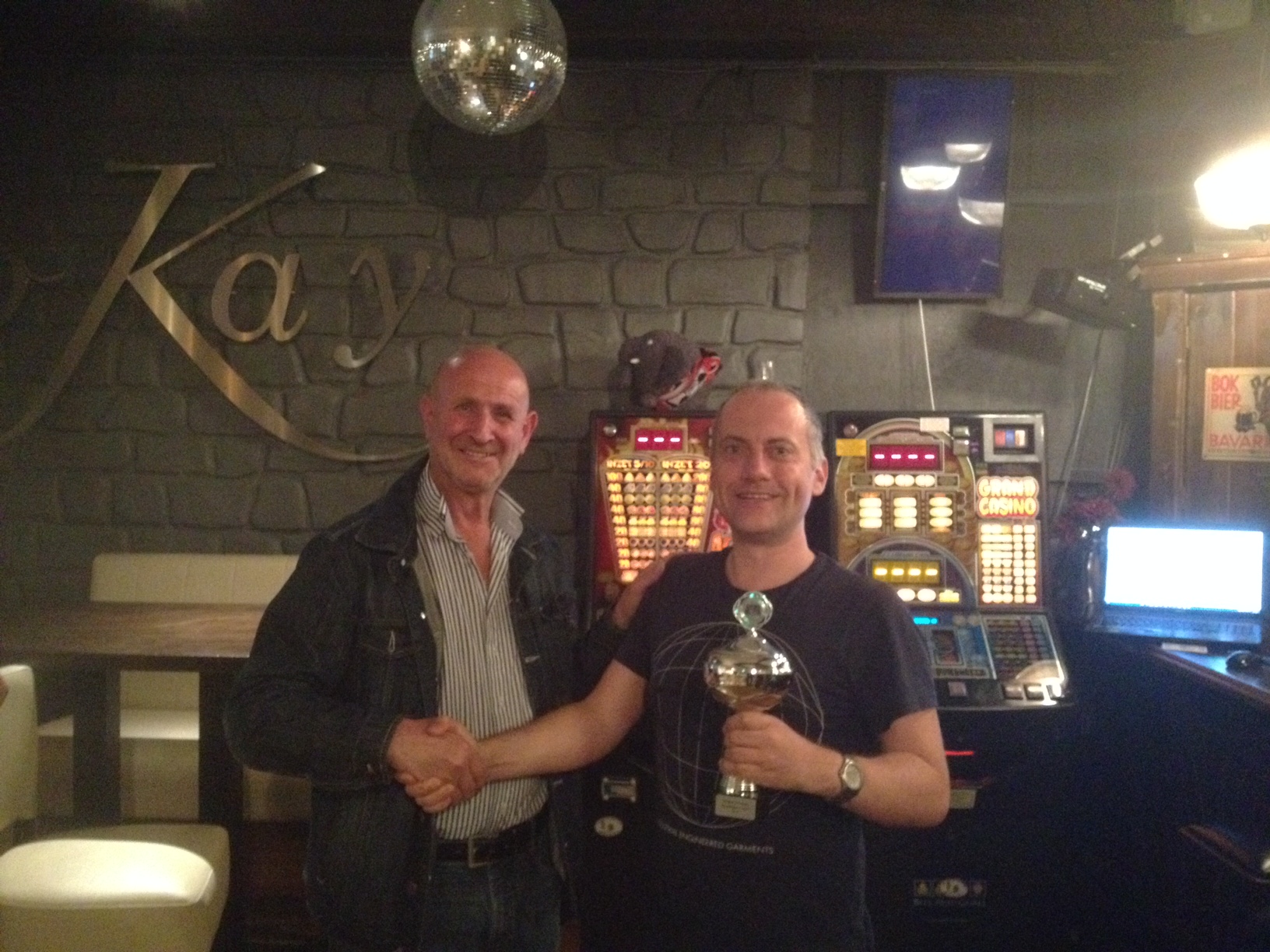
With emphatic wins over Nardy Pillards, Ed Baars, Michel Lamote and Paul Van Koningshoven, Belgium’s up-and-coming Geert VdS took the Rotterdam Open trophy.
Michel Lamote won the consolation after beating Rogier Van Gemert in the semi’s.
More Belgians made their presence felt. Toon Van Herreweghen and Patrick De Wilde (Leuven) took some scalps, but could not make it to the final rounds.
Gent’s Bert Van Kerckhove could not overcome unfriendly dice and was soon eliminated.
M
The Selection Committee (SC) has established a selection procedure to choose the 6 (or 7) players who will make up the Belgium Backgammon Team.
1. Three players have been selected : Michel Lamote, Walter Meuwis and Geert Van der Stricht. The three other players will be selected by means of a Selection Tournament (ST).
This ST will be held on Saturday and Sunday 20-21 June 2015.
A 7th player will join the team in case the Captaincy goes to a player who did not qualify (see 4. below).
2. Maximum 8 players will be allowed to enter the ST. Candidates need to be member of BGFed and 2015 BIC participant. They should have at least Advanced/Expert level.
Registration is possible till 25 May 2015. Mail to : guy.van.middelem@telenet.be.
3. The SC will carefully consider the merits and skill levels of the candidate players.
The list of players selected to compete in the ST will be made public on 1 June 2015.
4. When the results of the ST are known and the 6-player team is assembled, the SC will choose a Team Captain (TC) in concord with the team.
The TC will represent the intrests of the team, starting from the moment he is appointed. He will be responsible for administrative duties and make sure the team players can fully focus on their game.
During the Championship in Budapest, the TC will have the prerogative to decide who plays in which encounter. It should be his policy to field the strongest team possible, as long as Belgium has a chance of securing a place among the last 4. Once prospects of success have vanished, the TC is no longer bound by this restrictive directive and it becomes his full discretion to decide who plays and who does not. However, his decisions should always be made with the general intrest of the team in mind.
1. Format.
Complete round robin. All matches with clock.
If 6 players : 5 rounds of 15-point matches (30 minutes + 12 seconds increment).
If 7/8 players : 6/7 rounds of 11-point matches (22 minutes + 12 seconds increment).
To ensure the integrity of the outcome, all players must play all rounds, even if they cannot qualify anymore. Penalties may be considered in case of non-compliance.
Standings will be based on number of victories. In case of a tie, mutual results will be considered.
If necessary, a tie-breaking round will be played.
The winner of the ST will at least play 3 matches in Budapest. Runner-up and 3rd placed will at least play 2 matches.
The 4th/5th ranked players will be nominated 1st/2nd Substitute. They will be first in line to complete the team should one of the team players drop out.
2. Venue and schedule.
The ST will be held at Longchamp, Brussels.
Saturday 20 June, 11 am : start Round 1. Clocks started.
If 5 rounds : Saturday 11.00, 15.00, 19.00 + Sunday 11.00 and 15.00.
If 6 rounds : Saturday 11.00, 14.00, 17.00, 20.00 + Sunday 11.00 and 15.00.
If 7 rounds : Saturday 11.00, 14.00, 17.00, 20.00 + Sunday 11.00, 15.00 and 18.00
3. Entry fee.
The entry fee is set at 100€.
For the 3 players who qualify for the team, this sum will be deducted from their proportionate part of the total Entry and Registration Fee in Budapest. This ERF is 1100€. This ERF will be paid in 6 (or 7) equal shares by the 6 (or 7) team members.
First/Second Substitute will get a 50€ refund.
Should the Belgium Backgammon Team win money prizes in Budapest, then the money will be equally divided among the team members, regardless of the number of matches played.
Entry fees from the eliminated players will be used as contribution to the ERF.
4. ST Director.
Michel Lamote will act as TD.
This individual tournament is organised in conjunction with the 2nd EBTC. It starts on Thursday 17 September 2015. Players can compete in two divisions : Intermediate and Champions.
Players scheduled to play for Belgium on Friday are advised not to participate in this individual event.
Players who joined the team through the ST, however, are encouraged to compete in this event.
Details about accommodation, flights, etc. can be obtained via guy.van.middelem@telenet.be.
M.
For the second time, the European Backgammon Federation (EUBGF) organises the European Backgammon Team Championships (EBTC).
The tournament is set up in Swiss format. Every represented country will play 7 rounds of four 15-point matches. After these 7 rounds, the four highest ranked countries will play semi-finals and a final.
1. As member of the EUBGF, the Belgian backgammon federation, BGFed.be, has unanimously decided to send a representative team (Belgium) to Budapest.
2. The Board of BGFed.be has appointed a Selection Committee (SC) to decide on a selection procedure to send the best possible team to the 2nd EBTC. This SC is composed of : Guy Van Middelem (chairman), Michel Lamote (member) and Luc Palmans (member).
3. BGFed.be will not share in the expenses. Entry fee, registration, travel and accommodation will be paid by the selected players.
After two wins, Zsolt faced Maurits in the 3rd round of the 1st Brugge Backgammon Day. The match turned out to be an interesting encounter with a shockingly spectacular Crawford game. You can download the annotated match (*.xg).
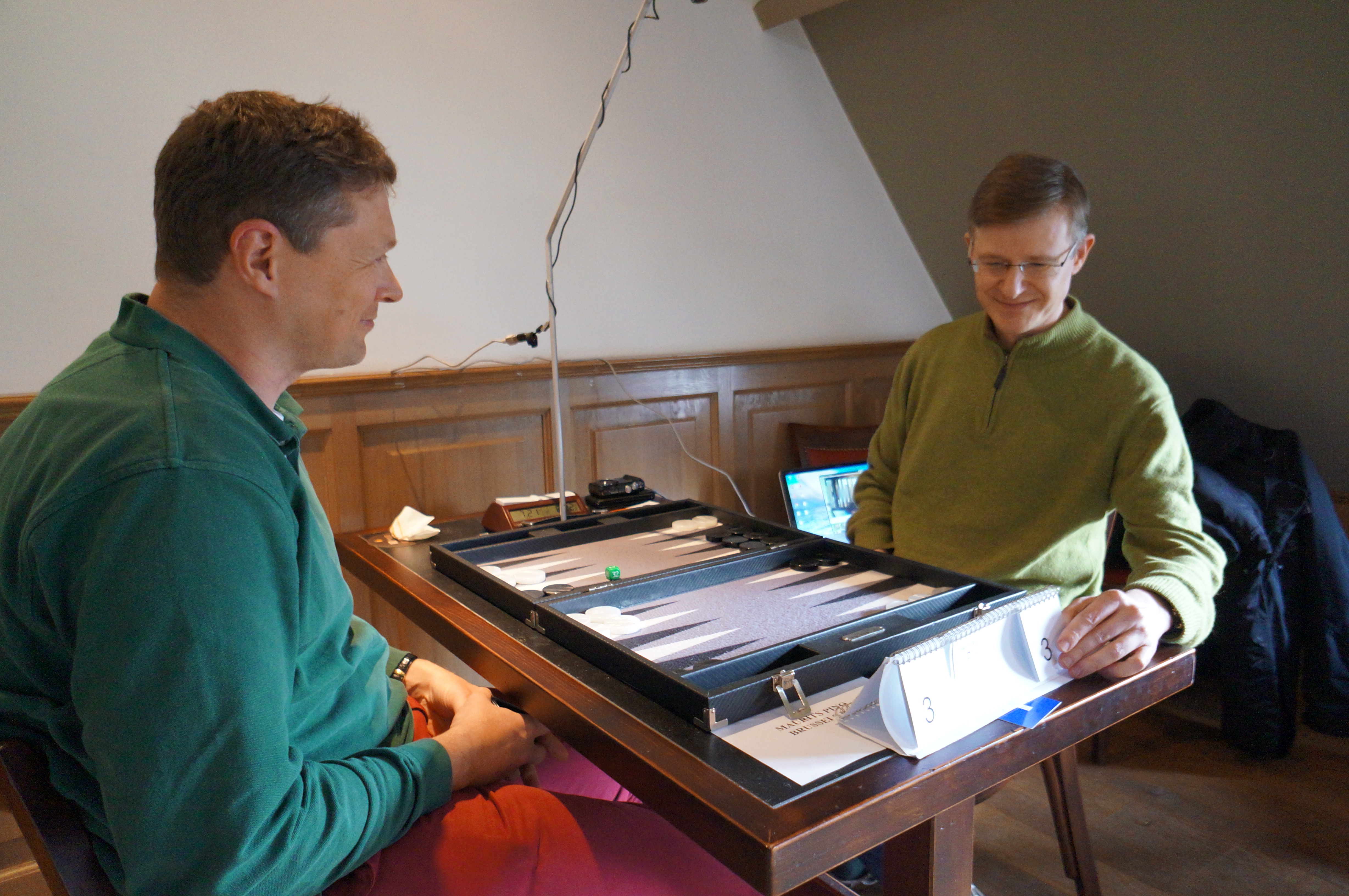
With the score tied at 1-1, both players found themselves in an opening skirmish. In such games it is mostly correct to keep hitting – Thou shallt hit in the beginning – but at a certain moment it becomes correct to anchor up and cut your losses. When that moment has come is not easy to assess. Here is how the game went :
Game 3
Zsolt Tasnadi (Black) needs 6 Maurits Pino (White) needs 6
1. 32 : 24/21 13/11 32 : 13/10 6/4*
2. 43 : bar/21* 24/21 64 : bar/21 24/18
3. 53 : 8/3 6/3 31 : ?

3. —– 31 : 18/14*
Hitting catches up in the race of course. White is only down 4 pips after the hit. The alternative would be to anchor up on the 18-point and play 10/9 with a less volatile position as a result. This turns out to be a serious error here :
1. XG Roller+ 18/14* eq:-0,31
Player: 44,87% (G:9,61% B:0,37%)
Opponent: 55,13% (G:19,20% B:1,22%)
2. XG Roller+ 21/18 10/9 eq:-0,376 (-0,067)
Player: 42,62% (G:8,46% B:0,28%)
Opponent: 57,38% (G:18,47% B:0,62%)
So, the fact that Black has made the 3-point should not deter you from hitting, even though the hit leaves 4 blots.
4. 65 : bar/20 21/15* 32 : ?

Maurits sees himself faced with the same problem : he can keep hitting and leave 5 (!) blots against a stronger board, or he can anchor up. What would you do?
4. —– 32 : bar/23 13/10*
Hitting is still correct, but by a much smaller margin :
1. XG Roller++ Bar/23 13/10* eq:-0,434
Player: 42,65% (G:9,33% B:0,36%)
Opponent: 57,35% (G:22,47% B:1,84%)
2. XG Roller++ Bar/23 24/21 eq:-0,457 (-0,024)
Player: 40,63% (G:8,45% B:0,29%)
Opponent: 59,37% (G:18,95% B:0,78%)
Just to show how subtle changes can make hitting wrong, have a look at this variation :

The extra spare on the 8-point and the fact that you can make the golden anchor are sufficient to make hitting an error :
1. XG Roller++ Bar/23 24/20 eq:-0,395
Player: 41,59% (G:8,69% B:0,27%)
Opponent: 58,41% (G:17,48% B:0,65%)
2. XG Roller++ Bar/23 14/10* eq:-0,422 (-0,027)
Player: 42,47% (G:8,82% B:0,30%)
Opponent: 57,53% (G:20,55% B:1,39%)
5. 62 : bar/23 21/15* 51 : ?

5. —– 51 : bar/20 21/20
Maurits intuitively knows that enough is enough. Time to wave the white flag and fight a defensive war :
1. XG Roller++ Bar/20 21/20 eq:-0,364
Player: 43,28% (G:9,44% B:0,33%)
Opponent: 56,72% (G:20,13% B:0,88%)
2. XG Roller++ Bar/20 6/5* eq:-0,429 (-0,065)
Player: 44,12% (G:9,64% B:0,39%)
Opponent: 55,88% (G:25,82% B:2,75%)
Still, circumstances may occur where hitting here may be a tactical option worth considering. A world-class player might keep hitting to complicate matters. And, should this position come up towards the end of a match, the trailer might rightfully hit here if his oppenent is in time trouble.
6. 32 : 23/20 13/11* 31 : bar/24 13/10*
7. 52 : ?

Now it is Zsolt’s turn to ponder whether he should hit or not. This position is fundamentally different, however. Here, Black has a significant edge (58% winning chances), whereas in the previous positions, White was always a clear underdog (40-45% winning chances) no matter what he did. This points to a consolidating play : Black should come in on the 20-point and make his 11-point. It is not so difficult to see that the 11-point is very strong against the 20-point anchor. Moreover, White already has 5 men back, so hitting a 6th checker might lead to a complex triple-anchor backgame where each checker play might pose challenging problems. Also, hitting gives up the golden anchor, a decision one should not take lightly.
Not hitting here yields a simple holding game with a 41-pip race advantage, low volatility and easy checker play coming up. The fact that Zsolt made the wrong choice here is indicative of how the intuitive hit may lead one astray in certain positions.
Still, the error is far from monstrous. Forward mobility and flexibility are important in positions where O (= opponent) has established multiple anchors.
1. XG Roller++ Bar/20 13/11 eq:+0,397
Player: 57,73% (G:18,75% B:0,91%)
Opponent: 42,27% (G:8,37% B:0,27%)
2. XG Roller++ Bar/20 11/9 eq:+0,341 (-0,056)
Player: 56,38% (G:18,28% B:0,88%)
Opponent: 43,62% (G:8,55% B:0,28%)
3. XG Roller++ Bar/23 20/15* eq:+0,331 (-0,066)
Player: 54,68% (G:22,44% B:1,72%)
Opponent: 45,32% (G:9,85% B:0,41%)
7. —– 43 : bar/21 24/21
8. 62 : 15/9 11/9 63 : ?

Having established a 5-4 backgame structure, it seems natural to just eject one of the back men into the outfield. This is probably what I would have done. Maurits, however, decides to go for Black’s barpoint by simultaneously slotting it and hitting on his 5-point. An ingenious tactical find in a complex position!
1. XG Roller++ 24/18 8/5* eq:-0,281
Player: 46,58% (G:10,32% B:0,43%)
Opponent: 53,42% (G:23,40% B:0,84%)
2. XG Roller++ 24/15 eq:-0,304 (-0,023)
Player: 45,03% (G:9,65% B:0,37%)
Opponent: 54,97% (G:20,59% B:0,62%)
3. XG Roller++ 23/14 eq:-0,309 (-0,028)
Player: 45,10% (G:9,65% B:0,38%)
Opponent: 54,90% (G:21,01% B:0,70%)
The reader can follow the rest of this exciting game via the link provided above. Both players held their own amid all that complexity : Zsolt scored a 4,36 PR (World Class), but was still outplayed by Maurits who even outplayed the computer : – 0,68 PR (Wow!). Nicely done.
M
For the 10th time, Bert Van Kerckhove organized the Gent Open. As always, the location was the Koninklijke Club Union Sandeman in Gent. This year, 24 players showed up to play 7 rounds of 7-point matches. All matches were played with clock.
After 6 rounds, Michel was the only player left with 6 victories. However, in the last match of the day, Belgian-born Nardy Pillards managed to beat Michel to draw even. The tense match culminated in a thrilling DMP game where Nardy skillfully blitzed Michel off the board after a 52 (24/22 13/8) 55 (6/1* 6/1* 8/3* 8/3*) opening sequence.
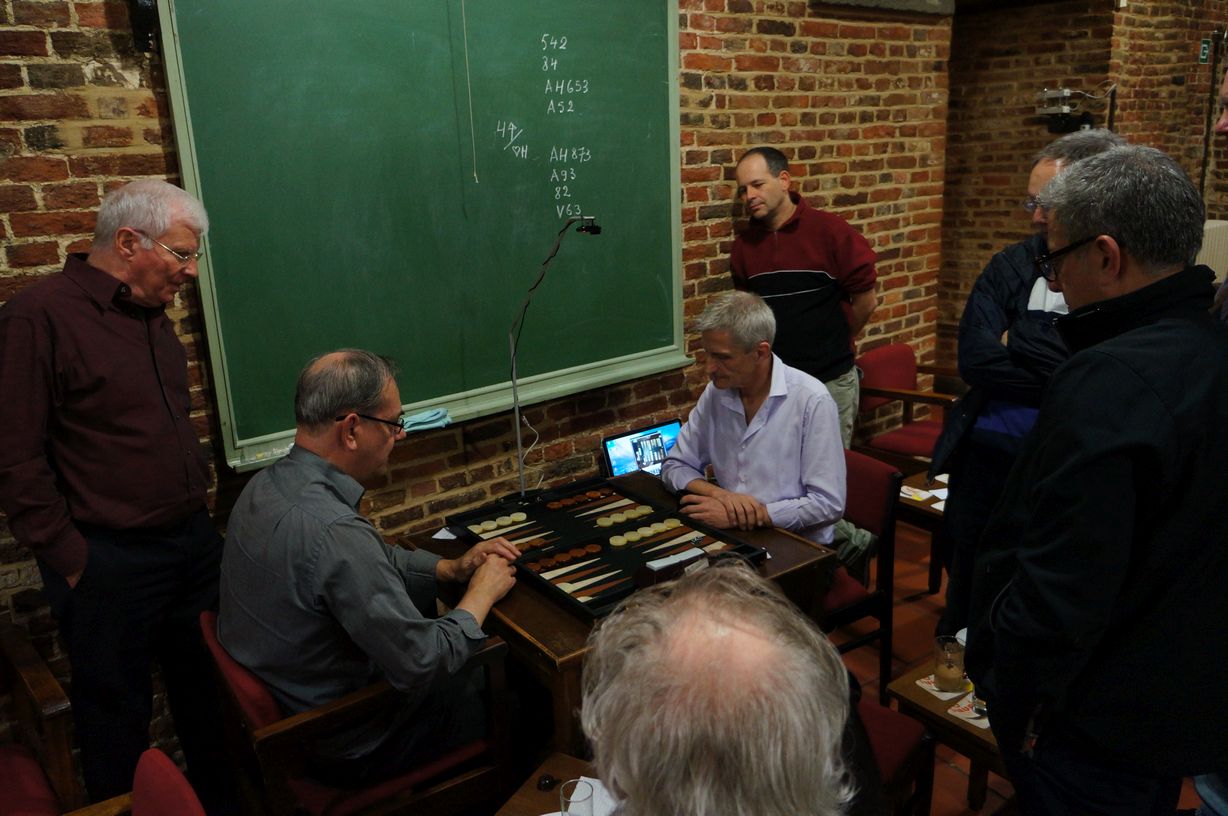
This left both players with 6 wins, but the trophy went to Michel because his opponents had collected more wins (Buchholz-system).
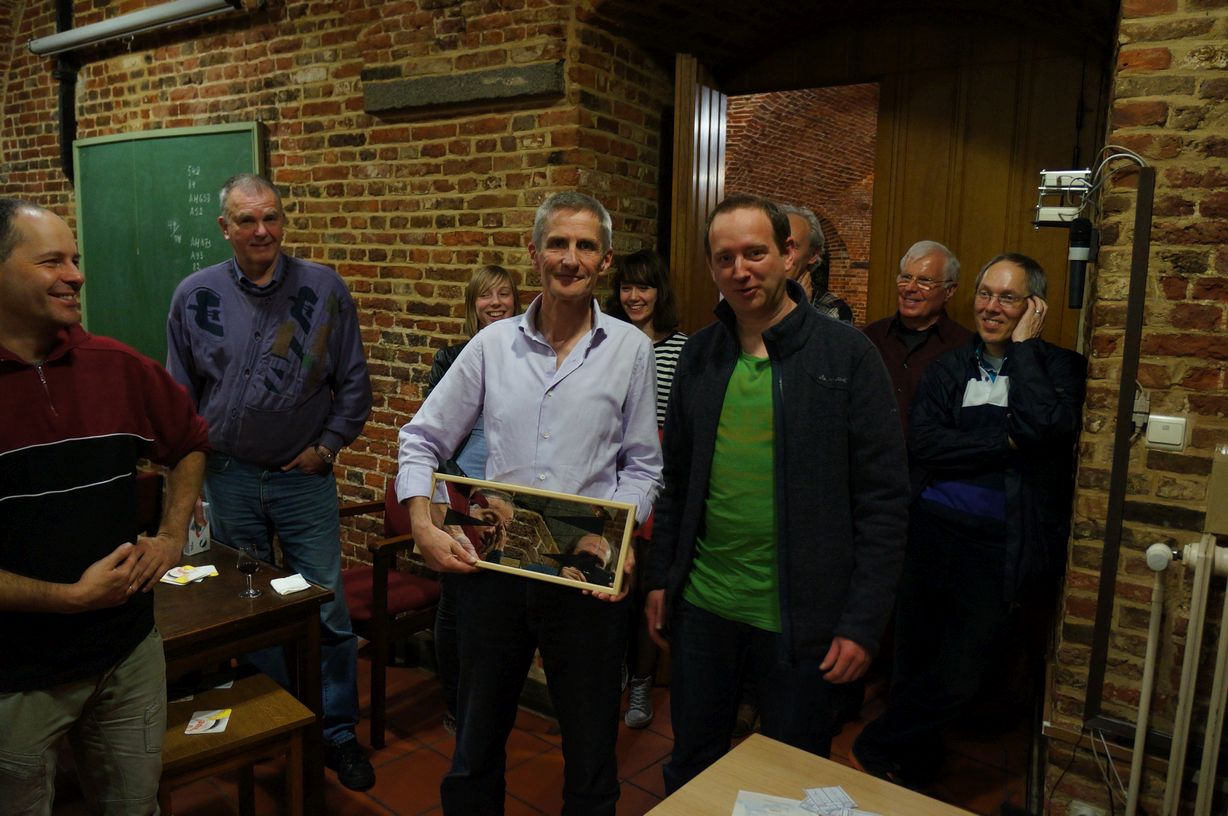
The Intermediate Division was won by Manolitto from Amsterdam. He was one of 6 players from the Netherlands who had travelled a couple of hours to compete in Gent. One of his opponents, Peter Allemeersch, was baffled by the fastness of Manolitto’s decision-making : “He played incredibly fast,” said Peter, “and ended the match with 11 minutes and 24 seconds left on the clock!” Truly, an amazing feat.
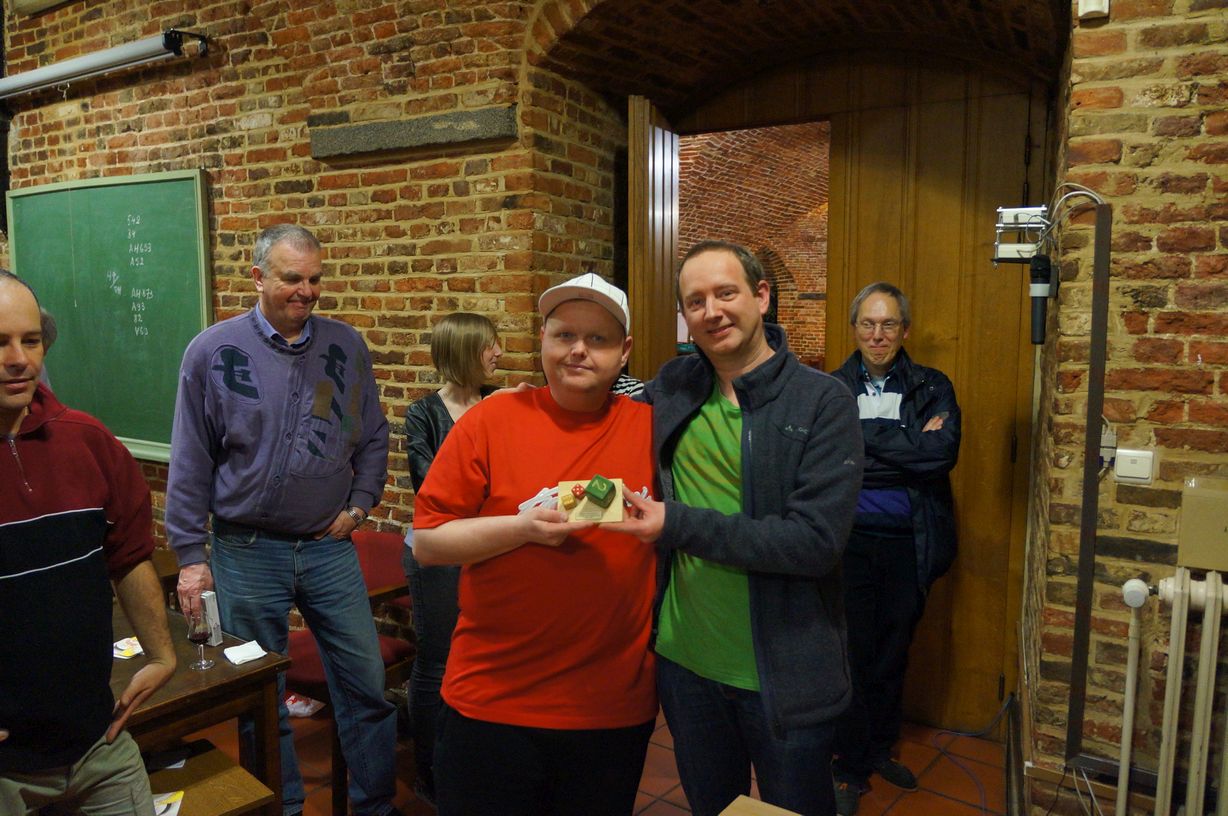
In the picture, Manolitto poses with the colourful trophy. All three trophies were handcrafted by Gent club member Robin Bilderbeek.
The Beginner’s flight was won by Kristoffer De Weert. In addition to the trophy, he received Bill Robertie’s bestseller Backgammon for Serious Players as study material.
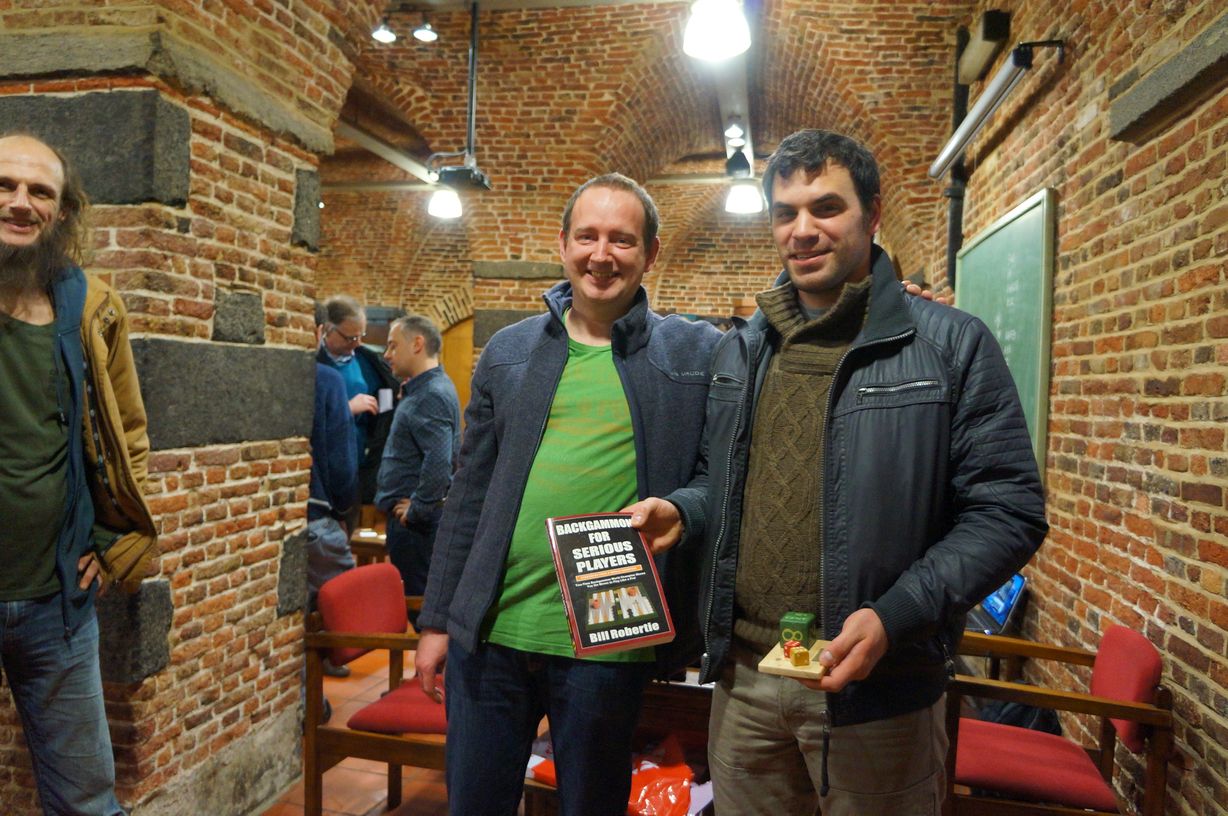
This anniversary edition of the Gent Open was a success. There was constant action and the playing conditions were excellent. Congrats to organizer Bert for a job well done.
An extra word of thanks to the Dutch players who made the trip. They gave the tournament an international flair and blended in perfectly with the predominantly Flemish crowd.
M
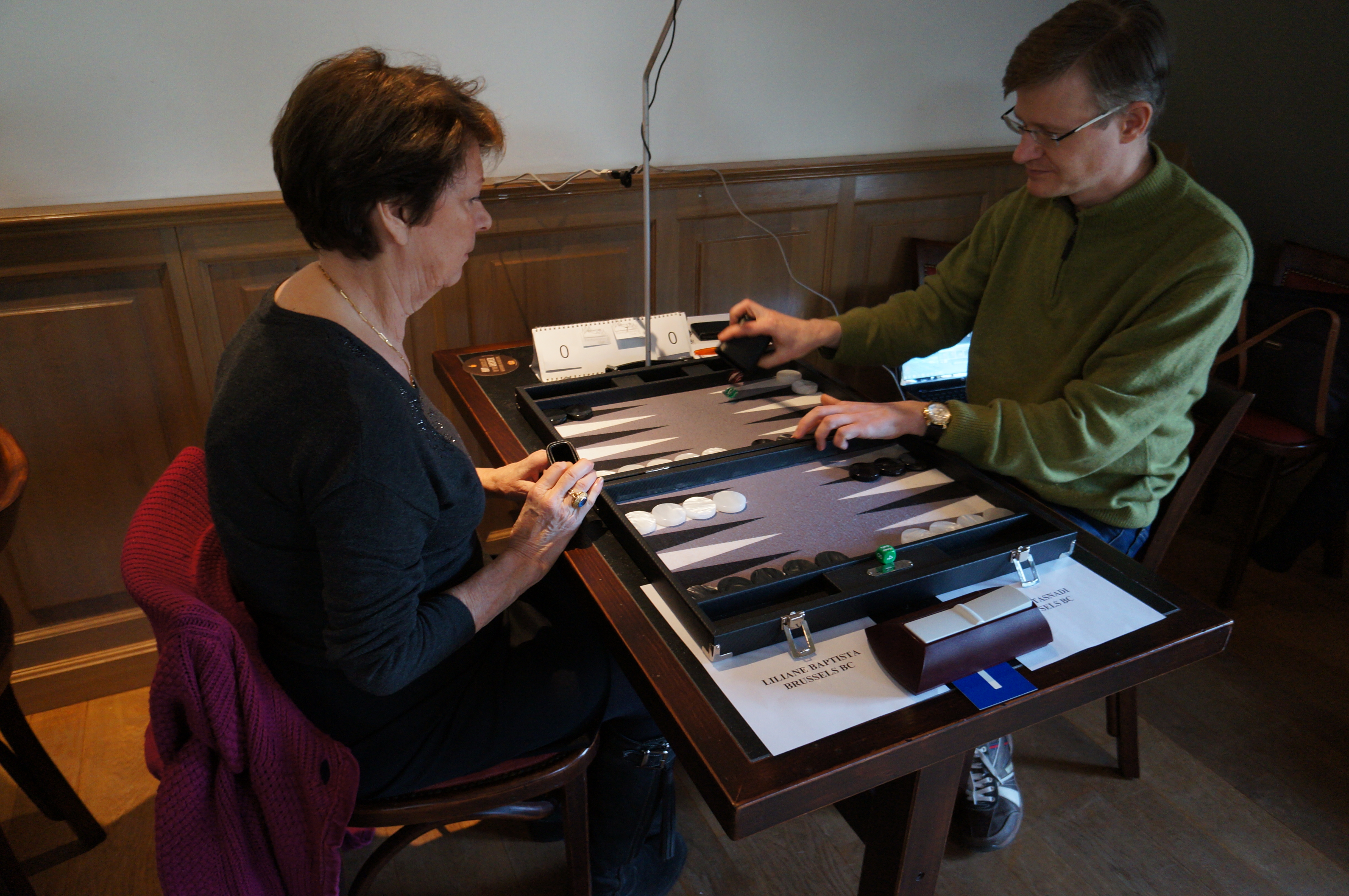
In backgammon, certain types of positions occur time and time again. One of the most common types are holding games. In a holding game, one player has made an advanced anchor (4-point or higher) and the opponent has escaped his men to the midpoint. Now it is time for the favorite to assess all features of the position and decide on his cube action.
In their match, Zsolt and Liliane each got doubled in a 4-point holding game and struggled with the cube decision. Here, for instance, is the position in Game 1 :

First thing to consider is – as always – the RACE. Zsolt is only up 11 pips. Typically, against a 4-point anchor you would need about 20 pips race advantage to have a correct double. Of course, with his barpoint already made, Zsolt has a broken 5-prime which compensates for the fact that he has not yet fully safetied his last checker to the midpoint. Also, Liliane’s own forward position is far from perfect : she has not yet made a extra point in her board, but she should have no problems building a strong board soon. Moreover, in such kinds of positions the volatility is generally low. This means that only rolls like 66, 55 and 44 would lose Zsolt’s market. Therefore it is very improbable that Zsolt would make a big error by waiting one roll before cubing.
Player Winning Chances: 73,72% (G:2,76% B:0,05%)
Opponent Winning Chances: 26,28% (G:1,24% B:0,01%)
No double: +0,799 (-0,009)
Double/Take: +0,807
Double/Pass: +1,000 (+0,193)
Best Cube action: Double / Take
As eXtreme Gammon shows, this is a borderline Double, but an easy Take for the defender. Liliane does not take a big risk in taking this. She can only lose one extra point by taking, since the chance that she will get gammoned is less than 3%. However, players who are not familiar with these positions might easily get spooked and give away a point. This is what happened in the match. Liliane passed, making a big mistake in doing so.
Knowing your opponent’s tendencies can help with the cube action here. Maybe Zsolt estimated that there was a significant chance that Liliane would pass. In that case, his double becomes a strong bluff double. If he did not consider Liliane’s weakness, his double could be called premature.
In Game 2, the roles were reversed. This time Zsolt is the one defending from the 4-point anchor :

Here, Liliane is up 26 pips in the RACE. She could have turned the cube 2 rolls earlier, but decided to wait. This turned out well for her, because Zsolt, probably thinking the open 5-point was a significant weakness in Red’s position, took the cube without thinking too long about it. This also turns out to be a big mistake :
Player Winning Chances: 81,58% (G:2,79% B:0,02%)
Opponent Winning Chances: 18,42% (G:0,90% B:0,04%)
No double: +0,988 (-0,012)
Double/Take: +1,202 (+0,202)
Double/Pass: +1,000
Best Cube action: Double / Pass
The Americans have come up with the term double whopper for errors of this magnitude. By accepting this cube, Zsolt sacrificed 0,202 mps in equity.
Something to consider when you get doubled is whether the opponent will be prone to making checker play mistakes in the game continuation. In the position above, Red has a relatively easy task bringing the checkers home. Still, she might not dare leave an indirect shot in clearing the 11-point or misplace her checkers in some other way. Still, these errors are unlikely to be big mistakes, so they would not compensate for the 0,202 in sacrificed equity.
However, this is what happened 2 rolls later :

The reader can have no doubt as to what is the correct move : making the 5-point is hugely correct. I am sure Liliane will play this correctly 90% of the times, but due to the tension of the big occasion, she nervously played 8/6 8/2. Her underlying thought may have been that a point cleared, is a point not to be feared, and there are situations where this would definitely be the right play. Here, however, this useful tenet does not apply.
1. XG Roller++ 11/5 7/5 eq:+0,661
Player: 84,29% (G:2,56% B:0,04%)
Opponent: 15,71% (G:0,61% B:0,01%)
2. XG Roller++ 8/6 8/2 eq:+0,484 (-0,177)
Player: 76,71% (G:2,59% B:0,05%)
Opponent: 23,29% (G:1,30% B:0,02%)
To make matters worse for Liliane, Zsolt ended up escaping with a 66 and reached this position some rolls later :

This is a classic bear-off cube decision. If Zsolt rolls an ace, he loses, in all other cases he wins. This is typically something that distinguishes Intermediate players from Beginners : the ability to calculate probabilities. What are the chances Zsolt rolls an ace? Well, it is 11/36 or 30%. That means he is 70% favorite here and should redouble. Liliane, who has 30% winning chances, should take. It must be said that it might be scary for the better player to give this cube, because rolling an ace swings the score to 1-4 down in a match to 7. However, the error in not cubing is so big (0,415 – !), that the skill difference between both players would have to be between 12 and 15 PR ( = difference in Performance Rating as calculated by eXtree Gammon) for not doubling to be correct. This means that a world class player, who averages about 4 PR, would make an error cubing this against Liliane. Zsolt, who played this match at Advanced level, had to bite the bullet and ship the cube. He took a long time fretting over it, but eventually redoubled to 4. Liliane, to her credit, accepted, which as a matter of fact is very well played. Many players, even strong ones, get overwhelmed by superstitions and end up passing this. Gutsy cube action by both players!
Zsolt did not roll a 1, took a 5-0 (7) lead, and ended up beating Liliane 7-0.
Hopefully, these remarks will motivate players of all levels to spend some time studying the game. Improving your game gives greater long-term satisfaction than winning the occasional match by chance.
See you soon.
M
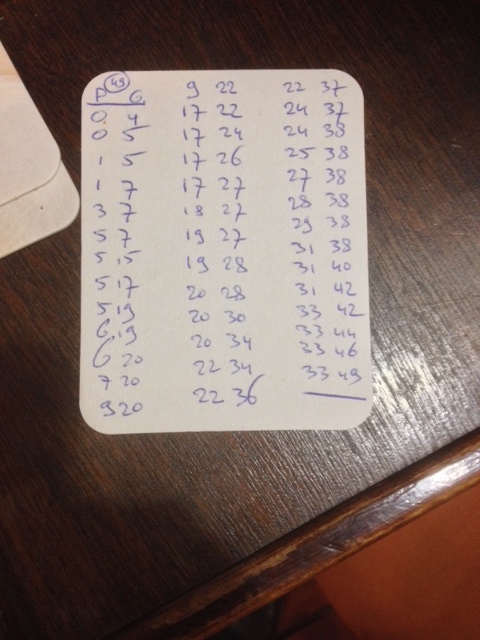
Last Saturday, 14 March 2015, a 49-point match was played at the Royal Sandeman Club in Ghent. Only a few spectators witnessed the match, among them Ghent player Johan Vervust, who could not believe his ears when I told him about the lenght of the match.
I have had this idea for a couple of months and eventually found Dutch player Paul Van Dijke, never shy of a real challenge, prepared to take up the gauntlet. Play started at 1:30pm and finished just before 8:30pm, when Paul got gammoned in the last game of the match, which ultimately finished 50-33 in my favour.
The match was clocked, each player starting with 1 hour and 38 minutes in the time bank, with a 12 seconds increment each move. Only 7 or 8 small 2-minute breaks were taken, in order to be sure we could finish the match that same day before the Sandeman closed its doors.
In the match we saw two 16-cubes, which both had to be passed (either player won one). The match was fully recorded and the full transcription in Extreme Gammon will follow in about a week. For the moment, only the score sheet is available (see picture above).
Geert Van der Stricht
In the first round of BBD1 two players of the Brussels Four Cubes team were pitted against each other. Zsolt Tasnadi and Alain Chif have worked their way up the national ranking to the edge of the top-10. They are working hard to make the step from Intermediate to Advanced level.
Their match was witnessed by nobody except the camera. All other players were completely wrapped up in their own decision-making processes. Their matches have disappeared into nothingness. The Tasnadi-Chif match, however, has now been transcribed in XG and fully annotated. If you are a member of BGFed, you can send me an e-mail (kynos8000@gmail.com) and we (i.e. Zsolt, Alain, and I) will share this fascinating contest with you. You can review it at leasure and – hopefully – learn something from the annotations.
Game 3 was particularly instructive. Zsolt is leading 2-1, which makes this a 5-away 6-away game. This is a very challenging match score, especially when the cube has been turned. It requires some in-depth understanding to fully grasp the implications of re-cube action. Fortunately for us, this is no issue here, as the game played itself out with the cube in the middle. Let us see what happened :
Game 3
Zsolt Tasnadi (Red) needs 5 Alain Chif (White) needs 6
1. —– 61 : 13/7 8/7
2. 61 : 13/7 8/7 41 : 24/20 24/23
3. 43 : 24/20 24/23 52 : 13/8 6/4*
4. 61 : bar/24 20/14 52 : 13/8 6/4
5. 31 : 8/5* 6/5 62 : bar/17*
6. 31 : bar/22 6/5 ?
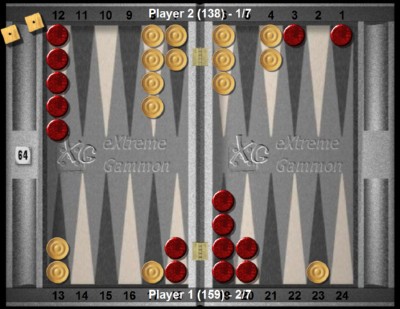
This is a borderline No Double for money, but ats ( = at the score), White can turn the cube. White’s Gammon Value (GV) is slightly higher and so is Red’s Takepoint (TP). White is up 21 pips in the race, has a better position (one checker semi-escaped + the bar- and 4-point) and some powerful threats.
White’s Winning Chances: 66,23% (G:20,00% B:0,72%)
Red’s Winning Chances: 33,77% (G:7,11% B:0,26%)
No double: +0,763 (-0,076)
Double/Take: +0,840
Double/Pass: +1,000 (+0,160)
Best Cube action: Double / Take
6. 65 : 23/17 8/3*
7. 31 : bar/22* 6/5 61 : ?
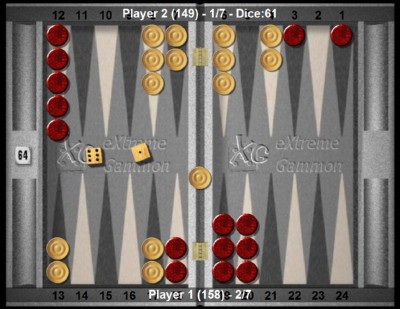
61 : bar/24 17/11
After entering with the ace, White cannot afford to give up the 17-point. Alain must be suffering from early morning drowsiness, because this is an error you cannot afford to make. With a stranded checker on the 24-point, you simply must keep the 17-point to keep that man connected. This is a bad mistake (0,166) simply because the correct move is so obvious.
8. 21 : 6/4 5/4 61 : ?
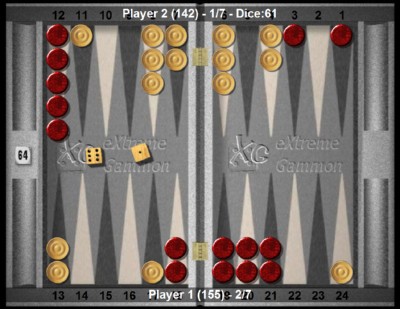
Alain is lucky to have rolled a joker, but unlucky in that there is such an attractive alternative (with a 63 the choice would be crystal clear). How can making the 5-point be wrong? Well, this is a pvp-position (prime-vs-prime) and this territory is governed by different laws. A useful guideline is : Do what is most difficult first. Here, your back man is away from the edge of a 4-prime, so he can only successfully jump to the 17-point with 61 and 52 (4 rolls out of 36). Making the 5-point is much more probable : 61, 63, 31, 66, 44, 33, 11 do the job (10/36).
Still, the resulting position after Alain’s move is worth a look :
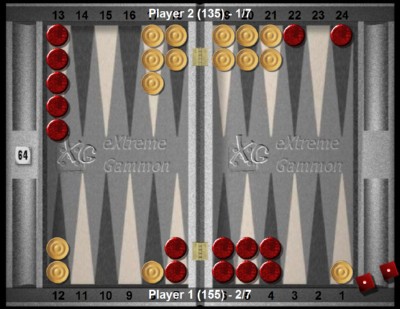
It is easy to see the lure of this position : White has a 5-prime with a spare and only one man behind a stripped 4-prime. Red on the other hand has 2 men behind a 5-prime. The value of the assets is clearly in White’s favour. However, the problem is that Red is on roll : 15 rolls hit the blot on the 17-point and nine 2s anchor up (Red hits with 32). In other words, Red’s initiative negates his positional disadvantages. This is a very important concept in pvp-games. By the way, I would not be surprised if chess players were more likely to go for the 5-prime here than non-chess players.
Another aspect is the cube. After reconnecting with the blot on the 17-point, White is close to a Double if Red does not roll something spectacular like 42, 62, 64 or 22. After making the 5-point, Red has 5s that hit and 2s that anchor, leaving a No Double, Take position. The computer labels this a monstrous blunder (0,447). However, pvp-positions are notoriously complex, so I would not beat myself up over this, had I got it wrong.
1. XG Roller++ 24/17 eq:+0,759
Player: 66,98% (G:13,44% B:0,42%)
Opponent: 33,02% (G:5,81% B:0,19%)
2. XG Roller++ 24/23 17/11 eq:+0,388 (-0,370)
Player: 58,16% (G:14,58% B:0,63%)
Opponent: 41,84% (G:10,23% B:0,35%)
3. XG Roller++ 11/5 6/5 eq:+0,312 (-0,447)
Player: 55,27% (G:16,33% B:0,79%)
Opponent: 44,73% (G:11,74% B:0,53%)
9. 31 : 13/9 22 : ?
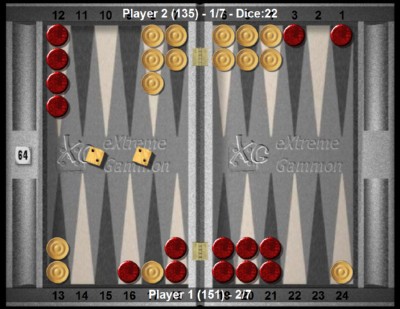
Alain was not punished for his mistake and should have doubled here. Failing to do so, costs 0,112. Once again, the dice offer him a tricky choice : one might be tempted to make a full 6-prime with 13/9 (2). Alain keeps a cool head though and finds the right priorities : safety the blot (17/13), come to the edge of the prime (24/22) and put a spare on the 6-point (8/6). Well played!
10. 31 : 13/9 44 : ?
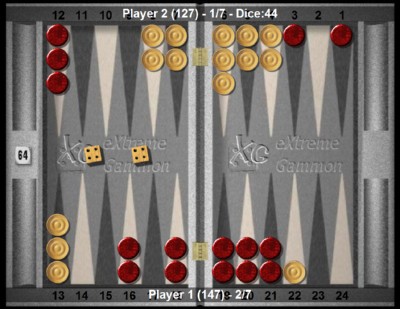
It is almost comical how Alain is once again confronted with a great roll which is so difficult to play. What would you do? Surely one looks at 13/9 (2) 13/5, right? This builds a 6-prime with a great distribution of spares. However, this is a massive blunder, costing 0,342! The key to this position is that Alain is behind a broken 5-prime himself and needs to roll a 5 to escape. Chances of doing that are only 30% (11/36), so that may take a few rolls. Alain’s timing is precarious : his 6-prime may only hold for one or two rolls if a 5 does not come quickly. Therefore he needs to prevent Red from either counter-priming or attacking him. This is achieved by putting Red on the bar. Several plays are worth considering, but the best way to do that is to point-and-shift : 7/3* (2) 5/1* (2)(!!). Congrats to the reader if he got this one right.
1. XG Roller++ 7/3*(2) 5/1*(2) eq:+0,958
Player: 67,28% (G:47,04% B:0,45%)
Opponent: 32,72% (G:6,25% B:0,35%)
11. 32 : 24/22 13/10 53 : 22/14 (the required 5)
12. 51 : 9/3 32 : 14/11 6/4
13. 41 : 9/8 7/3 Double to 2
14. Pass.
After this game the score was tied at 2-2 (7). Game 4 turned into an exciting blitz : Alain found a world-class Take and Zsolt struggled with the checker-plays. You can review this game and the rest of the annotated match by simply sending me an e-mail (see above).
M
When Line, Peter, and I made the first steps towards organising a small-scale tournament in Brugge, we had no idea what to expect. Would it work? Would the backgammon community show up en masse or would we be completely ignored? These were some of the anxieties we struggled with as our plans became more and more concrete.
Now that the event is history, we are delighted by the enthusiastic response we received. Due to the limitations of our playing room, only 26 players could be admitted, so, with that number, we achieved maximum attendance.
Moreover, notwithstanding the required adherence to rules and schedule, all players effortlessly contributed to the success of the tournament. Thier punctuality, sportsmanship, and placidity under duress were the key ingredients of a memorable backgammon day.
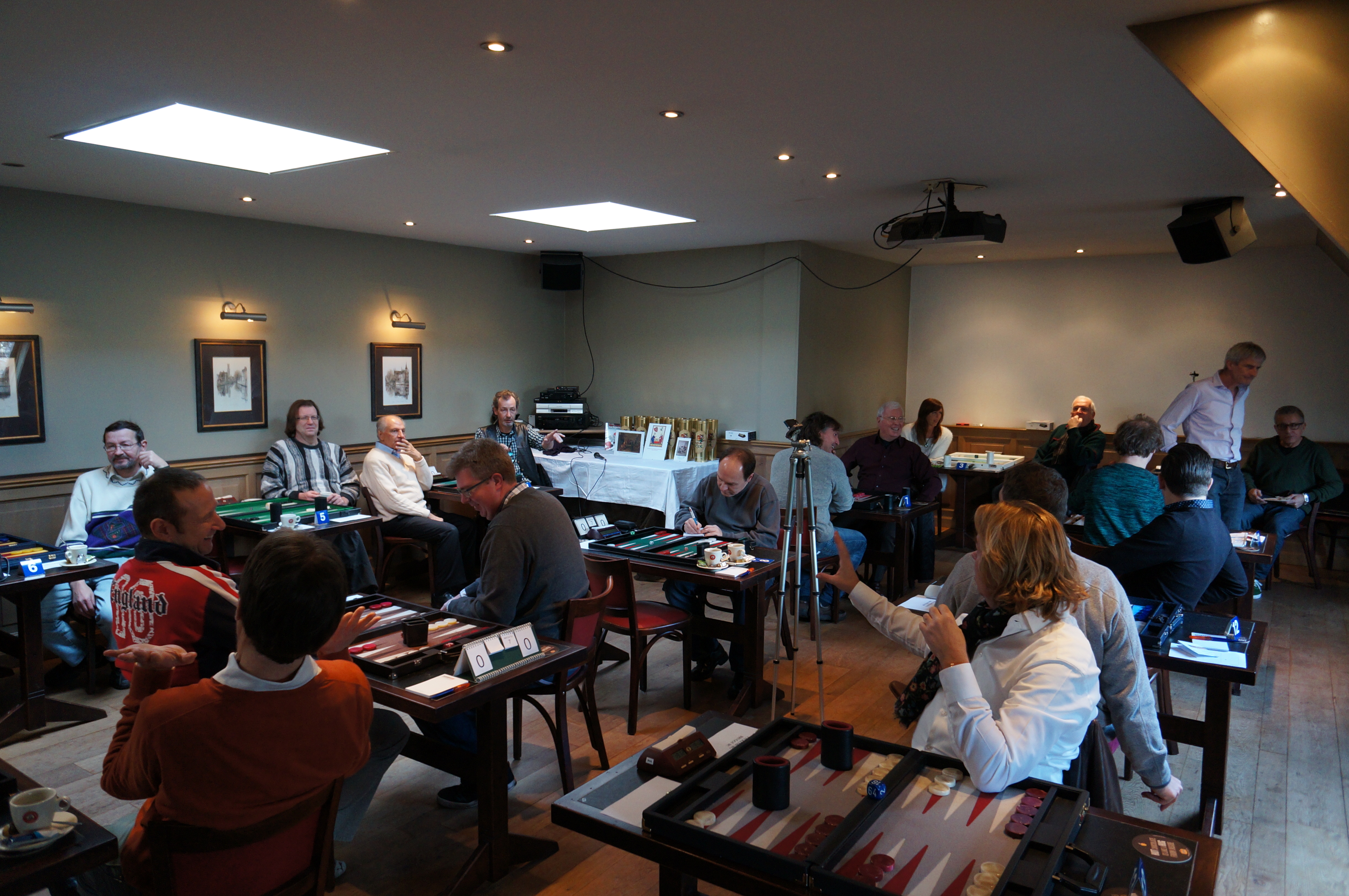
Also, with this low-threshold tournament, Brugge BC has tried to put some of the aims and aspirations of the recently founded BGFED (Belgian backgammon federation) into practice :
Hope to see you soon.
M
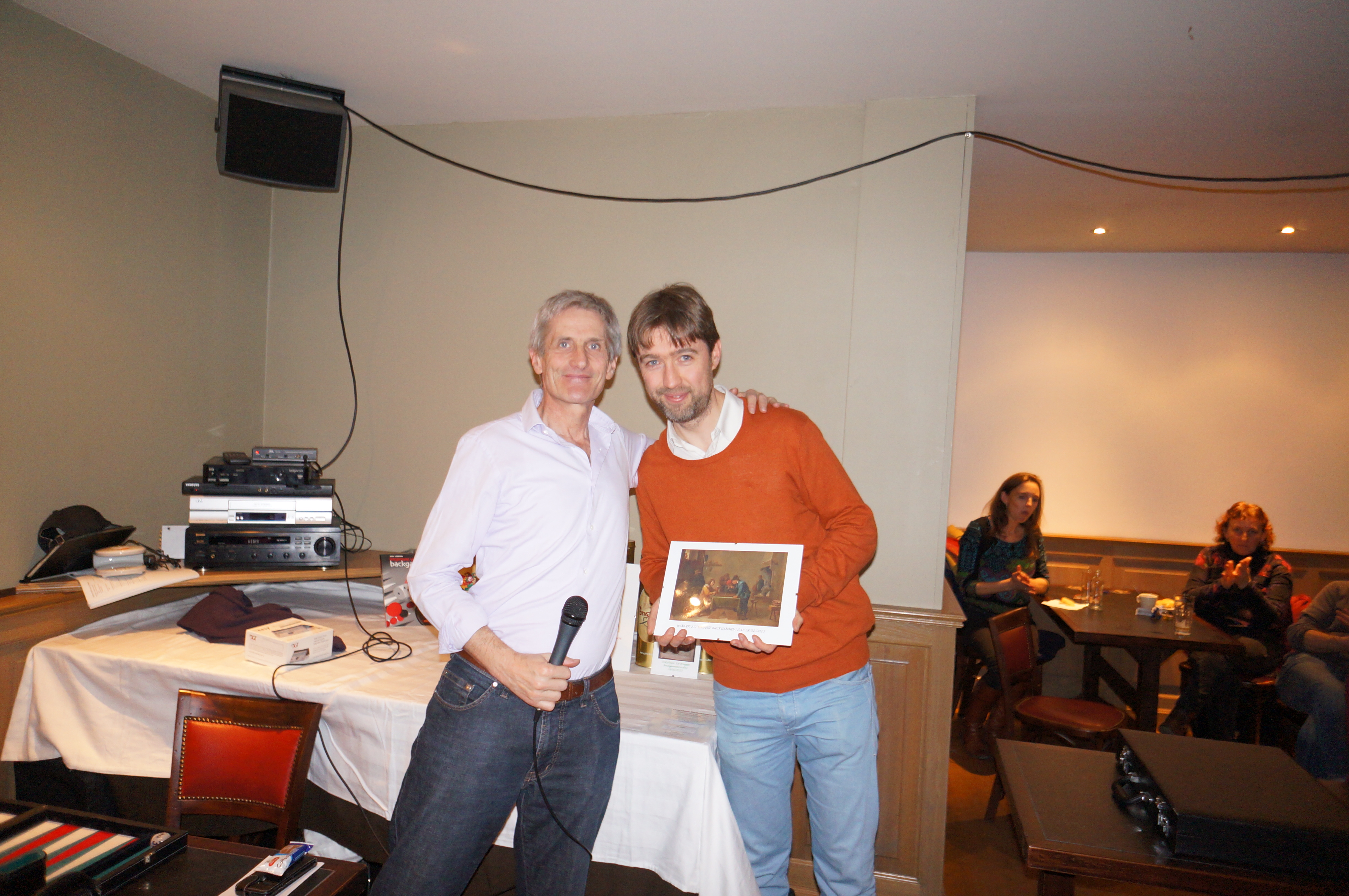
Johan Segers hammered his way to a convincing triumph at BBD1 yesterday. He nailed a 5-win streak to clinch a resounding victory.
Paul van Dijke was runner-up (4/5) with Geert Dooms, Zsolt Tasnadi and Bert Van Kerckhove sharing 2nd place (4/5).
The hometeam was able to hold on to the Brugse Zotten, but only with the narrowest of margins. Leuven BC came close to achieving a sensational steal, but 5th round victories by Brugge’s Eddy Cabooter and Nigel Vergaerde made sure the hoard of local beer stayed in Brugge.
More later this week.
M
At BBD1 next Saturday in Brugge, a decorative canister with Brugse Zot beer will go to every player of the club which wins most matches. Can anybody but the Brugge team win this challenge? We asked celebrated backgammon writer John Squeeze for his opinion :
– “With 12 players the home club is of course well represented. True, half of their players are recreational players or at least players who cannot claim to have reached a playing level beyond Beginner. Still, they should be good for an occasional win and will probably collect at least 6 points for the team. Add to that the presence of the complete Four Cubes team plus an experienced veteran like Mark Steyvers, and it is already starting to look like mission impossible for the other clubs. If you throw an extra handful of Intermediates in the mix (Peter, Line, Nigel) it is truly starting to look bleak for the other clubs”
– “Is Leuven BC the only challenger?”
– “At least with 7 delegates, they represent a good chunk of equity. If it had not been for the absence of Toon, who is, as you know, currently ranked number two on the national ranking, I would have given them a 40% chance to grab the trophy. As it is, their best players will really have to come up with their A-game to stand a chance”.
– “What about the other clubs?”
– “Brussels of course has a strong, but small team. Their Four Cubes team is present, which on a good day could be good for 9 wins, but I do not see them play a significant role in the contest. Ghent has top player Bert in their ranks, but their chances are of course seriously crippled by the absence of 2013 BIC winner Geert, who acts as wedstrijdleider. They cannot have more than 5% chance to grab the Brugse Zotten”
Thank you, John, for this lucid preview to the 6 Brugse Zotten Challenge.
M
Dear players, backgammon friends,
thank you all for signing up for BBD1. We are looking forward to a fun day full of exciting backgammon.
Here are some last practical guidelines :
1. Draw :
As announced, the draw will be done on Friday at noon. After the draw is done, you will be notified of your table number and opponent, either by mail or SMS.
We have a field of 26 players, with Robin Bilderbeek on the stand-by list.
I count on everybody’s discretion to inform me as soon as possible should unforeseen events prevent you from attending.
2. Getting there :
Car : remember that Saturday is market day in Brugge. Shoppers flock to the city centre pretty early and parking lots tend to fill up quickly. Most practical option is to park your car in public parking Pandreitje (put either Gevangenisstraat or Park 5 in your path finding device). Day fee is 8,70€/day. From there it is less than 5 minutes on foot to the Hollandse Vismijn.
Train : walking from the station to the H. Vismijn takes about 30 minutes. You can also take a bus to the market square and walk another 5 minutes to the Vismarkt.
3. Boards, clocks and other stuff :
If you have not been personally requested to bring your board, then we suggest you do not bring it to the venue. You will not have time to use it.
Boards, clocks, dice, etc. are provided by Brugge BC and some befriended players from other clubs.
The playing room is not spacious and there is no cloak-room available. So travel light and bring only the most necessary things to the H. Vismijn.
4. Schedule (modified!) :
9 – 10 : arrival : you will be greeted by either Line Vandamme or Isabelle Goeman. From them, you will get a coupon which you can exchange at the bar for your welcome coffee. Boterkoeken are upstairs in the playing area.
10 – 10:15 : if you have not moved upstairs by this time, it is time you did. Take a seat at your designated table and await proceedings.
At this time, only players and staff are allowed upstairs. Once the tournament is underway, visitors are welcome. Smoking and pets are not allowed. Visitors are expected to be quiet.
10:15 – 10:30 : Welcome word and Player Presentation (by Michel).
10:30 : start of tournament by wedstrijdleider (tournament director) Geert Van der Stricht. He will inform you on certain aspects of playing etiquette and then get Round 1 of the tournament underway by starting the clocks.
12 : Round 2
13:30 – 14 :15 : lunch break. Soup, sandwiches and cake will be brought upstairs.
14:30 : Round 3
16 : Round 4
17:30 : Round 5
19 : Prize giving.
Players are requested to replace the checkers in the starting position once they have finshed playing their match. They can then either watch some other matches or go downstairs for a drink or a breath of fresh air.
5. Side-pools :
At this time, 4 players have entered the 50€ side-pool. They are : Line Vandamme, Bert Van Kerckhove, Paul Van Dijke and Michel Lamote.
One player has entered the 20€ side-pool. That is Peter Allemeersch.
You can still sign up for either side-pool. Just inform Michel before Saturday, 10 am.
6. Buying drinks :
Upon arrival, you will receive a personalised zuipkaart. Whenever you order drinks during the day, you order will be noted on the card. No need to take out cash. At the end of the day, we count on everybody’s savoir vivre to pay the bill at the counter before stepping into the night.
7. Public table :
We play on 13 numbered tables. All these tables have a board, 30 checkers, 2 dice, 2 cups and 1 doubling cube. Pen and paper are available for scorekeeping. Scoreboards are not provided but feel free to bring your personal scoreboard.
Table 1 is the Feature Table. The board on that table belongs to Geert Van der Stricht. It was awarded to him upon winning the first edition of the BIC (Belgian Individual Championship) in December 2013. If you find yourself playing on that board, you should be first on the Leaderboard (except for Round 1 of course, which is random).
All matches played on the Feature Table will be recorded. Afterwards they will be transcribed in XG and posted on the BGFed website along with some comments and annotations by Michel Lamote.
Table 2 is the Public Table. This board is the only board set up in the café. It brings backgammon and the tournament in the public eye.
Since it is Table 2, the players at this table will probably be seasoned players who should be able to cope with the noise (music, talking, …). However, if you are drawn to play on the Public Table and you feel uncomfortable playing in those rowdy conditions, just let Geert know and you will be allowed to play upstairs in monastic silence.
Tables 3 to 8 are the Homeboard Tables. They are the personal boards of members of Brugge BC, viz. Peter Allemeersch (Table 3), Line Vandamme (Table 4), Paul Van Dijke (Table 5), Guy Van Middelem (Table 6), Nigel Vergaerde (Table 7) and Eddy Cabooter (Table 8).
The last 5 tables are the Guest Board Tables. The boards belong to Johan Segers (Table 9), Maurits Pino (Table 10), Patrick De Wilde (Table 11), Geert Dooms (Table 12) and Luc Palmans (Table 13).
We trust that all participants will treat these boards with respect (or at least try not to spill drinks in the board).
Conclusion :
Let me thank you all beforehand for helping to make this pioneering event a success.
We count on your punctuality and, above all, your sportsmanship.
Michel Lamote
for : the organizing committee (Line Vandamme and Peter Allemeersch)