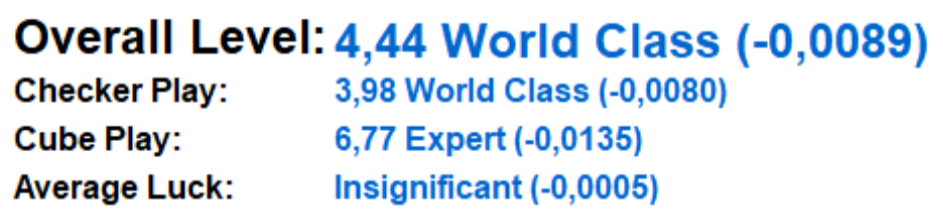
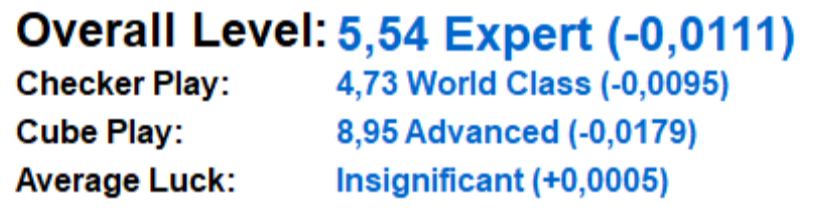
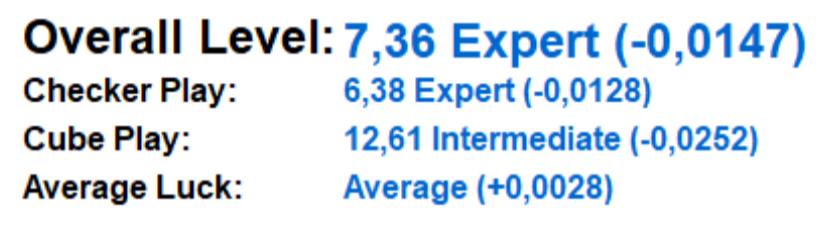
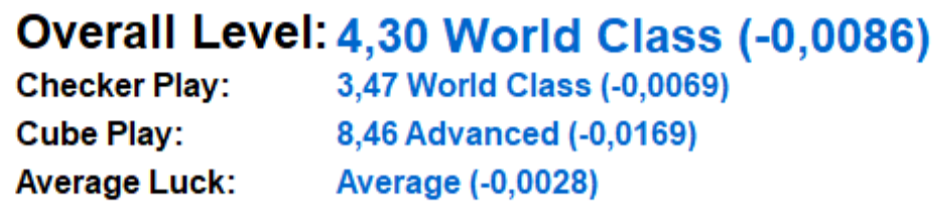
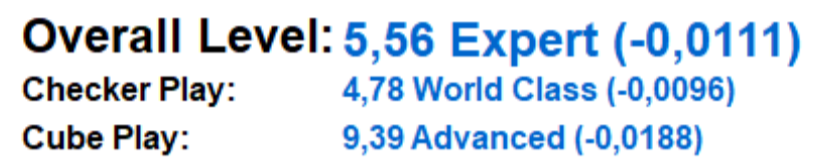
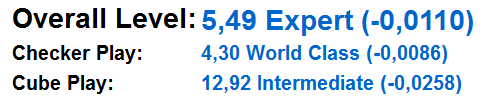
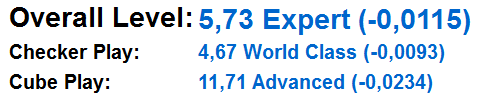
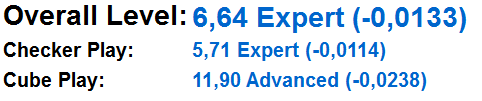
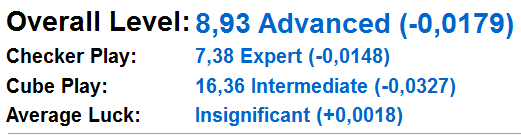
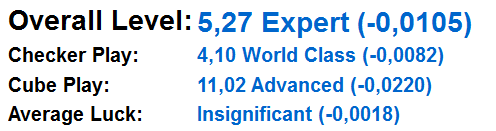
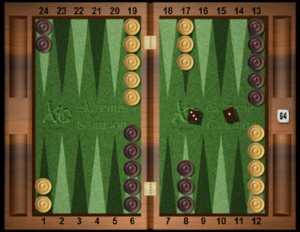
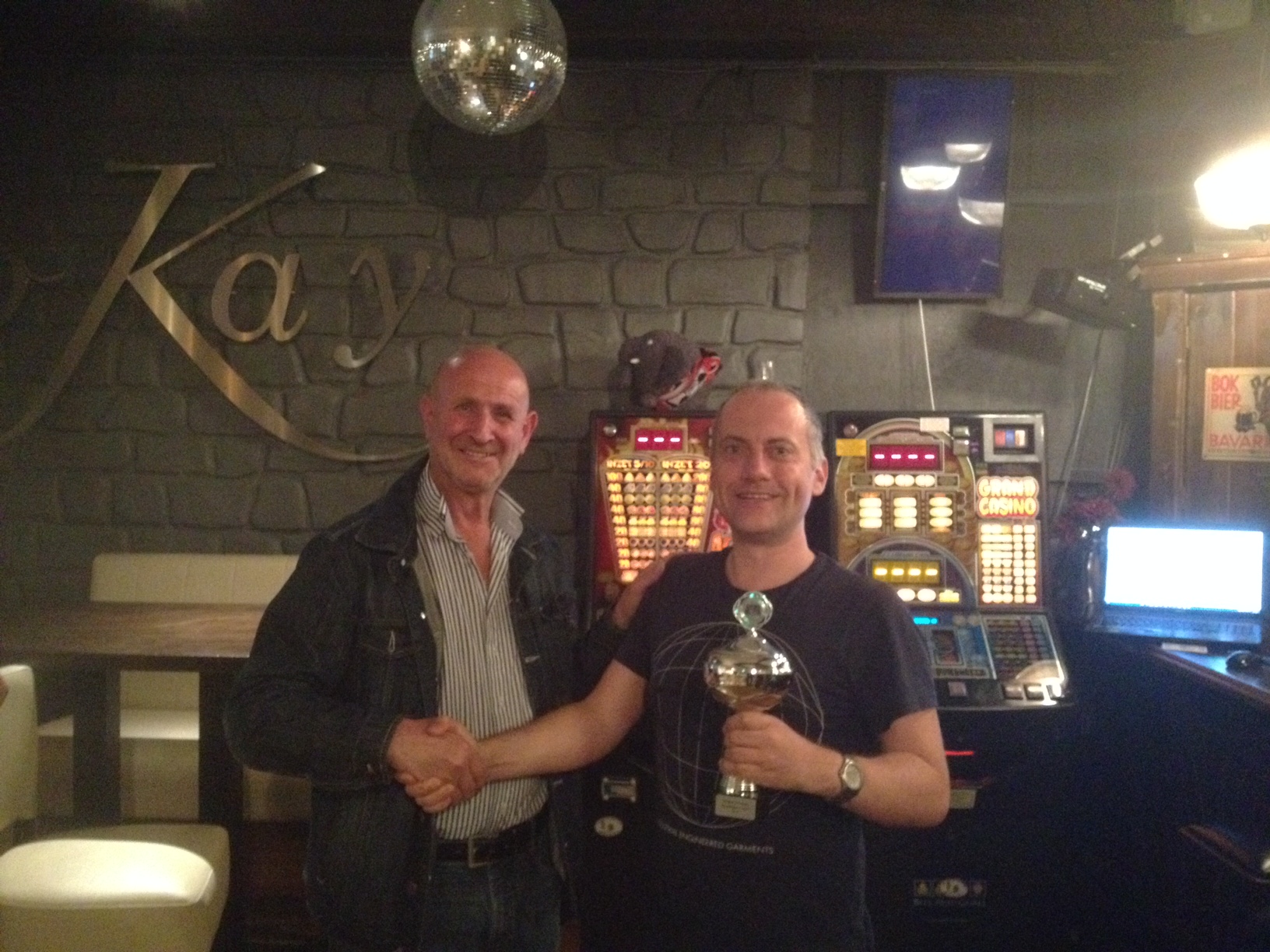
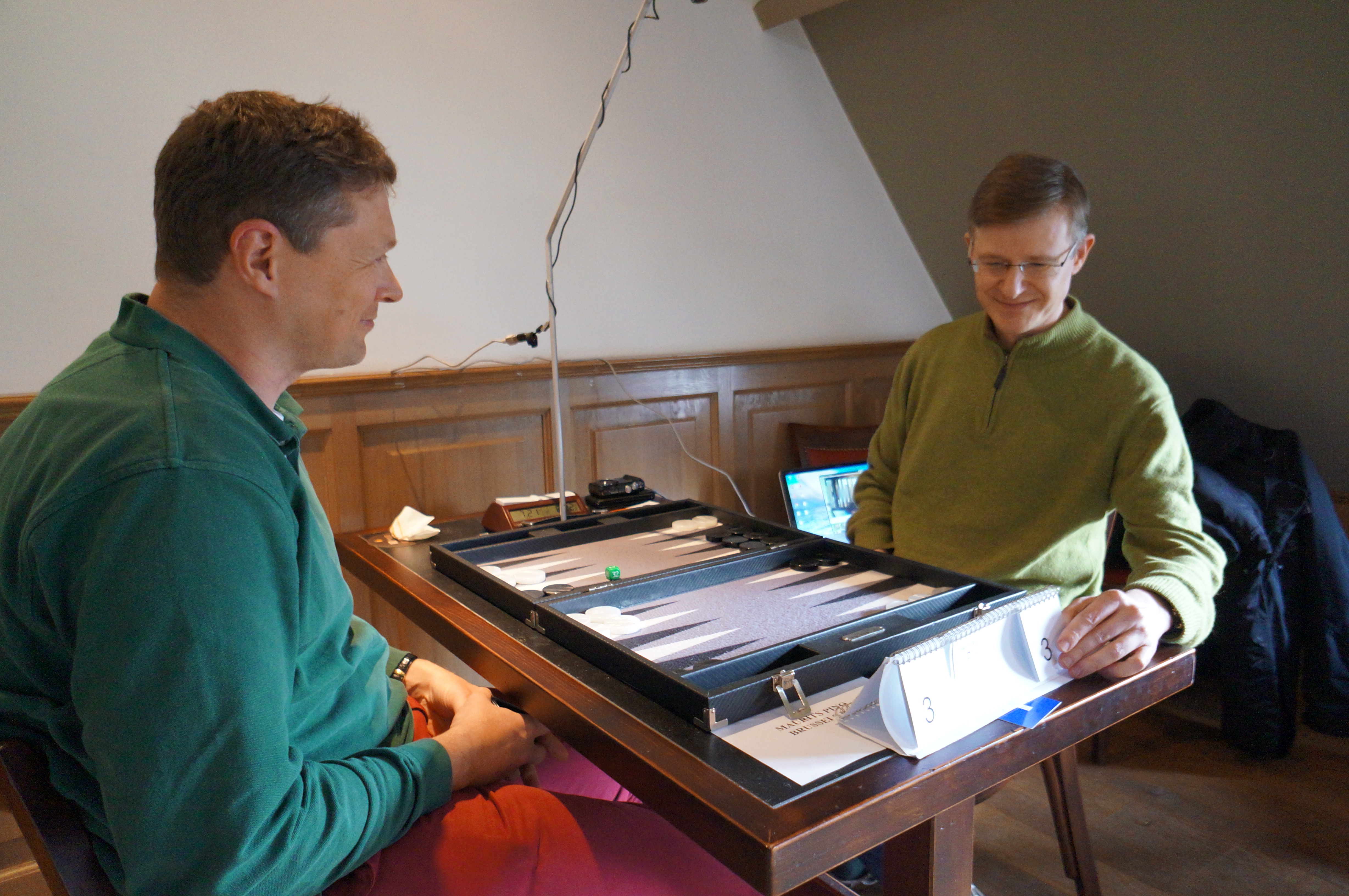
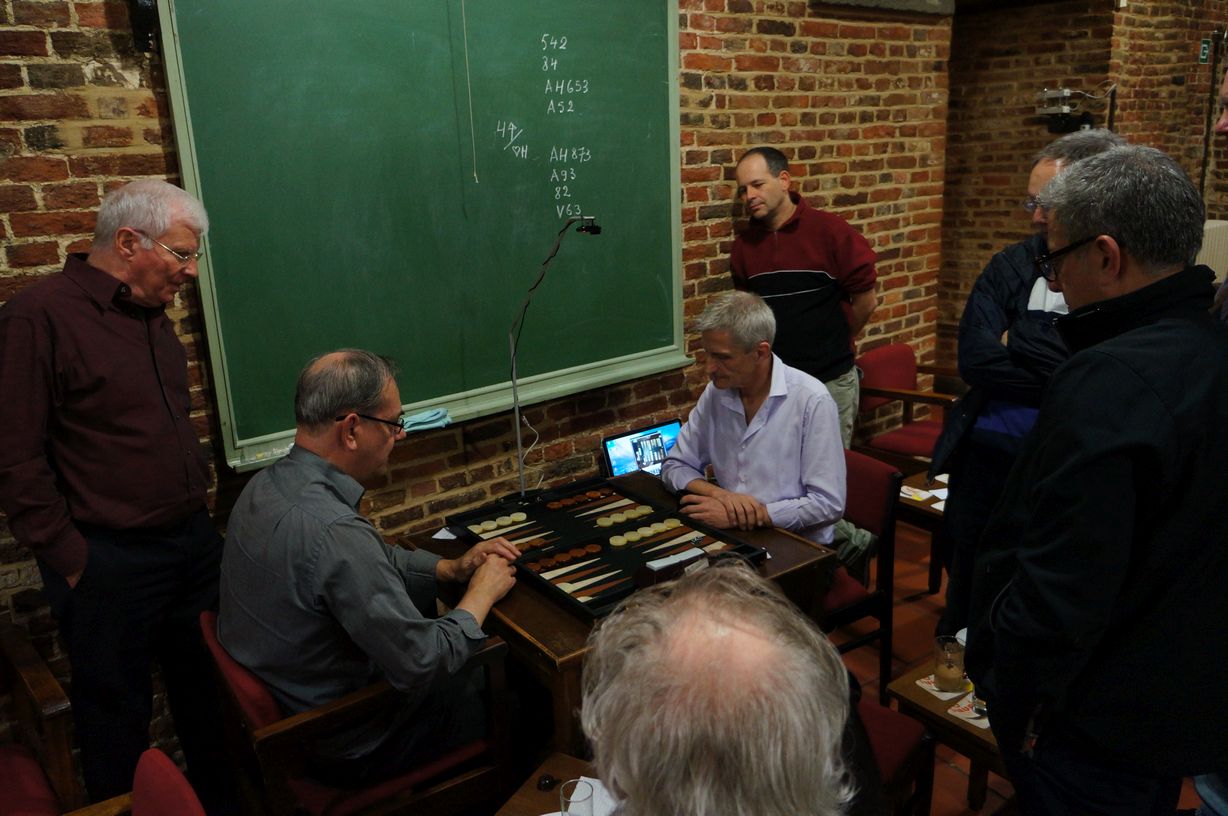
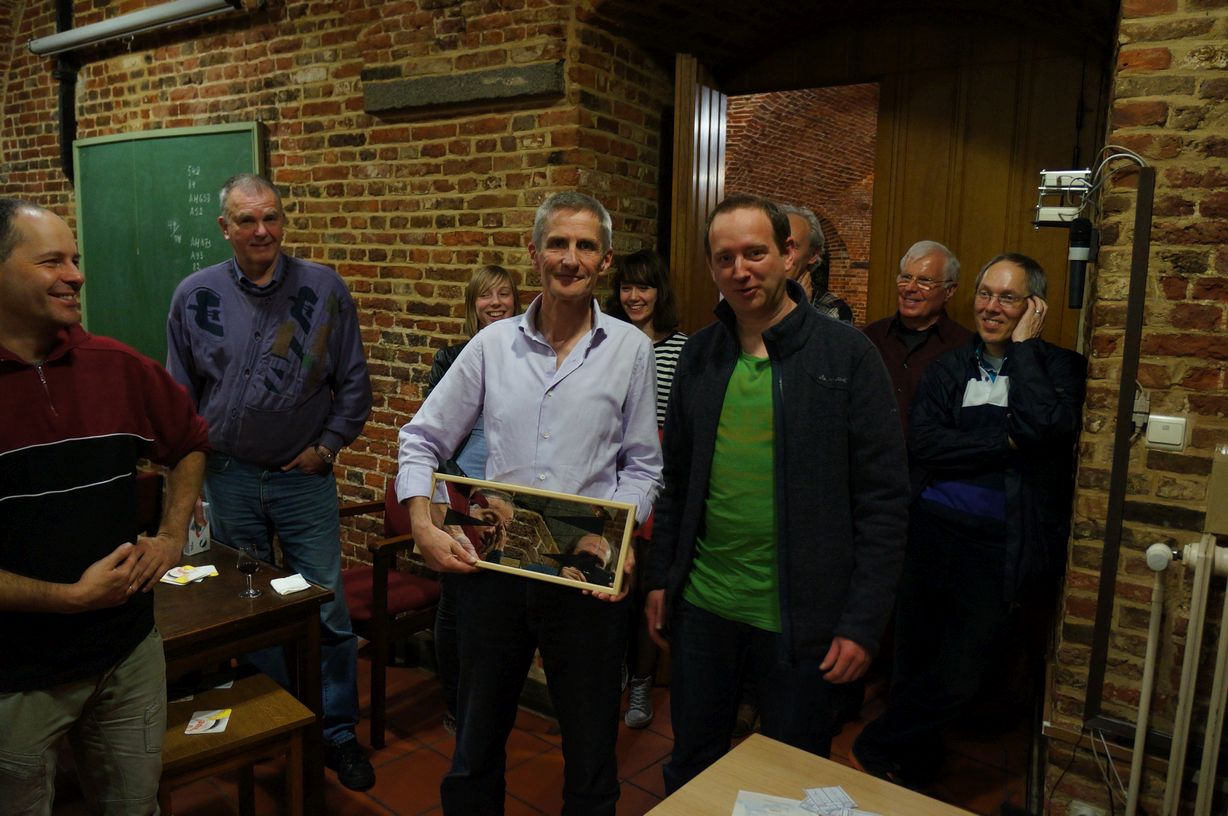
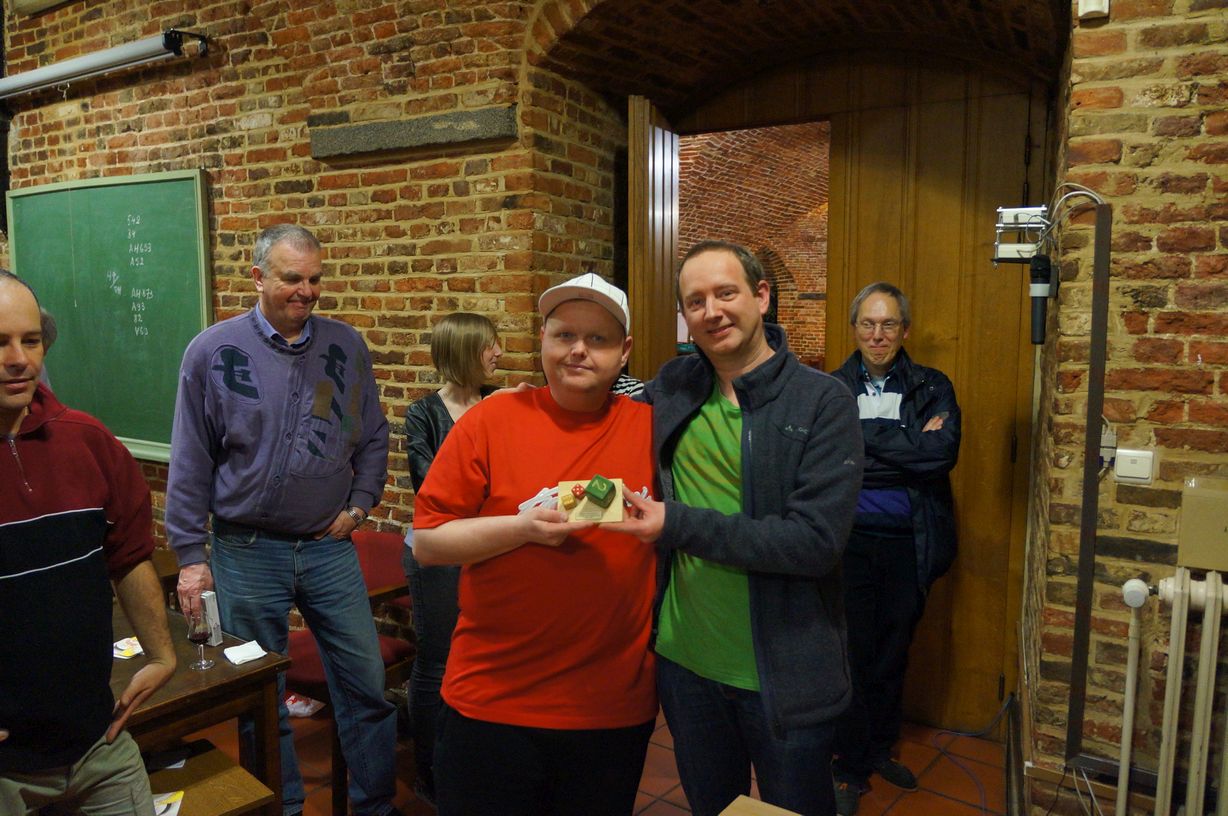
In a continued effort to improve their game, Geert Van der Stricht, Johan Huyck, Robin Bilderbeek and Michel Lamote played, recorded and transcribed ten 13-point matches. Over the past years it has become clear that PR’s achieved in Master Series of that length do not deviate much from the players’ actual playing strengths and thus provide a good indication of where they stand as far as intrinsic skill is concerned :
PR Geert (10*13). MS1 0064 is drawn 5-5.PR Johan (10*13). MS1 0064 is drawn 5-5.PR Robin (10*13). MS1 0062 is drawn 5-5.PR Michel (10*13). MS1 0062 is drawn 5-5.
Encourageing PR’s by all four players. Geert (3), Johan (4) and Michel (2) solidify their BMS ranking, while Robin (9) is edging closer to below-7 status.
In an effort to make progress on the BMS Grading Table, Johan Huyck and Geert Vander Stricht played, recorded and transcribed six 17-point matches. These matches were played on Tuesday afternoons at the Sandeman Club in Gent.
Here is how they did :
PR Geert (loses MS1 0037 by 1-5)
This is a bit of set-back for Geert, who seems to be moving away from the 5 PR threshold, instead of towards it. As a Backgammon Master (Class 2), Geert is expected to score PR’s between 5,50 and 4,75, so in this series of long matches, Geert played slightly below his acknowledged skill level. His current PR over the last 500 Experience Points (EP) is 5,45, eerily close to the cursed 5,50 PR boundary.
Moreover, Geert’s number 3 status may be in jeopardy as Walter Meuwis (4) is only 0,13 PR behind (5,58) and Johan Huyck (5) is also edging closer (5,87). Johan seems to have missed an opportunity to catch up as he could not find a below-6 PR in this MS :
PR Johan (wins MS1 0037 by 5-1)
Find the current standings of Belgium’s Best and all their match PR’s by clicking on BMS(BE)/Backgammon Master Series in the black banner above.
The upcoming quarter finals of the Belgian Individual Championship (BIC) provide another opportunity for our top players to display their skills. Here is the draw :
Walter Meuwis (4) versus Metin Ates (unranked)
Johan Segers (7) v Geert Van der Stricht (3)
Paulus Van Rooijen (8) v Guy Van Middelem (12)/Maurits Pino (14)
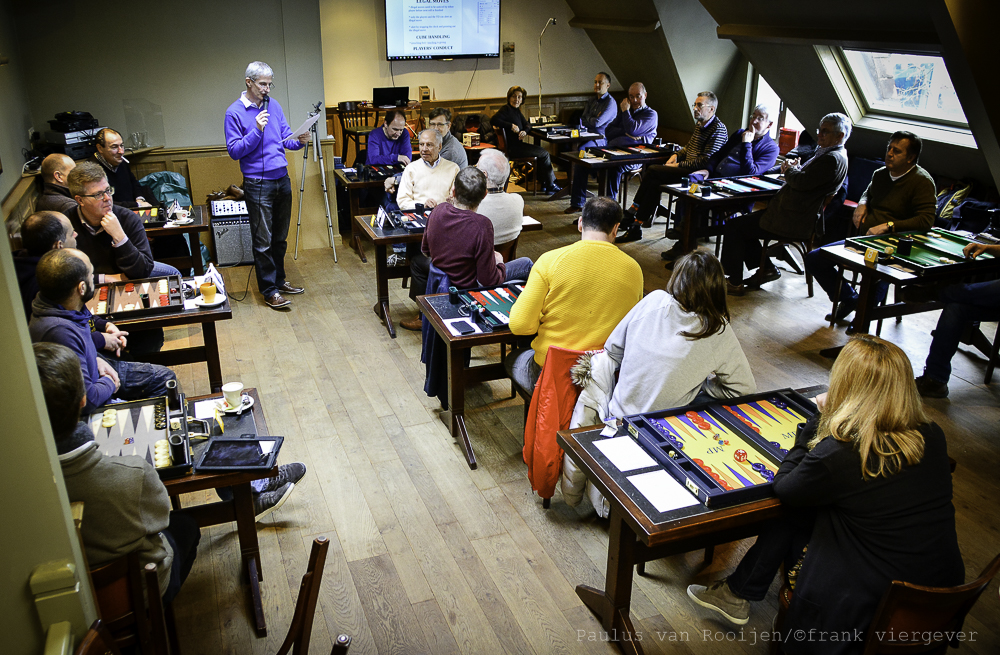
The 2nd Brugge Backgammon Day opened innocently enough with an introduction of all players (click on photos to enlarge) :
Player presentation at BBD2.
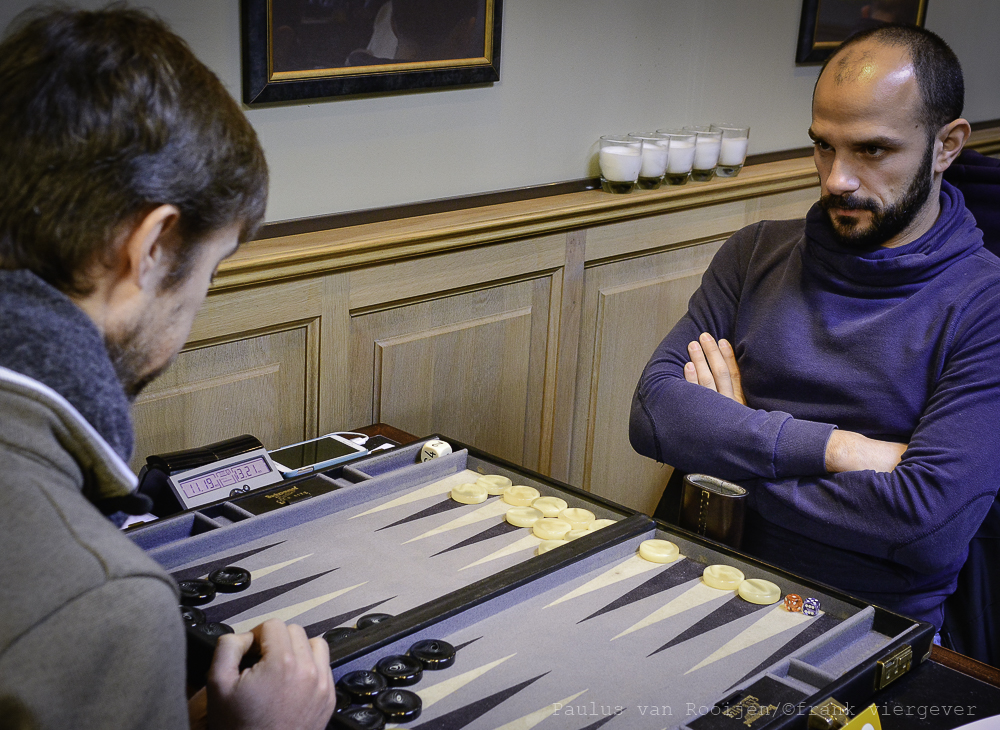
In the first round, defending champion Johan Segers’ streak of 5 consecutive wins ended at the hands of Leonidas, ranked n° 4 on the BGFed Rating list :
Leonidas, staring down Johan (l) (photo : Paulus van Rooijen / frank viergever)
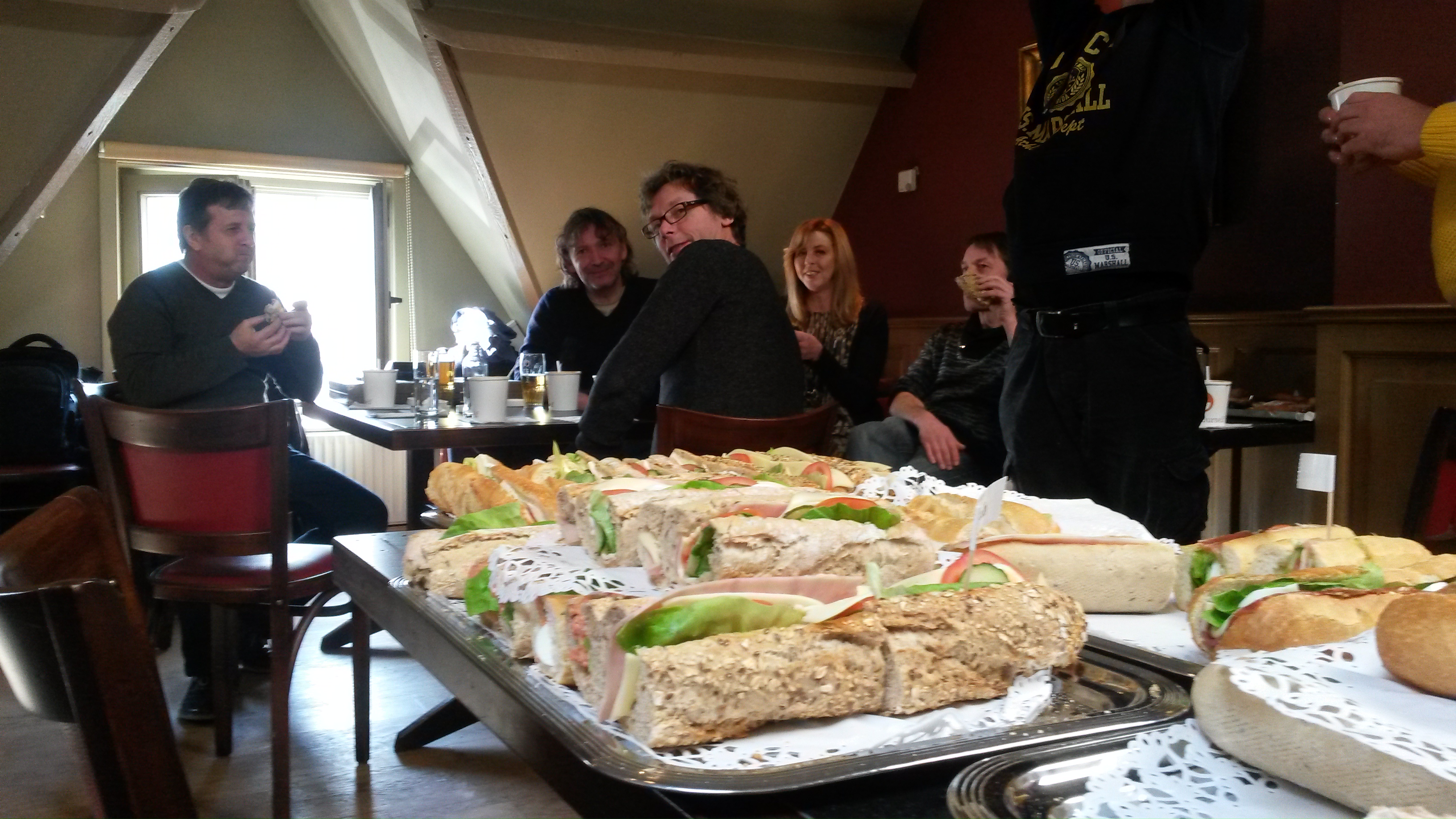
After 2 rounds, players took a break for lunch :
(l to r) Dan, Nigel, Eddy, Isabelle and Ronny (photo : Robin)
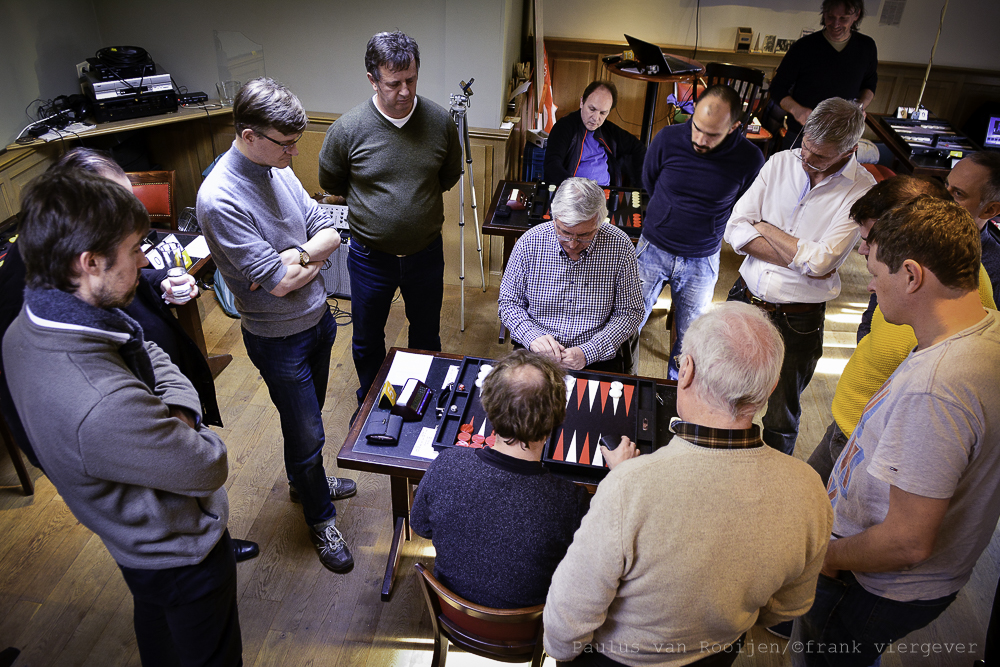
The 3rd round match between Alain Chif and Eddy Cabooter was a close affair. The exciting climax was watched by 10 kibitzers (!) : (left to right : Johan, Sassan, Zsolt, Dan, Leonidas, Michel, Geert, Kristoffer, Maurits and Marc)
Watching Eddy and Alain battling it out (photo Paulus van Rooijen / frank viergever)
The 4th round saw some players shifting their focus to more rewarding matters :
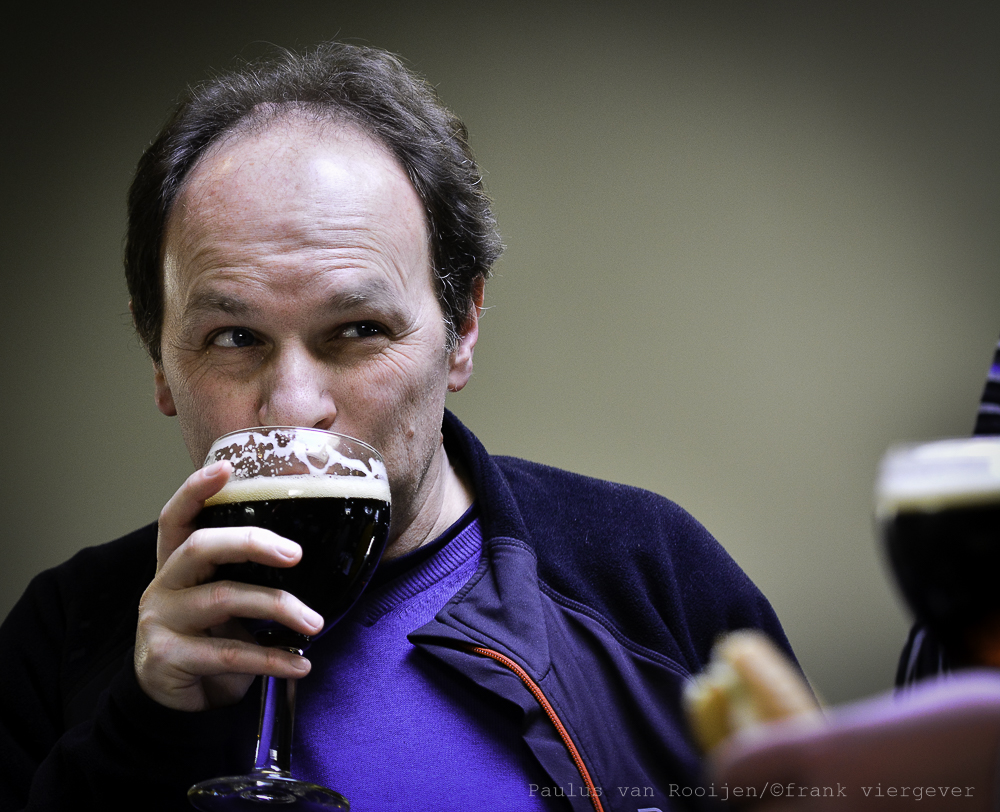
We can recognize Luc behind a dark Leffe… (photo : Paulus vanRooijen / frank viergever)
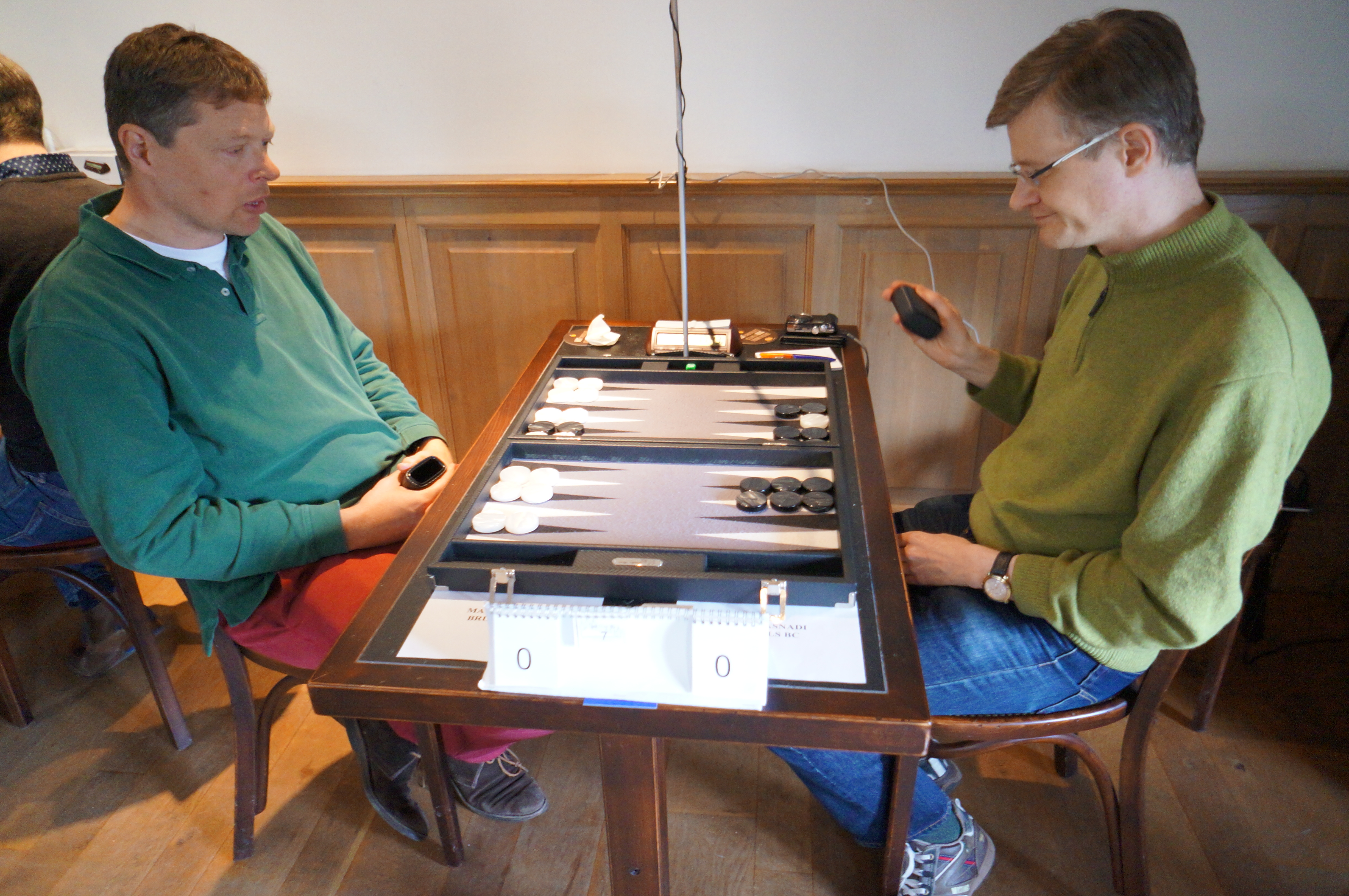
After 4 rounds of play, two players were still unbeaten : Geert and Johan Huyck, both professional mathematicians :
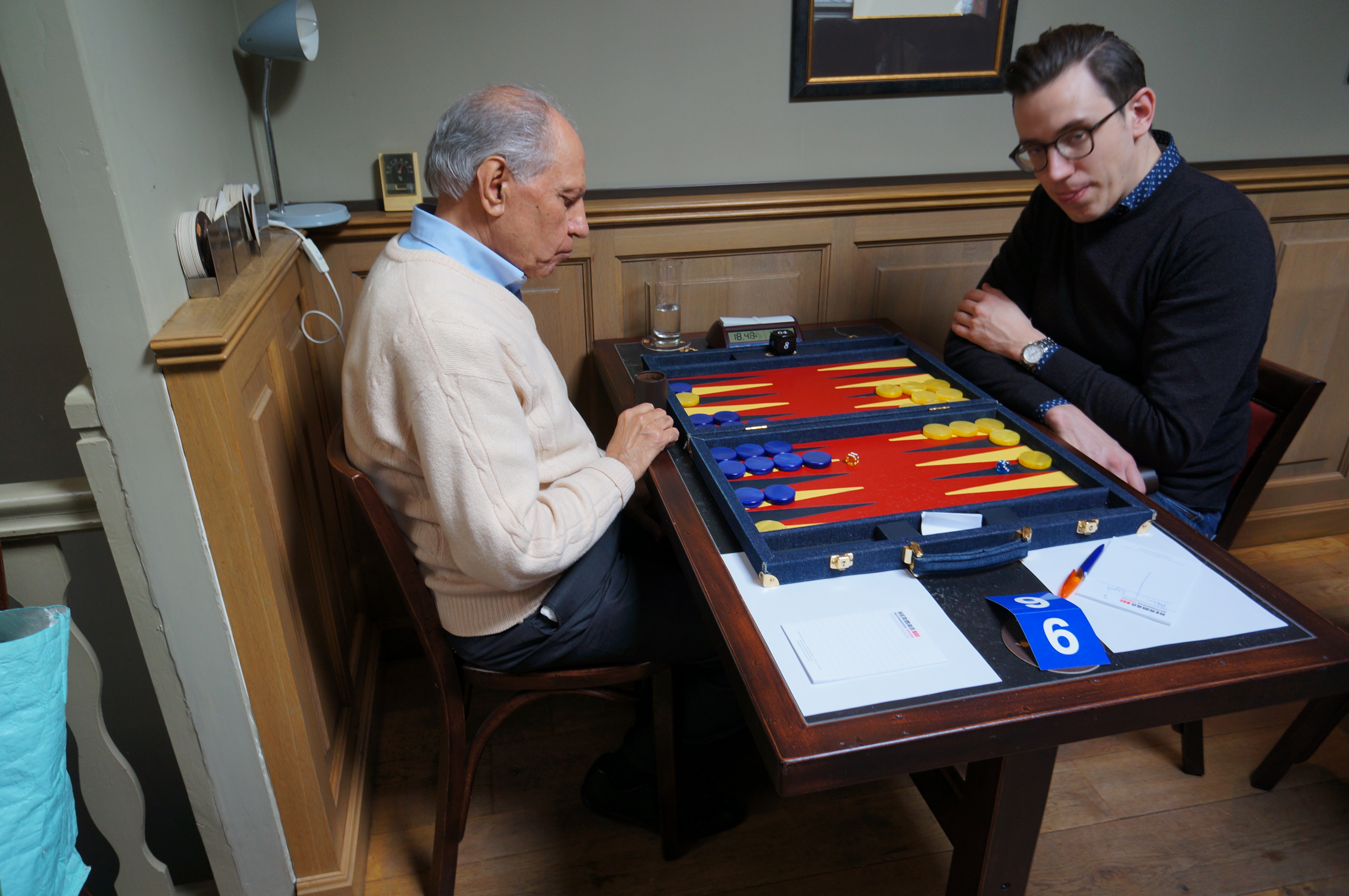
Johan (l) en Geert (r) in the final (foto : Robin)
The thrilling final went all the way to DMP in which Geert was able to bust Johan’s well-timed 5-1 backgame after surviving a double shot while bearing in. Congratulations to a deserving winner!
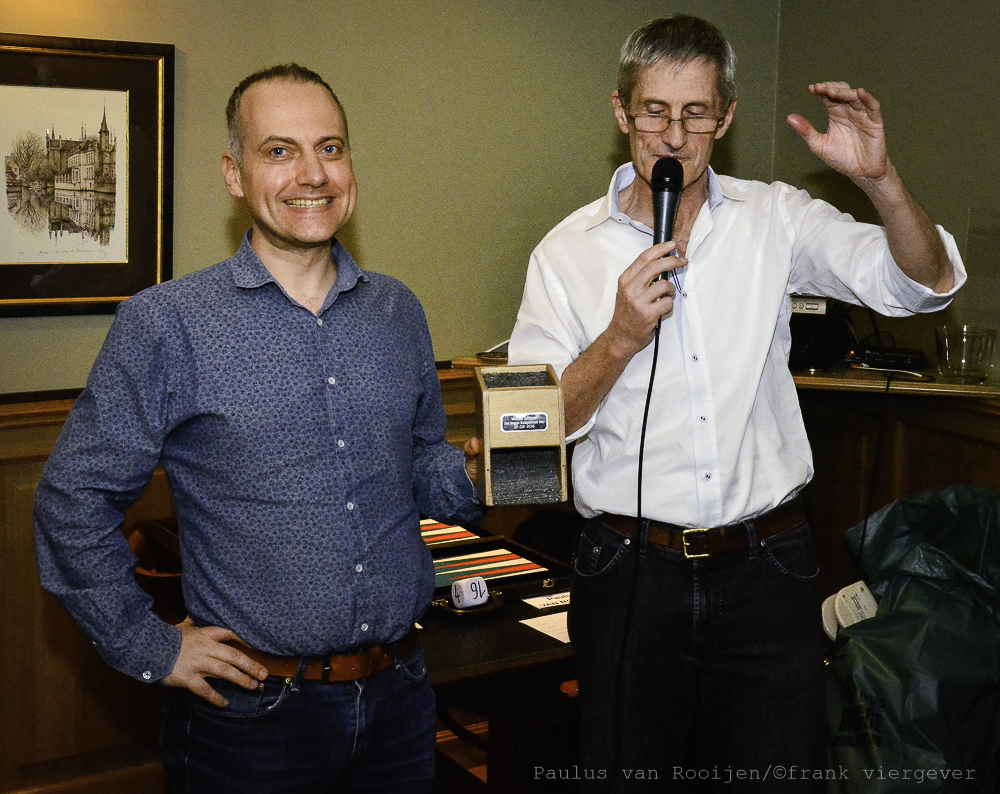
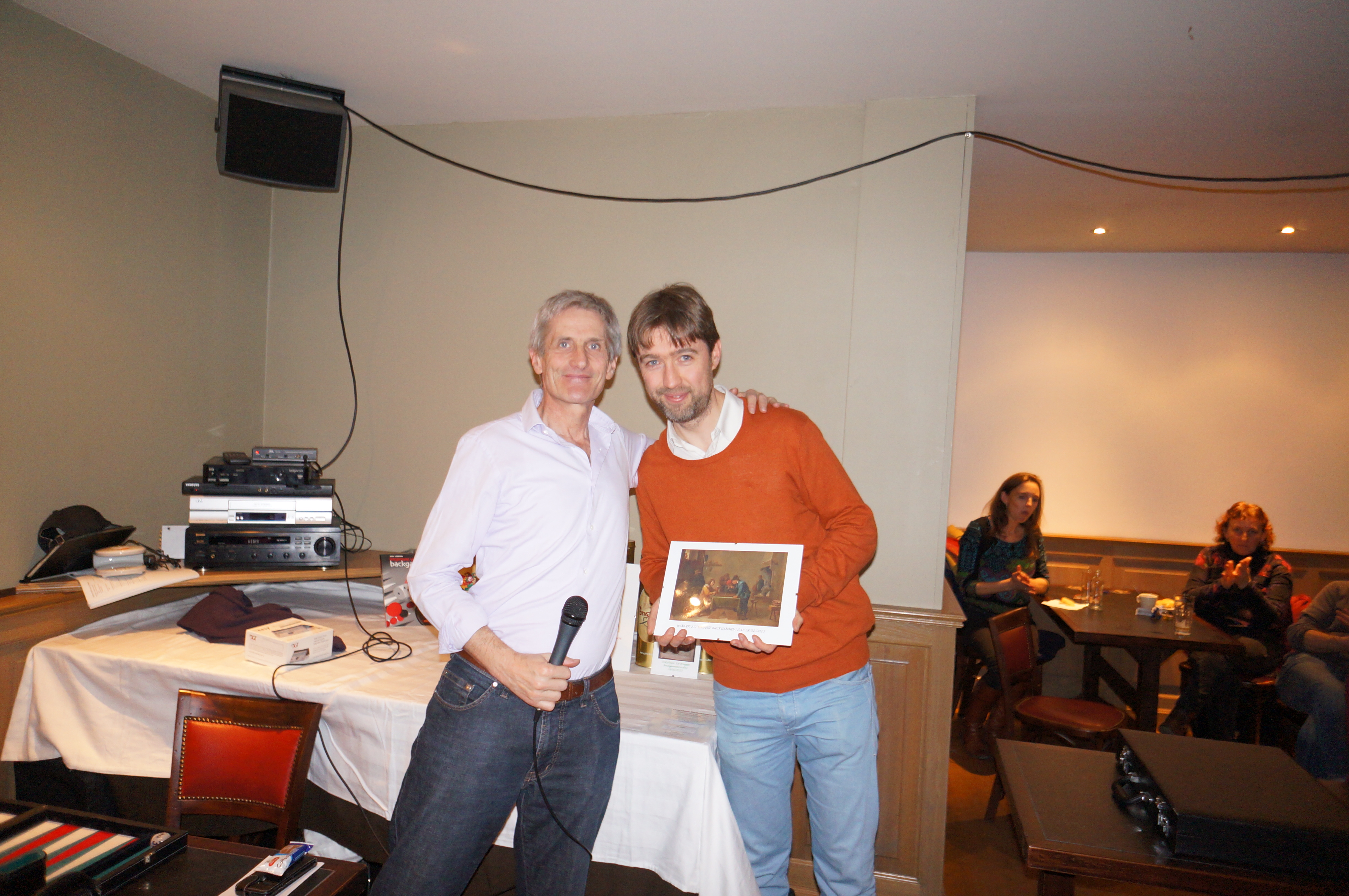
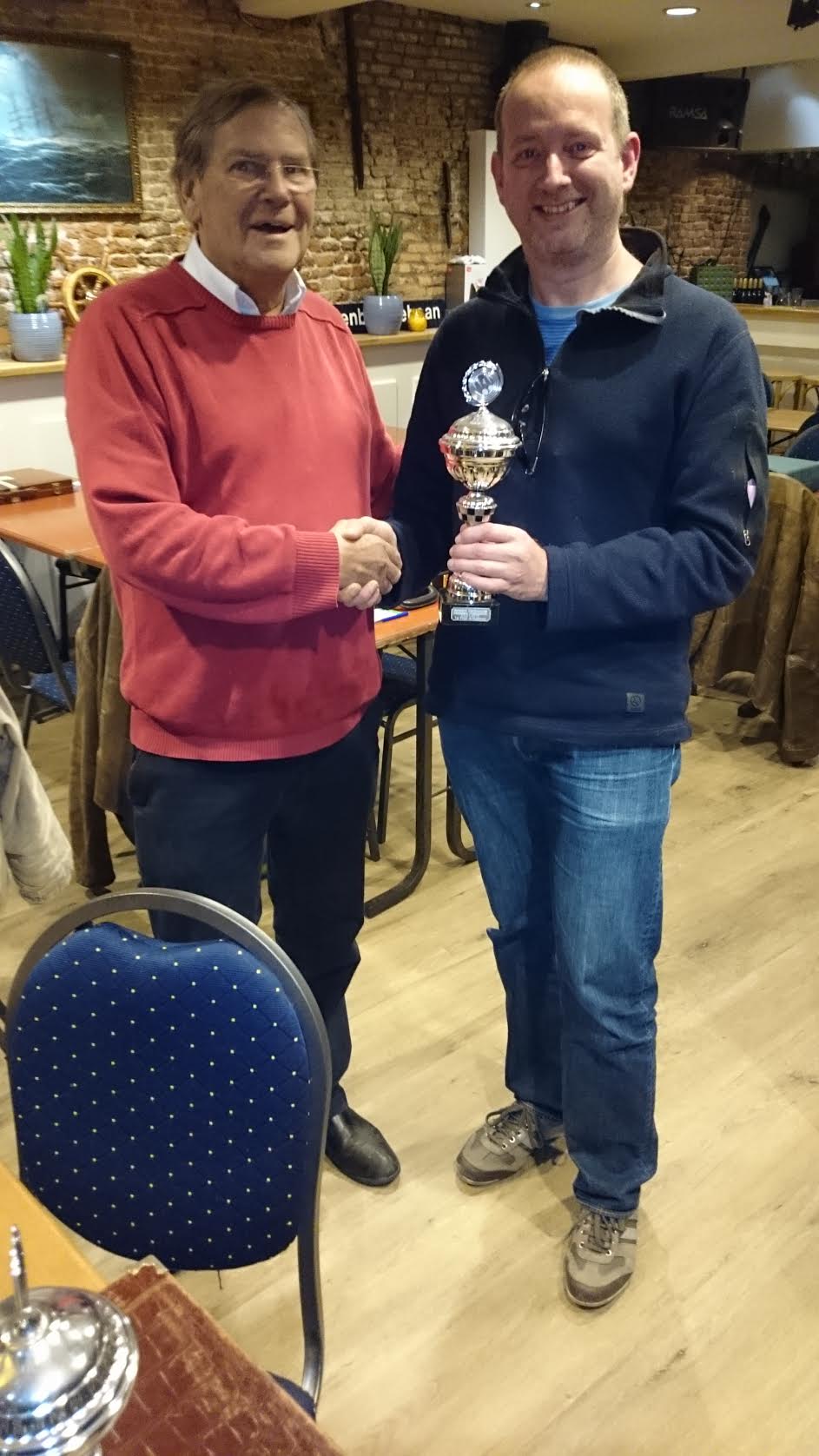
Geert left) proudly poses with BBD2 trophy.
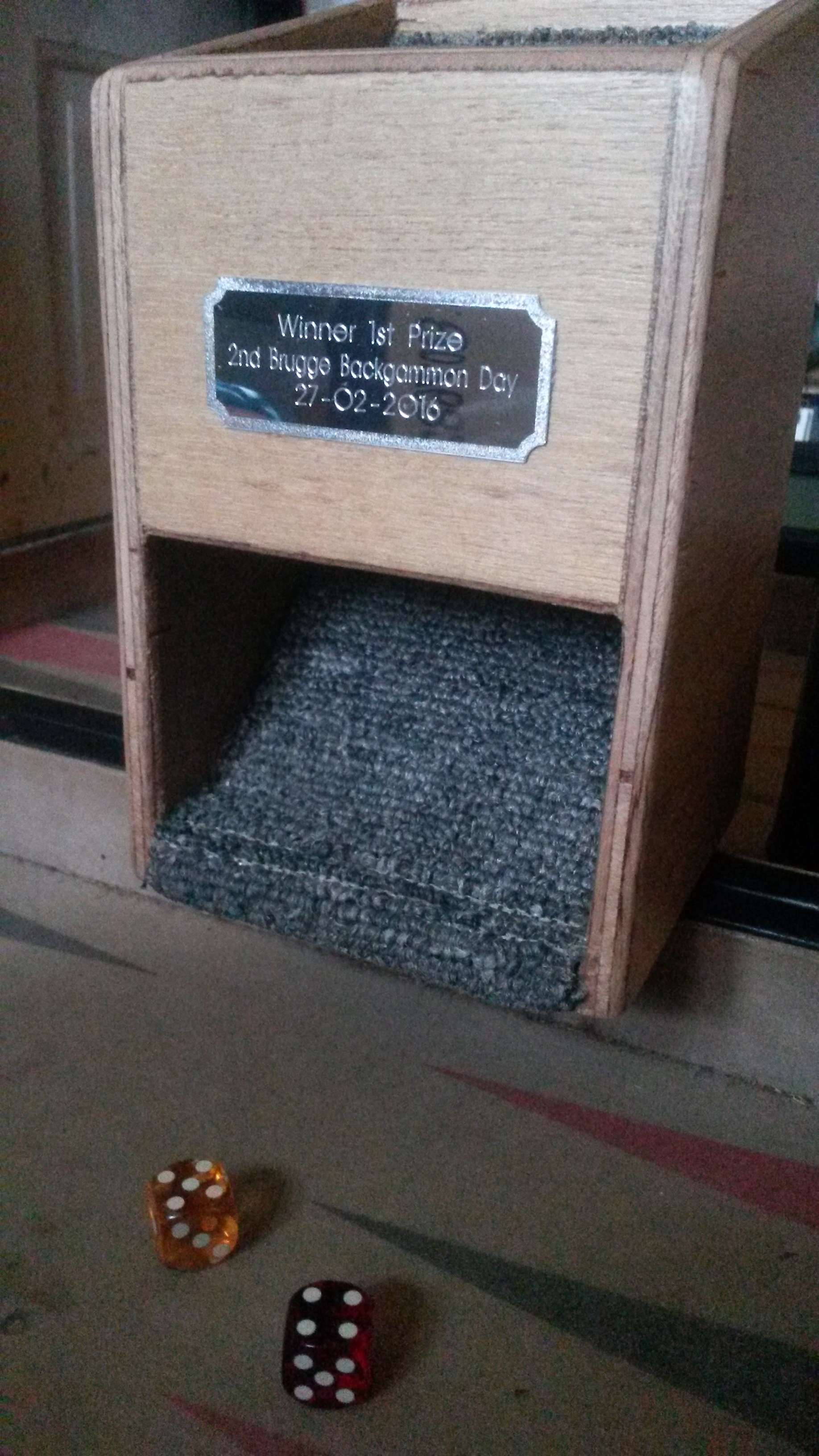
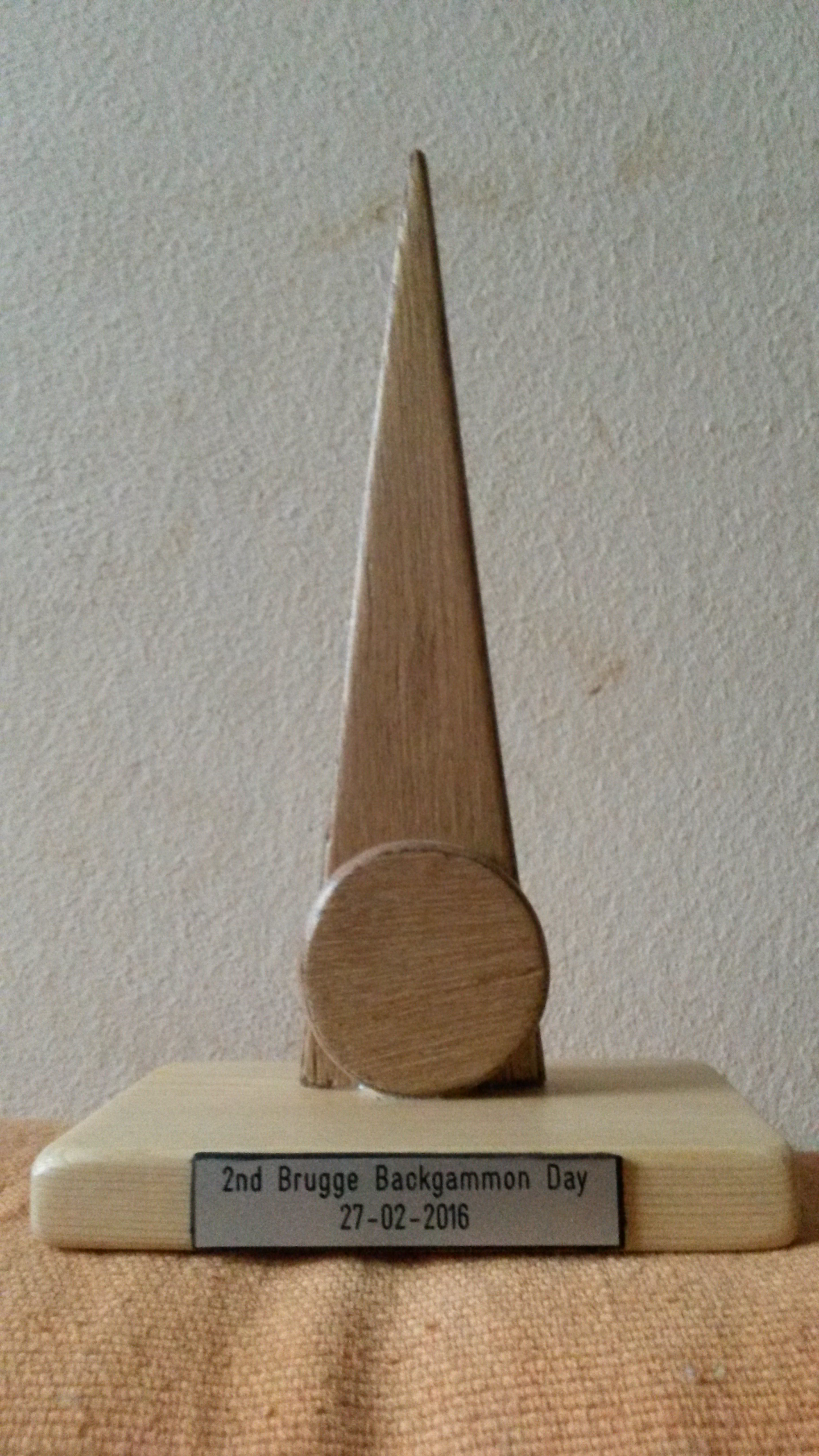
The trophy : a handmade, wooden baffle-box (created by : Robin Bilderbeek).
Since the match was recorded, we know that Geert and Johan both put down a worthy performance :
(Geert plays 3,53. Johan plays 2,87)
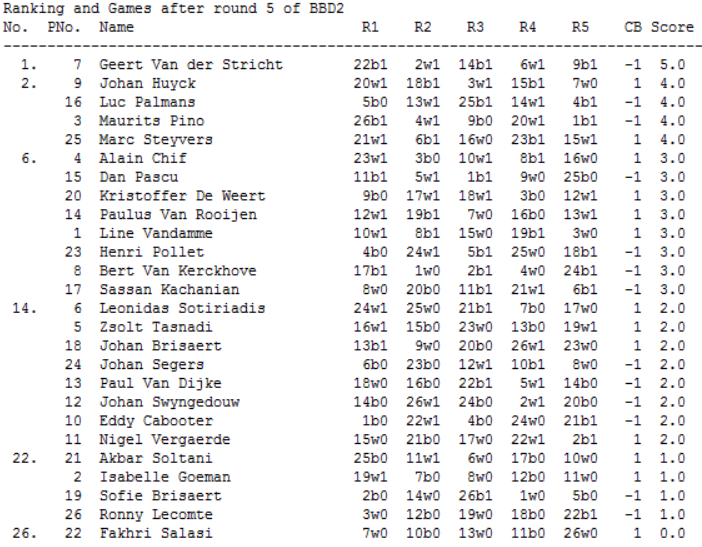
Johan ended up sharing 2nd place with Maurits Pino, Luc Palmans and Marc Steyvers.
Here is the final ranking :
Sofie Brisaert received a BBD2 memento as youngest participant :
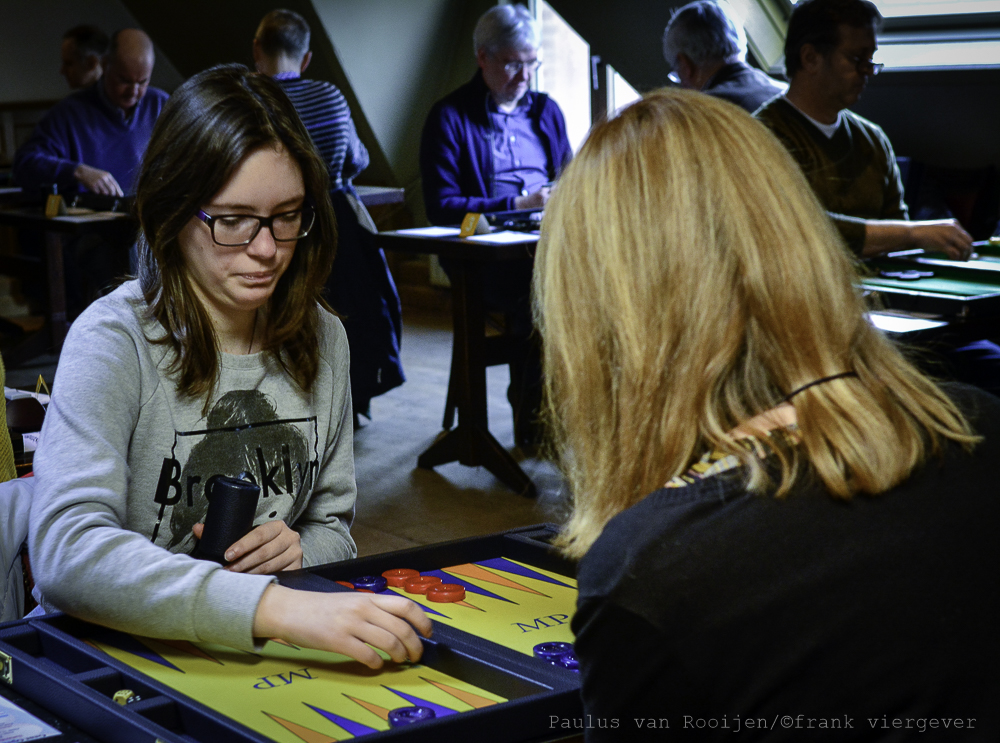
Sofie (l) playing Isabelle (r) on Maurits’s flashy new board.Sofie’s prize (created by : Robin Bilderbeek)
Hope to see you all at the 11th Gent Open on Saturday March 19.
If you want to compete at the highest level, it is absolutely necessary to familiarize yourself with the dynamics of long matches. Certain cube decisions can be pretty plain at a normal score, but can become quite sophisticated at scores like 12-away 5-away. A player with no schooling in long matches will be like a 17th-century mariner on a nocturnal ocean without a compass. Of course, if the skies are clear, he can navigate by the stars, but what if it’s cloudy? Experience with long matches is the compass without which you will be – and I weigh my words – completely helpless when faced with (re-)cube-decisions in, say, a 15-point match.
To become more acquainted with this subject matter, Geert and I have played another set of ten 15-point matches. Here is how we did :
Geert’s performance over ten 15-pointers (loses 3-7).Michel’s performance over ten 15-pointers (wins 7-3).
Once again we see that playing the checkers is not the issue. Checker-plays do not differ much depending on score. You can practise that aspect of the game as well in a 3-point match as in a 15-point match. The cube is a different story, however. Both Geert and I made some skilled cube decisions in our ten matches, but also messed it up way too often. Since cube blunders tend to be costly as far as equity goes, this has an extremely detrimental effect on our respective PRs.
En forgeant on devient forgeron, my father used to say. It is now up to Geert and myself to review the matches we played, study our errors and blunders and hopefully gain some insight from that.
You can see these performances reflected on the BMS Grading Table. Just click on BMS(BE) in the black banner above.
thank you all for joining BBD2. We are looking forward to a fun day of competitve backgammon. Here are some practicalities :
1. Schedule.
9 – 10 : arrival : you will be welcomed by Line/Isabelle, who will give you 2 drankbonnen. Upstairs in the playing room are 2 boterkoeken per person.
10 – 10.15 : seating at designated tables.
10.15 – 10.40 : player presentation.
10.45 : round 1. Clocks are started.
18.45 : prize giving.
Please, be on time. All matches start at the set times.
2. Boards.
Do not bring your own board to the venue. You will not be able to use it.
3. Getting there.
Venue : De Hollandse Vismijn, Vismarkt, Brugge.
Coming by train is very convenient. Buses will take you from the train station to the Vismarkt every 5 minutes. You can also walk : from the station it takes about 20 minutes.
If you come by car, be aware that Saturday is market day in Brugge and that public parkings fill up quickly. Allow for at least 45 minutes to get from the E40 (exit Oostkamp) to the venue. Your best bet is Parking Pandreitje (8,70€/day). From there it is a 5 minute walk to the Hollandse Vismijn. Cheaper is the parking at the train station : 3,50€/day.
4. BPR.
Players who will submit their matches as BPR clusters, need to announce their intention to do so beforehand. To facilitate match filming, they will be given a fixed playing table where they can play all their matches. They are urged to show up well before start of the tournament, so there is plenty of time to set up the recording equipment.
5. Draw.
The draw will be done on Wednesday 24 February, at 18.00. It will be posted on this website later that evening, together with the designated table seating.
To kick off the 2016 Four Cubes competition, Brussels sent its elite troups to Gent. Alain Chif (c), Maurits Pino and Zsolt Tasnadi arrived well on time to face the ambitious Ghent team : Geert Van der Stricht (c), Bert Van Kerckhove and Johan Huyck.
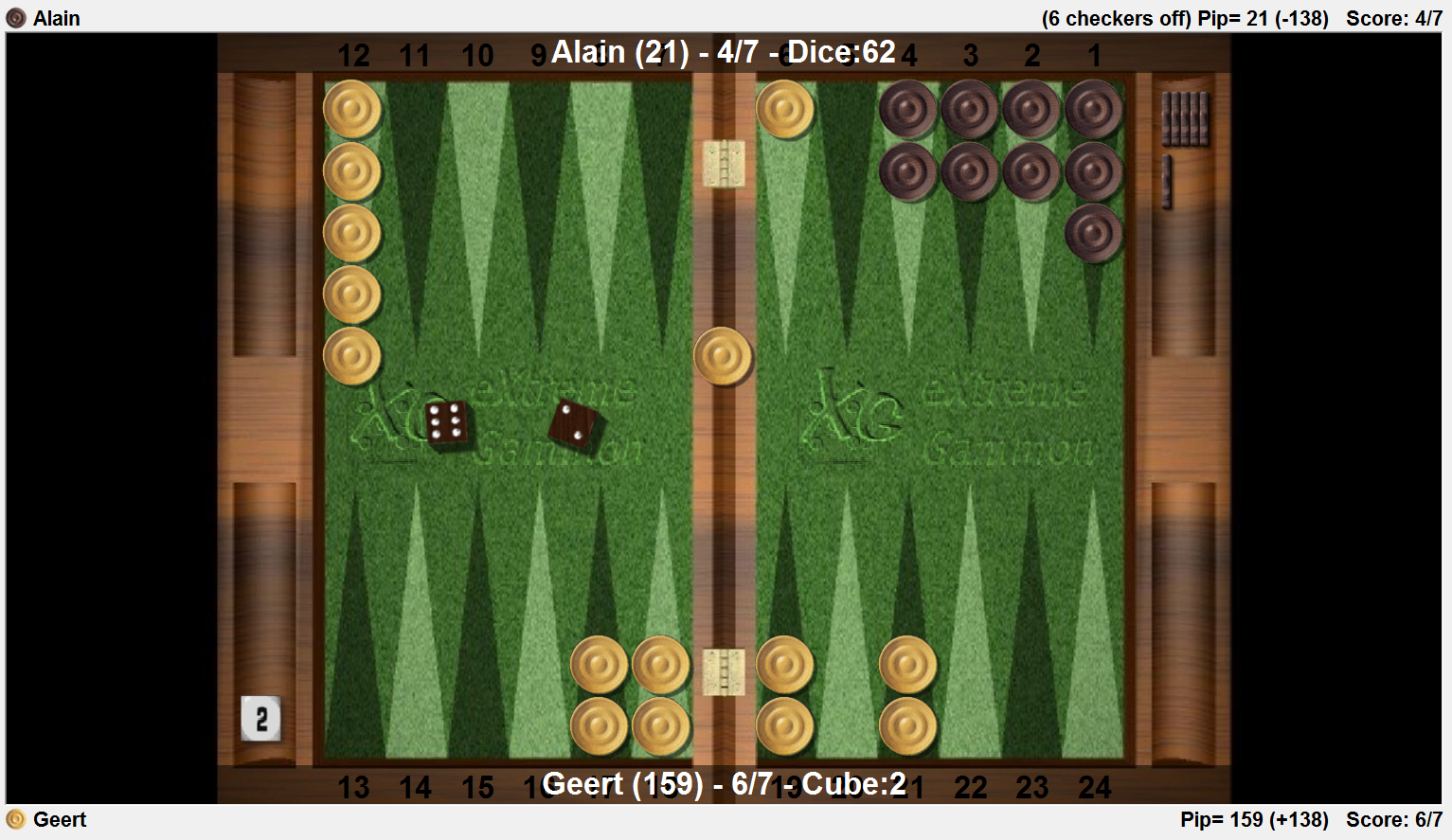
After 2 rounds of play, the score was tied : 3-3. Then Maurits beat Johan and Bert beat Zsolt : 4-4. All eyes now turned to the feature table, where the two captains had to fight it out. It had all looked very promising for Ghent when Geert took a 6-3 lead. Alain, however, was able to win the Crawford game and with the cube turned in the post-Crawford game, it looked as if it was all over :
What can possibly go wrong here? Have a look at the numbers :
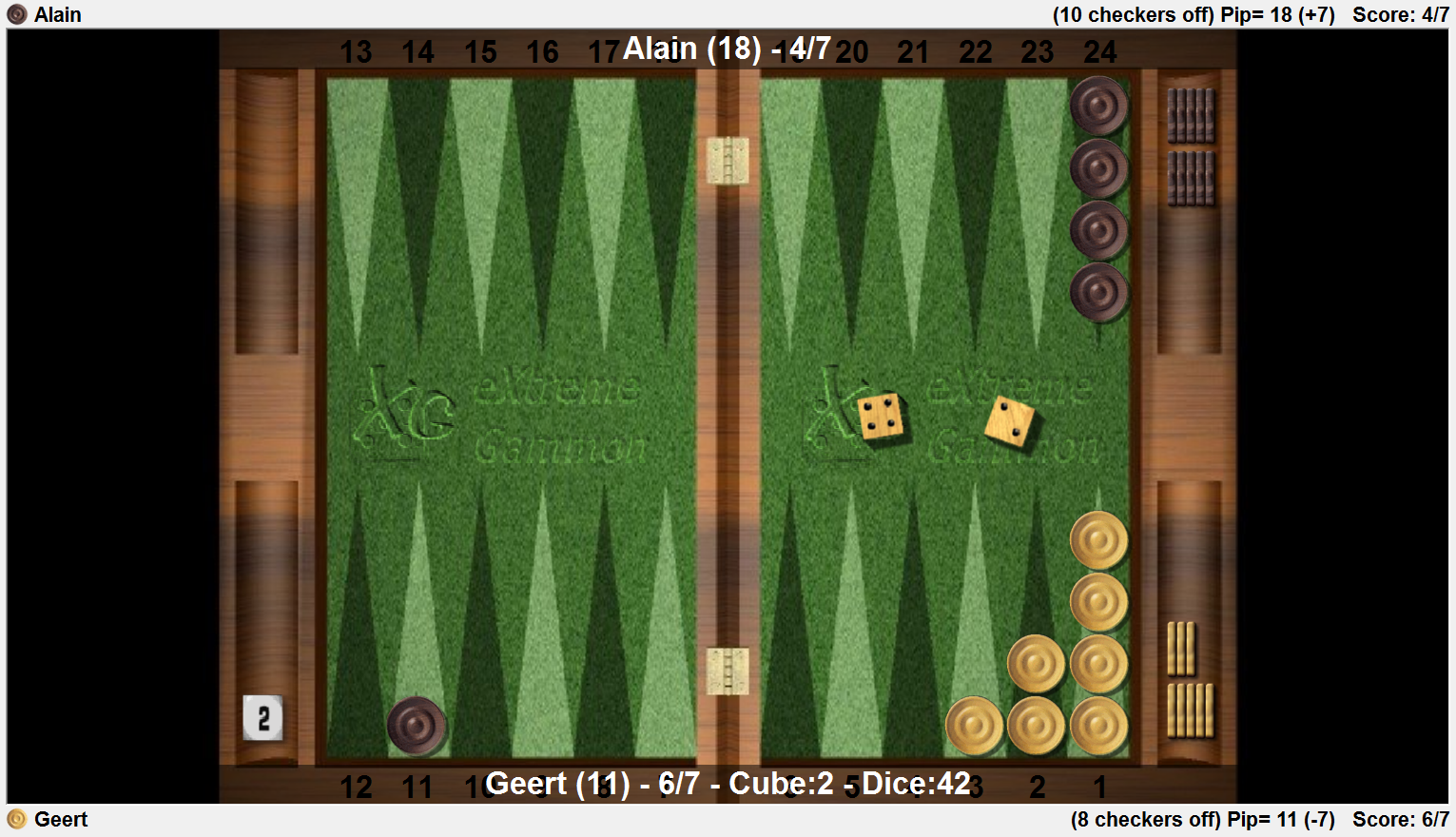
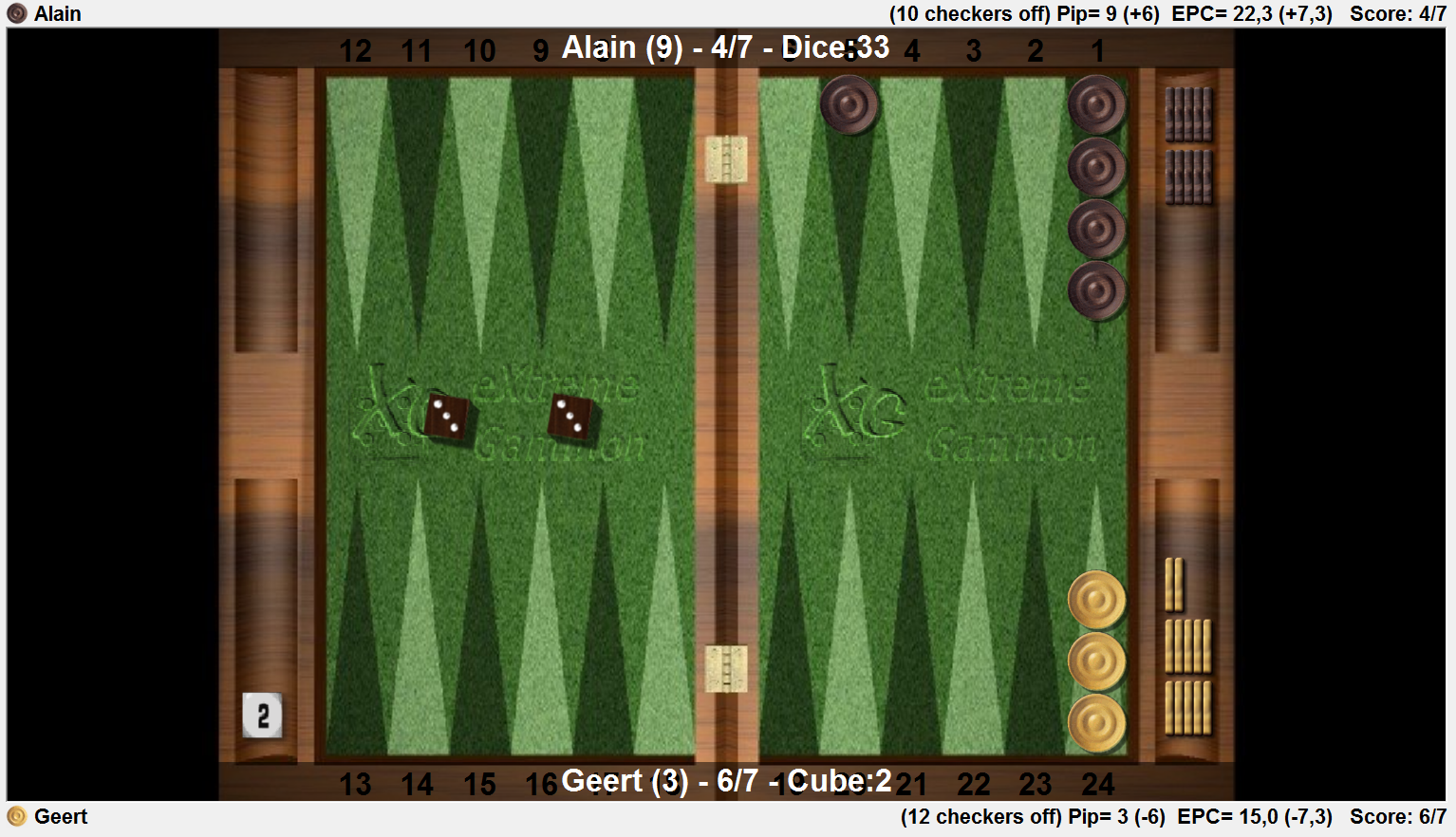
Alain will only lose this game 2 times in 1000 and will win a gammon (and the complete Four Cubes encounter for his team) 989 times in a 1000. Many people would feel comfortable with these numbers on their side. Not Alain though. He had had a bad premonition in the morning, and this had been confirmed in his earlier matches against Bert and Johan, where almost-sure wins went awry. If Geert comes in, the victory is assured, but … Geert rolls 32 and stays on the bar. Alain then rolled 62, clearing the 3-point. For Geert to dance, he would now have to roll 11,22 or 21. He rolls 11. Ok, this sequence is nasty (the chance is about 1 in 40), but that happens in backgammon. Now, however, with 3 men on the 2-point, Alain finds his 3rd consecutive 62, leaving a blot on the deuce… which Geert hits with a 32. Gasps all around. Alain is thrown back to enemy territory and has to try and scramble his way home through a mine-field. He tries, but is hit several times and ends up being closed out. Ok, the gammon is gone, but with 10 men off, Alain is still favourite to win the game (67%). But Alain dances a couple of times and is suddenly a huge underdog. Geert has about 81% chance here to win the encounter for Ghent :
For those of you who do not know what a swing is, well, this is one. Alain went from 99,8% favourite to 19% underdog. I am sure he experienced a sense of doom here, but, to his credit, he did not betray it. At least not in histrionic fashion. Experienced backgammon players know these things can and will happen and they can keep their composure. And, lo and behold, see what happens next :
In his time of deepest despair, Alain is blessed with this affectionate caress by Lady Fortune. It came so unexpected that Alain could hardly believe he could take 3 checkers off. He did though, meticulously, and so was catapulted back from 23% to 83%! Geert needed a double to win, but could not produce it and so the score was 6-6.
It is hard to describe the nerve-shredding effect these swings can have on a player’s psyche. We should not forget that Geert too had to undergo a horrific swing : he went from giant underdog (0,2%) to big favourite, only to see victory slip away. Both captains kept their cool in exemplary fashion here.
Of course, everything remained to be played for in the DMP-game. An unfortunate dance by Geert on a two-point board allowed Alain to convert a pretty hopeless blitz-attempt into a winning game-plan and so gain a precious victory for Brussels. A decisive battle or a skirmish? Only the future will tell…
On 30 October 2015, in an office building in Brussels, Maurits and Zsolt played the first of a series of ten 9-point matches. They did so during the lunch break at their job, in a cramped room where cleaning products, plastic buckets and dust brooms are stored. Hardly a worthy sporting arena, but adequate enough to play backgammon. In their eagerness to learn and improve, they recorded and transcribed the match and kept this up till they finished their Master Series (10 x 9) early February 2016.
Had they played for money, Zsolt would have made a nice profit, comfortably winning the Series 7-3. In this quasi academic format, however, where no pecuniary gain can be expected, players need not worry about the caprice of Lady Fortune, but instead can invest all their attention and mental energy in finding the optimal play.
Both played at Advanced level. This, undeniably, is an achievement. It takes hundreds of hours of study and practice to achieve this. One can imagine though that they will both be slightly disappointed by these data. I imagine they would have secretly hoped for PRs in the range of 6,50-8,00. The playing conditions can certainly count as extenuating factor. It is hard to focus on the game if you have just stepped away from your desk and know that you will be heading back to your paperwork once the match is finished. Still, I would evaluate this performance as below par for players of their level.
As always, the performance gap lies in the cube actions. Maurits did astonishingly well in this respect. A PR below 10 is almost unmatched in Belgium. It would be too rash to conclude that we have a cube magus in our midst, but the feat is definitely praiseworthy. Zsolt, on the other hand, seems to have suffered significantly from the strained playing conditions. I am in no position to speculate further on the cause of this débâcle, but I will certainly be excused for stating that Zsolt under-achieved here. The positive side-effect is that any improvement in that area will boost Zsolt’s overall PR enormously. His checker-play is close to Expert-level, so any normal cube performance should lift Zsolt’s game to the 6,50-8,00 Performance level.
Maurits (left) and Zsolt (right) on the 1st Brugge Backgammon Day.
By playing this Master Series, Maurits and Zsolt have gained a spot on the BMS Grading Table. Kudos to both players!
You can find the BMS GT by clicking on BMS(BE) in the black banner above and scrolling down to Backgammon Master Series.
In the course of a little under 3 months, Geert Van der Stricht and Johan Huyck played, recorded and transcribed ten 15-point matches. These long matches are notoriously difficult as cube decisions can become very counter-intuitive at lopsided scores. How did both players perform in this challenging format?
Well, honour where honour is due, let us start with Geert :
Geert dips below 6 on BMS Grading Table.
There can be no doubt that Geert is dexterous at checker-play : he played 8 matches at World Class level and the other 2 at Expert level. However, whereas checker plays seldom deviate according to score, the cube decisions will alter dramatically once there is a 3- to 4-point gap in the score. Mastering this aspect of the game requires in-depth knowledge of match equity tables, doubling-windows, gammon values, market-loss theory, and more of that fun stuff. Here, Geert has work to do : in only 1 match was his cube play better than Advanced level. Still, an admirable performance by one of Belgium’s best.
Johan is not known to many. He studied and played the game intensively at the start of the 21st century, but then took a sabbatical break. Now he’s back, encouraged and stimulated by the recent initiatives within the Belgian backgammon community, where the focus of attention has shifted from winning to playing well.
Although Johan’s game is still a bit rusty, he still achieved a level of performance many will find hard to emulate :
Johan H. appears on the BMS Grading Table.
Johan played 2 matches at an astonishing level : PRs of 3,39 and 3,34 serve to illustrate his potential. However, these promising performances were sadly offset by matches where PRs rose above 8. It cannot be a coincidence that these were the matches where Johan’s cube play was at its worst. Although his checker play was consistently Expert or better, his cube decisions were frequently wide of the mark. Like all of us, Johan has room for improvement here. But, hey, would we play this game if it were easy?
With this result, Johan gains a spot on the BMS GT. There has been some high-intensity jockeying for position on both the BMS and BPR tables. You can check what is going on by clicking on BMS(BE) in the black banner above, and chosing either table in the scroll-down menu.
Congrats to both players for a commendable effort!
As I have written before, playing a Master Series (MS1) is a good way to play longer backgammon matches without the pressure of win-or-lose. Players can focus solely on the objective correctness of their decisions and need not worry about trivial things like prestige and/or money at stake.
In the last week of 2015, Guy Van Middelem and myself played six 15-point matches, which we filmed and transcribed. Here is how we performed :
NYS Guy Van Middelem : overall PRNYS Michel Lamote : overall PR
How significant are these data? Well, it is most likely that they are pretty reliable. Since my official BMAB-grading is Master Class 2 (between 4,75 and 5,50 PR), it looks like my performance was average. As for Guy, although the sample is on the small side (only 90 EP), it is pretty likely that his PR here is also average, which means somewhere in the ballpark of his true playing strength. Is it a coincidence that Guy’s PR on the BPR Rating Table (which reflects performances in predominantly shorter matches) is … 8,98 (50 EP)? I do not think so. Until further data become available, it is probably fair to assume that Guy’s playing strength is Advanced Class 3 (between 8,50 and 10,00 PR). It is now up to Guy to prove that this provisionary grading is off the mark. He can do so only by submitting more transcribed matches to BMS (by playing a MS or a BPR cluster) and, most importantly, by … playing better.
Guy … waiting for you!
What is your level of play? Are you just a Beginner? Can you call yourself an Intermediate player? Or have you reached Advanced level?
One thing is sure : your own assessment is untrustworthy. We all over-estimate our own skill level. For some time I lived in a rosy world where I thought myself a World Class player. I now know this was nothing less than self-delusion. As for you, you can ask a good player what his estimate is of your level of play, or, better still, you can try and play the best you can when you are playing a match against someone who is filming. That way you can gather some reliable info as to your skill level and get a pretty accurate indication of your playing strength.
Brugge Backgammon Club would like to invite all BGFed.be-members to the 2nd Brugge Backgammon Day. The event will take place on Saturday 27 February 2016, from 10am to 19pm.
Last year’s format is retained : after the Player Presentation (10:15am), 5 rounds of 7-point matches will be played.
Entry fee : 25€. This includes : 2 drankbonnen, boterkoeken, soup and sandwiches, cake and pie.
Due to limited space, only 26 players can be admitted.
How to enter? Send an e-mail to : kynos8000@gmail.com.
More detailed information will be made available soon.
Hope to see you on 27 February!
Line, Peter and Michel (for : Brugge Backgammon Club).
Thank you to everybody for making the 7th Leuven Open (Nov 29, 2015, in de Abdijmolen, Heverlee) such a wonderful day.
Congratulations to the winners of the main tournament:
Johan Brisaert (Brussels)
Robin Bilderbeek (Gent)
Zsolt Tasnadi (Brussels)
Guy Van Middelem (Brugge)
Congratulations also to the Brussels team for winning the Fonske challenge.
Congratulations finally to the laureates of the Vesalius challenge, a Performance Rating (PR) based competition. Most skilfull players were Paul van Dijke, Michel Lamote, and Guy Van Middelem, incidentally or not the three players of the Brugge team, winning the 4 Cubes 2015.
In just under 2 months, Bert Van Kerckhove and Robin Bilderbeek completed a series of ten 7-point matches. They played these matches during the weekly club evening at the Sandeman, the home of Ghent BC. This series of matches is known as a Master Series and it grants both players a spot on the BMSB GT (Grading Table). This GT is meant to reflect players’ performances in longer matches – as opposed to the BPR RT (Ranking Table), which also includes matches of shorter length.
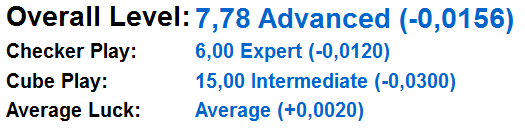
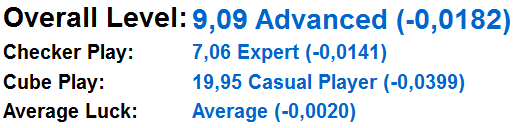
Here are the numbers which quantify both players’ performances :
Bert Autumn Series 2015Robin Autumn Series 2015
As was to be expected, Bert outplayed his opponent by some margin. It is not illogical that he won 7-3. However, his overall PR of 7,78 might raise an eyebrow here and there. The relaxed atmosphere at the Sandeman is of course an extenuating factor, but insiders nevertheless expected a better performance by this experienced player.
Robin has worked hard in previous months to improve his game. He records almost every match he plays and analyses them attentively. As we can see from the info above, his checker play is expert. It is – as for most of us – the cube handling that needs more careful attention.
Below is the updated BMSB GT : (enlarge by double-clicking)
BMSB Grading Table December 2015
Other Master Series currently underway :
Winter Series Michel Lamote v Geert Van der Stricht (10 x 15) : 0-3.
Winter Series Geert Van der Stricht v Johan Huyck (10 x 15) : 0-2.
Autumn Series Maurits Pino v Zsolt Tasnadi (8 x 9) : 2-3.
MS1 2016 Walter Meuwis v Ronny Connaert (10 x 15) : … (?)
If you feel like playing a Master Series, send an e-mail to kynos8000@gmail.com.
Like I said before, I enjoy participating at BMS(UK) events. Since all matches are recorded, transcribed and analysed by the tournament organiser, you can get a pretty accurate idea of your playing performance without the hassle of having to record and transcribe your matches yourself. Win or lose, you know if you played well or badly.
This was my second participation at Castle Donington. This time, I flew cheaply to Manchester, rented a car for four days and enjoyed the scenery of the Peak District on my way to and from the venue, which is situated just south-west of Nottingham.
The event takes place at the Holiday Inn Express, close to East Midlands Airport. The hotel is great : it is compact, sound-proof (at least to noise from outside), reasonably cheap (45£ / night), has friendly staff and serves good food. Free coffee and water all day through. Comfortable playing conditions. Entry fee : 75£. I especially like the playing schedule which involves no play after dinner. On Saturday, play starts at 11:30am. Every player plays three 11-point matches, which takes till about 6 or 7pm. Then there is dinner and time off. On Sunday, play starts at 10:30am and again all players play three 11-point matches. This guarantees a prize awarding ceremony at 6pm at the latest.
All playing and recording equipment is provided by Rick Janowski, the TD and mastermind behind BMAB and BMS events. So there is no need to bring anything along, except toothpaste and some fresh clothes.
Last time I participated, I won 2/6 (or 3 – who cares), but this time I had a good run with 5/6. Ok, that’s nice (it takes care of the expenses), but most important are the PRs of course, which will be made public in a week or two. Last time I felt I under-performed with a PR of 5,3. I hope I did better this time, but one can never be sure.
The butcher from Bruges has struck again: 1854.13 is Belgium’s current backgammon rating. Michel or machine? Lucky Lamote? Hopefully he’ll tell us some of his tricks during the lunch lecture at the 7th Leuven Open. Or has he been bitten by the BMS(BE) virus? Even so, my mother always instructed me not to indulge in bragging.
Although losing to Ghent 5-4, Brugge was able to take the Four Cubes home. Losing to Ghent meant that three clubs were tied at first place with 3 encounters won and one lost. To break the tie, the ancient Four Cubes codex had to be consulted. It revealed that in this case, the number of matches won in the 3 encounters between the equally ranked teams would break the tie. Brugge, who won 9-0 to Brussels and lost 4-5 to Ghent, ended up with 13 matches won, 4 more than Gent and 8 more than Brussels.
Ghent was seriously handicapped by the absence of Bert Van Kerckhove (the Scourge of the Lowlands). However, the team was led by a highly motivated Geert Van der Stricht, who set the example by winning his three matches (best score of the evening with 3/3). Johan Huyck and Robin Bilderbeek both won one match and sadly lost one each through clock violation. Johan, who was leading 6-4 against Guy and in the process of bearing in against a 4-point anchor, somehow forgot to keep track of his remaining seconds and lost on time. The same happened to Robin, who had brutally gambled on a 4-cube at 3-away 4-away against Michel Lamote, suddenly had real winning chances, but also allowed the time flag to drop on him. These two points proved to be extremely valuable to Brugge, who might otherwise have lost 7-2… What a thrill!
Brugge appeared in their strongest formation, with Guy Van Middelem and Paul Van Dijke completing the team led by captain Michel (2/3 on the night). Although probably the strongest club team in Belgium, Brugge looks quite vulnerable with only three players available for the team. Gent and Brussels appear to be the strongest challengers for the 2016 Four Cubes contest, with more players of Advanced level ready to complete the team.
Thanks to all teams and players for competing well in this prestigious competition.
Bert (r) receives the trophy from Jan Kollenbach (l) (foto : M)
With four consecutive wins in 11-point matches Bert Van Kerckhove won the Nederlands Kampioenschap. This result is that more amazing since Bert also won the Rotterdam Super Sunday the previous weekend. Two tournament wins on Dutch soil in less than 8 days surely is an achievement worth mentioning. It may well be unprecedented, but as I have no access to the Dutch backgammon archives, I mention this with some caution.
Bert started with a bang by eliminating last year’s Dutch champion Nouri and then had to face the Dutch chess player and commentator Hans Böhm. The match went to DMP and had a thrilling climax. Bert was hit in the bear-off and needed some luck to get his checker around the board. Hans most probably did not execute the containment tactics perfectly, but could nevertheless be considered unfortunate not to be able to close Bert’s straggler out.
Now Bert faced Arthur Braackx in the semi-final. Arthur is an adventurous money-game player, but knows his way around match-play as well. Bert, however, was in no mood to hand out presents. With astonishing resolve (and good dice of course) he steamrolled Arthur off the board in no time. Arthur was so dazed after this impressive display of power backgammon, that he looked in danger of quitting backgammon altogether and take up knitting.
In the final Bert showed no signs of slowing down. His opponent was the experienced Dutch player Paul Van Koningshoven, a man of many battles. Bert courageously took some scary-looking doubles early in the match and was rewarded for this bravery when a couple of well-timed jokers turned the tables. Whenever Paul got a glimmer of a chance, Bert responded with crushing high-equity rolls which left his opponent numb. Paul took it in good stride though and was visibly relieved when this ordeal was over. That left Bert with another prestigious title under his belt, that of Dutch Champion 2015. Congratulations!
Also worth mentioning is the Consolation win in Group B by Nick De Ruyck (Ghent BC) and the victory of Robin Bilderbeek (Ghent BC) over … me. Also Archil Katamadze (Ghent BC) was able to string a couple of wins together in Group A. With four players, the backgammon club of Gent was well represented and certainly left an impression in Den Bosch.
Geert (rechts) denkt na over 1. 41 (24/23 13/9) 42 (8/4 6/4) 2. 54 ? (links Akbar Soltani)
M : Hallo Geert. Proficiat met je overwinning in BIC D2. Je streed op de Brugge Backgammon Day in februari ook tot op het laatste moment mee voor de overwinning. Toch twee opmerkelijke resultaten in 1 jaar tijd. Bovendien sta je momenteel 5de op de BGFed.be ranking. De kans dat deze successen op toeval berusten is klein. We zijn benieuwd hoe je dat de voorbije jaren hebt aangepakt.
GD : Ik ben een tiental jaren geleden begonnen met sporadisch te spelen op een website met allerhande games die je online kon spelen, van schaken, bridge en backgammon, over poker tot meer ludieke spelletjes. Ik had toen nog geen duidelijk idee hoe het spel deftig gespeeld moest worden en ik vermoed dat mijn gemiddelde PR in die tijd hoge toppen scheerde. En met hoog bedoel ik : bestaande uit hoge cijfers.
Het is maar sinds begin 2012, toen ik samen met Steven Steeno voor het eerst de deuren van de Backgammon Club Leuven doorwandelde dat ik het spel pas écht leerde kennen. Eindelijk begon ik de logica en strategie achter het spel te begrijpen, met termen als primes, backgames en blitzes.
M : Hoe frequent speel je?
GD : Mijn speelfrequentie vertoont regelmatig ups en downs. Er zijn – zoals misschien ook bij anderen – periodes geweest waarbij ik het echt gehad had met het spel om dan toch later met hernieuwde interesse en passie de teerlingen weer op te nemen en elk vrijdagtornooi present te tekenen. Dezer dagen is het eerder een teveel aan andere bezigheden dat mij belet om nog regelmatig te spelen. Als ik de BIC matches en af en toe ook een tornooi kan spelen is het al veel.
M : Studeer je? Zo ja, hoe?
GD : Ik heb de afgelopen jaren af en toe gestudeerd, vooral met behulp van enkele boeken zoals 501 Essential Backgammon Problems van Bill Robertie of zelfs aanvankelijk de klassieker Backgammon van Paul Magriel. Verder lees ik ook artikels die op sites als www.bkgm.org te vinden zijn. Ook eXtremeGammon staat hier geïnstalleerd, inclusief de smartphone- en tabletversie, maar ik gebruik het lang niet zo “extreem” als de echte Belgische topspelers. Eerder als sparring partner of om specifieke posities te analyseren die zich tijdens matches voorgedaan hebben en dan vooral cube decisions. Een heel groot deel heb ik echter geleerd uit observatie en vooral door zelf te spelen en onnoemelijk veel fouten en blunders te maken. Uit ondervinding leert men immers vaak het beste 🙂
M : Is backgammon je hoofdhobby of slechts een perifere bezigheid?
GD : Momenteel zal ik backgammon jammer genoeg eerder als perifere bezigheid moeten catalogeren, alhoewel ik vind dat die beschrijving het spel wat oneer aandoet. Ik neem nog altijd graag de dobbelstenen ter hand voor een wat langere partij zoals in de BIC, maar ik kan nog moeilijk tijd vinden voor de maandelijkse tornooien. Tegenwoordig kruipt er meer tijd in het bijschaven van mijn bescheiden snookerkunsten.
M : Ook een nobele bezigheid natuurlijk. Wat zijn je doelstellingen voor 2016?
GD : Een goed resultaat in de hoogste regionen van het Belgische backgammon 🙂
M : Point taken! Bedankt Geert.
GD : Ik zou graag nog alle betrokkenen bedanken om o.a. met BGFed en de verscheidene clubactiviteiten backgammon in België op de kaart te zetten en onze eer te verdedigen op de internationale tornooien. Hopelijk tot in de BIC finale!
Michel, Guy and Paul scored 3 out of 3 against Leonidas, Zsolt and Maurits. Surprisingly, Brussels player Alain Chif decided to watch proceedings from the sidelines.
Brugge is now top contender for the 2015 BIC trophy.
As some of you have noticed, the website has been down for a bit over a day, from Saturday afternoon to Sunday evening. I apologize for any inconvenience caused and I thank you for your patience.
This downtime occurred when migrating the website to a different, cheaper web provider, from GoDaddy to One.com. Transferring the website was technically more involved than I thought: not only did it require transferring the domain name, it also meant transferring all the files from one host to the other with ftp, exporting and importing the database associated to the website, and manually edit a certain php file to connect the database to the website.
With the help of the friendly and helpful support staff from both providers, the transfer and reconfiguration was eventually brought to an end successfully. I’ve learned my lesson now and I promise to be more careful in the future.
Thank you for following bgfed.be. Let’s focus on backgammon again.
Jean congratulates Bert at Zandvoort (photo : Nardy Pillards)
The yearly tournament at Zandvoort-aan-zee is held in a spacious pavilion situated on a broad beach. On beautiful days the sea breeze can waft through the pavilion and on chillier days, the pavilion can be closed off with canvas. In short, a great location. Moreover, a super buffet is set up for dinner and the staff is exceptionally friendly. In short, I regret not having competed there this year, but will certainly do so at the 5th edition in 2016.
Only Bert Van Kerckhove (Ghent BC) made the 3-hour trip (I hopped in later in the day) and found himself in a worthy field of Dutch and German players. Bert succeeded in winning three 13-pointers in a row, which brought him to the final. There he was beaten by Paul Van Koningshoven, who sent some speculative cubes Bert’s way, but was rewarded with good dice.
Bert and Paul at the start of the final (photo : NP)
An encourageing result for Bert, who is also steadily climbing up the BGFed-ranking. It looks like Bert has his eyes on the number 3 spot…
The word blunder is conventionally used in backgammon to indicate a checker play or cube action mistake which costs 0,100 or more in equity. What does this mean?
Equity
Those of us who use eXtremeGammon as a learning tool are familiar with the numbers used in computer analysis. People not familiar with computer analysis, however, probably have no idea what these numbers are about. Still, it may be useful to have at least an idea of what the numbers reflect.
At the beginning of a game, the equity of both players is zero, which means that none of the players has even the slightest advantage over the other. If you win the game your equity has become +1. The loser of the game then has an equity of – 1. During the game the player who is favourite to win the game will have a positive equity of something between 0 and 1, whereas the underdog will have the same equity, but negative.
Let us have a look at an example. Mind you : we are playing a 1-point match here, so gammons do not count and are not taken into the mix.
Once again, it should be clear to every reader that at the beginning of this 1-point match, the probability of winning the match for either player is 50% or fifty-fifty (if both players are of equal playing strength). The equity of both players is 0 ( = zero).
1. 8/5 6/5 eq:+0,100
Player: 55,00%
We see that by winning the opening roll and finding the strongest possible opening roll, 31, Black is suddenly favourite to win the game. He has 55% winning chances (it is actually slightly more, but I have rounded down a bit). His equity has gone up from zero to +0,100.
Where does that + 0,100 come from? Well, it reflects the difference between the winning percentage of the favourite (55%) and the winning percentage of the underdog (45%), which is 10%. 10% of 1 = 0,100.
If, however, you misplay your 31 and play the second best move, 13/10 6/5, you have gained no advantage. Your winning chances are still 50% (actually it is a bit lower) and your equity is still zero (because your opponent is now on roll).
2. 13/10 6/5 eq: 0
Player: 50%
The bot tells us that playing 13/10 6/5 costs 0,100 in equity (the difference between 55% and 50%) :
2. 13/10 6/5 eq: 0 (-0,100)
Player: 50%
We have made a blunder.
Since not all blunders cost exactly 0,100 in equity, they are quantified in millipoints (one millipoint of course being one thousandth of a point). Here we would say that the player made a 100 millipoint blunder.
In the bag.
To help get a feel for the magnitude of this blunder, let us visualize a bag with 500 black and 500 red casino chips. The black ones are yours and they have a value of + 1€. The red ones have a value of -1€.
It is clear that with 500 black and 500 red chips in the bag, the value of the bag (i.e. your equity) is zero. If you replace all the red chips by black chips, there will be 1,000 black chips in the bag and no red chips, so the value of the bag becomes 1,000€ (i.e. your equity is + 1,000).
If you replace 50 red chips by 50 black chips, there will be 550 black chips in the bag and 450 red chips. The value of the bag has become : + 550 – 450 = 100€. Your equity is no longer zero, but + 100.
Look at it this way : if your life depended on drawing a black chip from the bag, would you grab a chip from the bag with 500 black chips and 500 red chips, or would you feel slightly more comfortable drawing one from the bag with 550 black chips and 450 red chips?
If you think this difference is negligible, then I suggest you quit playing backgammon and start gardening.
The difference is substantial. It is the difference between 55% chance of survival and 50% chance of survival. This is huge. So, in backgammon terms, picking a chip from the bag with only 500 black chips would be a blunder, namely the difference in equity between 0 and 100.
Exercises.
1) After 10 moves in your backgammon game, your winning chances have gone up to 65%. What is your equity?
O + 0,150
O + 0,300
0 + 0, 650
2) You have a choice between two moves. One move gives you 80% winning chances and the other gives you only 70% winning chances. How big is the blunder if you make the wrong move?
O 200 millipoints or -0,200
O 100 millipoints or – 0,100
0 400 millipoints or – 0,400
3) The game is not going your way. The probability of you winning the game has gone down to 30%. What is your equity?
O – 0,200
O – 0,400
O – 0,300
4) What is Black’s equity here if he is on roll?
O +0,250
O +0,750
O +0,500
5) Your equity in a DMP-game is +0,340. How much wc do you have? Or, in other words, what is your winning%?
O 66%
O 34%
O 67%
Answers
1) With 650 black chips in the bag and 350 red chips, the value of the bag would be +650 – 350 = 300€. Therefore your equity is +0,300.
2) With 80% wc (= winning chances) your equity would be + 0,600 (800-200). With 70% wc your equity would be : 700 – 300 = 400, so : 0,400. Your blunder is a double whopper, costing 200 millipoints or 0,200.
3) If you have 30% wc, your opponent has 70% wc. The difference is 40%. So your equity is – 0,400.
4) Every intermediate player should know that Black wins this game unless he rolls one of 9 rolls out of 36. These rolls are : 11, 21, 31, 41 and 32. So he has 75% wc. His equity therefore is +0,500.
5) Easy : 340 divided by 2 is 170. If you add that to 50 you have your wc. Answer : 67%. Once again, your equity is the difference between the winning% of the favourite and the winning% of the underdog : 67 – 33 = 34. In millipoints this becomes 0,340.
With emphatic wins over Nardy Pillards, Ed Baars, Michel Lamote and Paul Van Koningshoven, Belgium’s up-and-coming Geert VdS took the Rotterdam Open trophy.
Michel Lamote won the consolation after beating Rogier Van Gemert in the semi’s.
More Belgians made their presence felt. Toon Van Herreweghen and Patrick De Wilde (Leuven) took some scalps, but could not make it to the final rounds.
Gent’s Bert Van Kerckhove could not overcome unfriendly dice and was soon eliminated.
The Selection Committee (SC) has established a selection procedure to choose the 6 (or 7) players who will make up the Belgium Backgammon Team.
1. Three players have been selected : Michel Lamote, Walter Meuwis and Geert Van der Stricht. The three other players will be selected by means of a Selection Tournament (ST).
This ST will be held on Saturday and Sunday 20-21 June 2015.
A 7th player will join the team in case the Captaincy goes to a player who did not qualify (see 4. below).
2. Maximum 8 players will be allowed to enter the ST. Candidates need to be member of BGFed and 2015 BIC participant. They should have at least Advanced/Expert level.
Registration is possible till 25 May 2015. Mail to : guy.van.middelem@telenet.be.
3. The SC will carefully consider the merits and skill levels of the candidate players.
The list of players selected to compete in the ST will be made public on 1 June 2015.
4. When the results of the ST are known and the 6-player team is assembled, the SC will choose a Team Captain (TC) in concord with the team.
The TC will represent the intrests of the team, starting from the moment he is appointed. He will be responsible for administrative duties and make sure the team players can fully focus on their game.
During the Championship in Budapest, the TC will have the prerogative to decide who plays in which encounter. It should be his policy to field the strongest team possible, as long as Belgium has a chance of securing a place among the last 4. Once prospects of success have vanished, the TC is no longer bound by this restrictive directive and it becomes his full discretion to decide who plays and who does not. However, his decisions should always be made with the general intrest of the team in mind.
Selection Tournament : 20-21 June 2015.
1. Format.
Complete round robin. All matches with clock.
If 6 players : 5 rounds of 15-point matches (30 minutes + 12 seconds increment).
If 7/8 players : 6/7 rounds of 11-point matches (22 minutes + 12 seconds increment).
To ensure the integrity of the outcome, all players must play all rounds, even if they cannot qualify anymore. Penalties may be considered in case of non-compliance.
Standings will be based on number of victories. In case of a tie, mutual results will be considered.
If necessary, a tie-breaking round will be played.
The winner of the ST will at least play 3 matches in Budapest. Runner-up and 3rd placed will at least play 2 matches.
The 4th/5th ranked players will be nominated 1st/2nd Substitute. They will be first in line to complete the team should one of the team players drop out.
If 5 rounds : Saturday 11.00, 15.00, 19.00 + Sunday 11.00 and 15.00.
If 6 rounds : Saturday 11.00, 14.00, 17.00, 20.00 + Sunday 11.00 and 15.00.
If 7 rounds : Saturday 11.00, 14.00, 17.00, 20.00 + Sunday 11.00, 15.00 and 18.00
3. Entry fee.
The entry fee is set at 100€.
For the 3 players who qualify for the team, this sum will be deducted from their proportionate part of the total Entry and Registration Fee in Budapest. This ERF is 1100€. This ERF will be paid in 6 (or 7) equal shares by the 6 (or 7) team members.
First/Second Substitute will get a 50€ refund.
Should the Belgium Backgammon Team win money prizes in Budapest, then the money will be equally divided among the team members, regardless of the number of matches played.
Entry fees from the eliminated players will be used as contribution to the ERF.
4. ST Director.
Michel Lamote will act as TD.
The 2015 Budapest Open.
This individual tournament is organised in conjunction with the 2nd EBTC. It starts on Thursday 17 September 2015. Players can compete in two divisions : Intermediate and Champions.
Players scheduled to play for Belgium on Friday are advised not to participate in this individual event.
Players who joined the team through the ST, however, are encouraged to compete in this event.
More info.
Details about accommodation, flights, etc. can be obtained via guy.van.middelem@telenet.be.
For the second time, the European Backgammon Federation (EUBGF) organises the European Backgammon Team Championships (EBTC).
The tournament is set up in Swiss format. Every represented country will play 7 rounds of four 15-point matches. After these 7 rounds, the four highest ranked countries will play semi-finals and a final.
1. As member of the EUBGF, the Belgian backgammon federation, BGFed.be, has unanimously decided to send a representative team (Belgium) to Budapest.
2. The Board of BGFed.be has appointed a Selection Committee (SC) to decide on a selection procedure to send the best possible team to the 2nd EBTC. This SC is composed of : Guy Van Middelem (chairman), Michel Lamote (member) and Luc Palmans (member).
3. BGFed.be will not share in the expenses. Entry fee, registration, travel and accommodation will be paid by the selected players.
After two wins, Zsolt faced Maurits in the 3rd round of the 1st Brugge Backgammon Day. The match turned out to be an interesting encounter with a shockingly spectacular Crawford game. You can download the annotated match (*.xg).
Maurits (left) and Zsolt (right) exchange niceties before the match
With the score tied at 1-1, both players found themselves in an opening skirmish. In such games it is mostly correct to keep hitting – Thou shallt hit in the beginning – but at a certain moment it becomes correct to anchor up and cut your losses. When that moment has come is not easy to assess. Here is how the game went :
Hitting catches up in the race of course. White is only down 4 pips after the hit. The alternative would be to anchor up on the 18-point and play 10/9 with a less volatile position as a result. This turns out to be a serious error here :
So, the fact that Black has made the 3-point should not deter you from hitting, even though the hit leaves 4 blots.
4. 65 : bar/20 21/15* 32 : ?
Maurits sees himself faced with the same problem : he can keep hitting and leave 5 (!) blots against a stronger board, or he can anchor up. What would you do?
4. —– 32 : bar/23 13/10*
Hitting is still correct, but by a much smaller margin :
Still, circumstances may occur where hitting here may be a tactical option worth considering. A world-class player might keep hitting to complicate matters. And, should this position come up towards the end of a match, the trailer might rightfully hit here if his oppenent is in time trouble.
6. 32 : 23/20 13/11* 31 : bar/24 13/10*
7. 52 : ?
Hit or not?
Now it is Zsolt’s turn to ponder whether he should hit or not. This position is fundamentally different, however. Here, Black has a significant edge (58% winning chances), whereas in the previous positions, White was always a clear underdog (40-45% winning chances) no matter what he did. This points to a consolidating play : Black should come in on the 20-point and make his 11-point. It is not so difficult to see that the 11-point is very strong against the 20-point anchor. Moreover, White already has 5 men back, so hitting a 6th checker might lead to a complex triple-anchor backgame where each checker play might pose challenging problems. Also, hitting gives up the golden anchor, a decision one should not take lightly.
Not hitting here yields a simple holding game with a 41-pip race advantage, low volatility and easy checker play coming up. The fact that Zsolt made the wrong choice here is indicative of how the intuitive hit may lead one astray in certain positions.
Still, the error is far from monstrous. Forward mobility and flexibility are important in positions where O (= opponent) has established multiple anchors.
Having established a 5-4 backgame structure, it seems natural to just eject one of the back men into the outfield. This is probably what I would have done. Maurits, however, decides to go for Black’s barpoint by simultaneously slotting it and hitting on his 5-point. An ingenious tactical find in a complex position!
The reader can follow the rest of this exciting game via the link provided above. Both players held their own amid all that complexity : Zsolt scored a 4,36 PR (World Class), but was still outplayed by Maurits who even outplayed the computer : – 0,68 PR (Wow!). Nicely done.
For the 10th time, Bert Van Kerckhove organized the Gent Open. As always, the location was the Koninklijke Club Union Sandeman in Gent. This year, 24 players showed up to play 7 rounds of 7-point matches. All matches were played with clock.
After 6 rounds, Michel was the only player left with 6 victories. However, in the last match of the day, Belgian-born Nardy Pillards managed to beat Michel to draw even. The tense match culminated in a thrilling DMP game where Nardy skillfully blitzed Michel off the board after a 52 (24/22 13/8) 55 (6/1* 6/1* 8/3* 8/3*) opening sequence.
Nardy (left) and Michel (right).
This left both players with 6 wins, but the trophy went to Michel because his opponents had collected more wins (Buchholz-system).
Michel and Bert. Also (left to right) Johan Brisaert, Hans Böhm, 2 young fans, Marc Steyvers and Peter Gelpke.
The Intermediate Division was won by Manolitto from Amsterdam. He was one of 6 players from the Netherlands who had travelled a couple of hours to compete in Gent. One of his opponents, Peter Allemeersch, was baffled by the fastness of Manolitto’s decision-making : “He played incredibly fast,” said Peter, “and ended the match with 11 minutes and 24 seconds left on the clock!” Truly, an amazing feat.
Intermediate winner Manolitto.
In the picture, Manolitto poses with the colourful trophy. All three trophies were handcrafted by Gent club member Robin Bilderbeek.
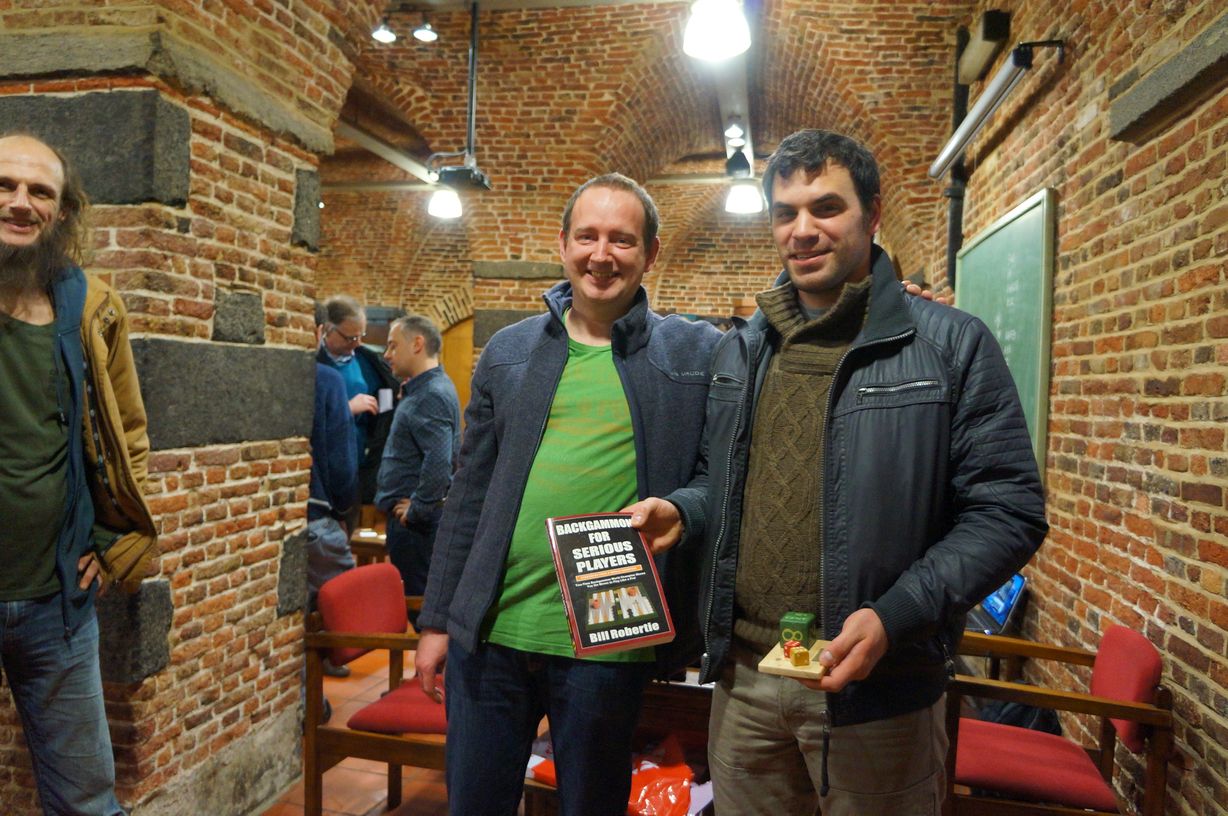
The Beginner’s flight was won by Kristoffer De Weert. In addition to the trophy, he received Bill Robertie’s bestseller Backgammon for Serious Players as study material.
Kristoffer and Bert. On the left, trophy designer Robin.
This anniversary edition of the Gent Open was a success. There was constant action and the playing conditions were excellent. Congrats to organizer Bert for a job well done.
An extra word of thanks to the Dutch players who made the trip. They gave the tournament an international flair and blended in perfectly with the predominantly Flemish crowd.
In backgammon, certain types of positions occur time and time again. One of the most common types are holding games. In a holding game, one player has made an advanced anchor (4-point or higher) and the opponent has escaped his men to the midpoint. Now it is time for the favorite to assess all features of the position and decide on his cube action.
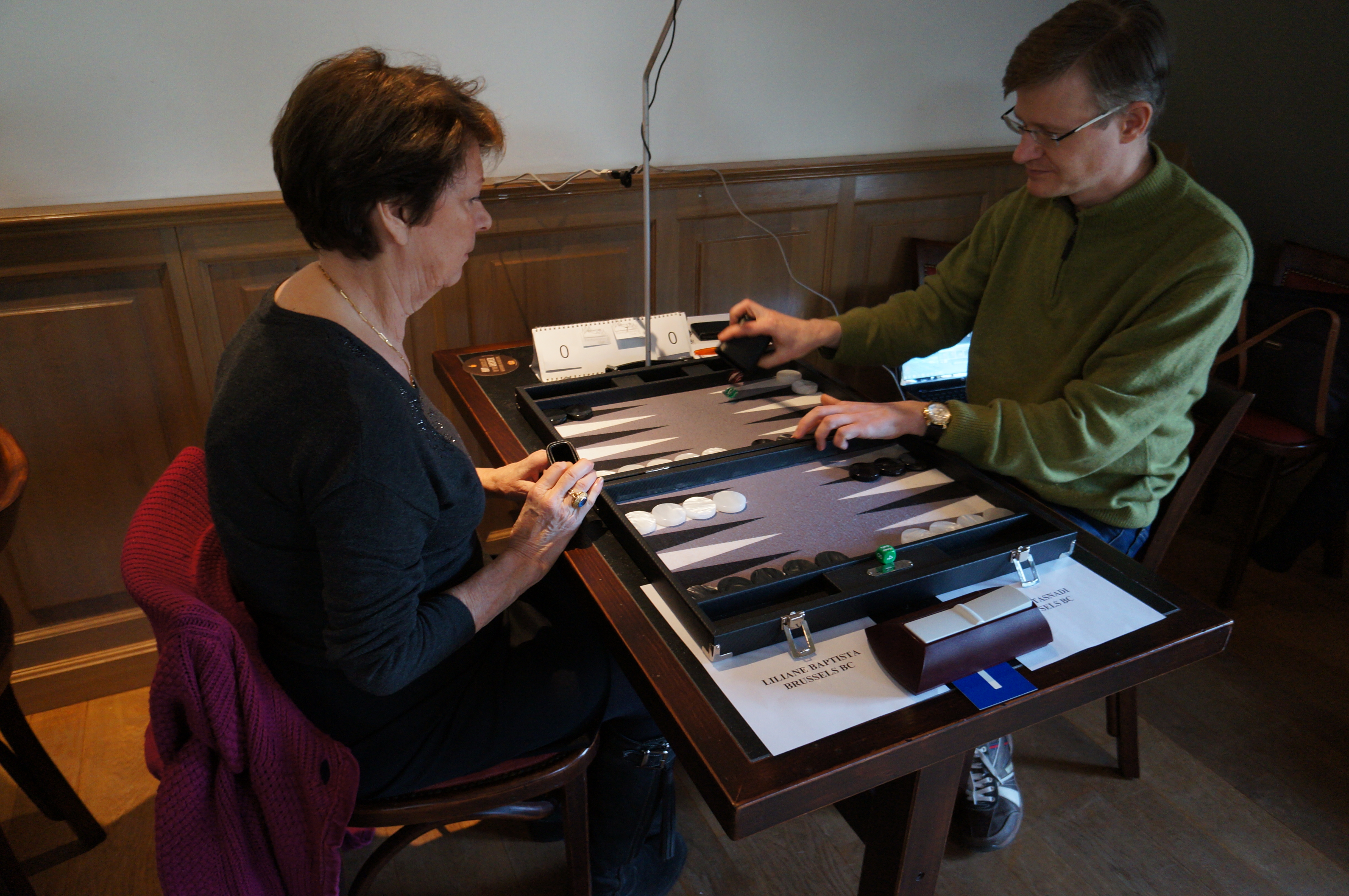
In their match, Zsolt and Liliane each got doubled in a 4-point holding game and struggled with the cube decision. Here, for instance, is the position in Game 1 :
White (Zsolt) on roll. Can he double? Can Red (Lilane) take?
First thing to consider is – as always – the RACE. Zsolt is only up 11 pips. Typically, against a 4-point anchor you would need about 20 pips race advantage to have a correct double. Of course, with his barpoint already made, Zsolt has a broken 5-prime which compensates for the fact that he has not yet fully safetied his last checker to the midpoint. Also, Liliane’s own forward position is far from perfect : she has not yet made a extra point in her board, but she should have no problems building a strong board soon. Moreover, in such kinds of positions the volatility is generally low. This means that only rolls like 66, 55 and 44 would lose Zsolt’s market. Therefore it is very improbable that Zsolt would make a big error by waiting one roll before cubing.
No double: +0,799 (-0,009)
Double/Take: +0,807
Double/Pass: +1,000 (+0,193)
Best Cube action: Double / Take
As eXtreme Gammon shows, this is a borderline Double, but an easy Take for the defender. Liliane does not take a big risk in taking this. She can only lose one extra point by taking, since the chance that she will get gammoned is less than 3%. However, players who are not familiar with these positions might easily get spooked and give away a point. This is what happened in the match. Liliane passed, making a big mistake in doing so.
Knowing your opponent’s tendencies can help with the cube action here. Maybe Zsolt estimated that there was a significant chance that Liliane would pass. In that case, his double becomes a strong bluff double. If he did not consider Liliane’s weakness, his double could be called premature.
In Game 2, the roles were reversed. This time Zsolt is the one defending from the 4-point anchor :
Red (Liliane) on roll. Can she double? Can White (Zsolt) take?
Here, Liliane is up 26 pips in the RACE. She could have turned the cube 2 rolls earlier, but decided to wait. This turned out well for her, because Zsolt, probably thinking the open 5-point was a significant weakness in Red’s position, took the cube without thinking too long about it. This also turns out to be a big mistake :
No double: +0,988 (-0,012)
Double/Take: +1,202 (+0,202)
Double/Pass: +1,000
Best Cube action: Double / Pass
The Americans have come up with the term double whopper for errors of this magnitude. By accepting this cube, Zsolt sacrificed 0,202 mps in equity.
Something to consider when you get doubled is whether the opponent will be prone to making checker play mistakes in the game continuation. In the position above, Red has a relatively easy task bringing the checkers home. Still, she might not dare leave an indirect shot in clearing the 11-point or misplace her checkers in some other way. Still, these errors are unlikely to be big mistakes, so they would not compensate for the 0,202 in sacrificed equity.
However, this is what happened 2 rolls later :
The reader can have no doubt as to what is the correct move : making the 5-point is hugely correct. I am sure Liliane will play this correctly 90% of the times, but due to the tension of the big occasion, she nervously played 8/6 8/2. Her underlying thought may have been that a point cleared, is a point not to be feared, and there are situations where this would definitely be the right play. Here, however, this useful tenet does not apply.
To make matters worse for Liliane, Zsolt ended up escaping with a 66 and reached this position some rolls later :
White (Zsolt) on roll. Can he double? Can Red (Liliane) take?
This is a classic bear-off cube decision. If Zsolt rolls an ace, he loses, in all other cases he wins. This is typically something that distinguishes Intermediate players from Beginners : the ability to calculate probabilities. What are the chances Zsolt rolls an ace? Well, it is 11/36 or 30%. That means he is 70% favorite here and should redouble. Liliane, who has 30% winning chances, should take. It must be said that it might be scary for the better player to give this cube, because rolling an ace swings the score to 1-4 down in a match to 7. However, the error in not cubing is so big (0,415 – !), that the skill difference between both players would have to be between 12 and 15 PR ( = difference in Performance Rating as calculated by eXtree Gammon) for not doubling to be correct. This means that a world class player, who averages about 4 PR, would make an error cubing this against Liliane. Zsolt, who played this match at Advanced level, had to bite the bullet and ship the cube. He took a long time fretting over it, but eventually redoubled to 4. Liliane, to her credit, accepted, which as a matter of fact is very well played. Many players, even strong ones, get overwhelmed by superstitions and end up passing this. Gutsy cube action by both players!
Zsolt did not roll a 1, took a 5-0 (7) lead, and ended up beating Liliane 7-0.
Hopefully, these remarks will motivate players of all levels to spend some time studying the game. Improving your game gives greater long-term satisfaction than winning the occasional match by chance.